The lowest weekly payment may not mean the cheapest car overall. To salary sacrifice a car in Australia, you generally need to work for an employer that offers vehicle salary packaging. A salary sacrifice car may help you maintain your lifestyle while saving, but the full cost depends on more than the amount deducted from your pay.
It makes sense to compare a novated lease with a car loan or buying outright before deciding. This article explains how salary sacrifice works, who may be eligible and how to compare the full costs, including running expenses and the residual payable at the end of the lease.
A tax benefit does not automatically make a lease the right choice for every driver. Weigh the effect on your take-home pay against the overall cost and consider how you want to own or change cars.
Key Takeaways
- Understand how salary packaging and a novated lease fit together, including how payments may use pre-tax and post-tax income.
- Estimate your expected kilometres and running costs to build a more realistic vehicle budget.
- Compare a novated lease, car loan and outright purchase by looking beyond repayments to the total cost over time.
- Factor in what happens at the end of a lease, including the residual amount if you want to own the car.
What’s the difference between salary sacrifice for a car and a novated lease?
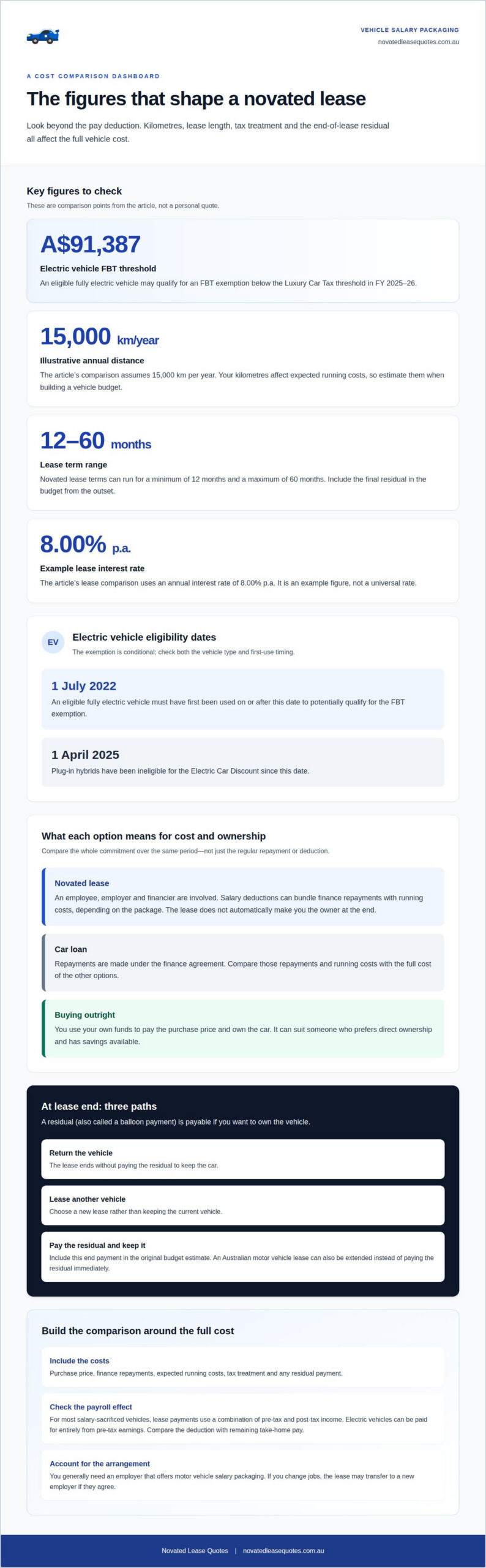
Salary sacrifice is the payroll arrangement; a novated lease links the employee, employer and financier to fund a vehicle. An eligible fully electric vehicle may qualify for an FBT exemption below the A$91,387 Luxury Car Tax threshold in FY 2025-26. It must have first been used on or after 1 July 2022; plug-in hybrids have been ineligible since 1 April 2025.
Bundled running costs and lease payments
A novated lease can bundle vehicle finance repayments and running costs into regular salary deductions. Depending on the package, expenses such as fuel or electricity and other vehicle costs can sit alongside repayments. This helps you budget for the whole vehicle rather than focusing only on finance. Estimate your annual kilometres first: the illustrative comparison assumes 15,000 km per year, and your mileage affects expected running costs.
Pre-tax lease and running cost payments
Salary packaging allocates part of your salary towards vehicle costs, but the tax treatment depends on the vehicle and arrangement. For most salary-sacrificed vehicles, lease payments use a combination of pre-tax and post-tax income; electric vehicles can be paid for entirely from pre-tax earnings. This changes the effect on take-home pay, so assess the payroll deduction alongside your income tax position and packaged expenses.
Potential savings and example costs
These are example figures, not a personal quote. Your kilometres, vehicle costs and tax treatment affect the comparison.
Comparing novated leases, car loans and outright purchase
Salary sacrifice describes how your pay is allocated; a novated lease is a vehicle finance arrangement involving you, your employer and a financier. A car loan and an outright purchase use different funding and ownership arrangements.
End-of-lease residual payments
A residual, also called a balloon payment, is an amount payable at the end of a lease if you want to own the vehicle. It matters because regular lease deductions don’t automatically make you the owner. You can instead return the car, start a new lease, or pay the residual and keep it. An Australian motor vehicle lease can also be extended instead of paying the residual immediately.
Eligibility rules and tax implications
In Australia, you generally need to work for an employer that offers motor vehicle salary packaging to enter a novated lease. The arrangement packages vehicle costs through payroll, while tax outcomes depend on the vehicle and lease structure. If you change jobs, the lease may transfer to a new employer if they agree. The Reserve Bank of Australia describes novated leasing as a car finance option that lets employees purchase a car and receive tax savings.
Compare the whole commitment, not just the payment method. A car loan has repayments under its finance agreement, while buying outright uses your own funds and avoids loan repayments. With a novated lease, the employer facilitates salary packaging and the financier funds the vehicle. The lease comparison example uses an annual interest rate of 8.00% p.a.
Buying outright can suit someone who prefers direct ownership and has savings available. A lease can suit an employee who values payroll packaging, but the residual affects the cost of keeping the vehicle. Use novated lease quote comparisons to assess how the finance structure and end payment affect your options.
How car salary sacrifice and novated leasing work
In Australia, salary packaging directs part of an employee’s pay towards agreed vehicle costs. A novated lease connects that payroll arrangement with vehicle finance.
Salary packaging through a novated lease
A novated lease is an agreement between an employee, their employer and a financier to fund a vehicle through salary packaging. The employer makes agreed deductions from the employee’s pay and directs them towards lease costs. Your budget needs to account for these deductions as well as your remaining take-home pay.
Before entering an arrangement, compare the vehicle’s finance and expected running costs with your regular expenses. The tax benefit depends partly on your income, and salary packaging a vehicle may provide little or no tax benefit at lower income levels. A reduction in taxable income may not improve your budget if the deductions leave too little for other expenses.
How novated leasing works
The employee chooses a vehicle and agrees to package its costs through their employer; the financier provides the lease finance. Lease terms can run for a minimum of 12 months and a maximum of 60 months. The arrangement may include vehicle costs and running expenses, with the payment mix depending on the vehicle’s tax treatment.
At the end of the term, the employee may have options such as returning the vehicle, leasing another, or paying the residual to own it. That final choice belongs in the original budget estimate, not just the monthly calculation. Eligible electric vehicles may qualify for an FBT exemption, while plug-in hybrids have been ineligible for the Electric Car Discount since 1 April 2025. An exemption can affect the tax calculation, but it doesn’t remove the need to assess lease costs and the residual together.
Comparing the whole cost of leasing and purchasing
Compare total vehicle costs over the same period, not just the weekly payment. Include the purchase price, finance repayments, running costs, tax treatment and any residual payment. For a lease, also account for any GST savings and the vehicle’s value at the end of the term. Together, these factors show what each option costs across the full arrangement.
These figures are comparison points, not universal outcomes. Vehicle choice, kilometres travelled and lease structure all affect the totals.
Ownership changes the comparison. With an outright purchase, you pay the purchase price upfront and own the car. A novated lease spreads payments through the arrangement, but ownership does not automatically transfer at its end. Include the residual if you plan to keep the vehicle, or account for returning it or leasing another car. A car loan adds interest to the purchase cost, so compare its repayments and running costs with the full lease cost.
Resale value matters, too. New cars in Australia typically lose around 30% of their value during their first three years of ownership. That depreciation affects the cost of buying outright, even though it isn’t a regular payment. Compare the likely value remaining with what you’ve paid, while including running costs over the same period. For electric vehicles, the fringe benefits tax treatment can also change the calculation where the vehicle qualifies for an exemption.
Set out each option over the same term, then total its upfront payment, finance, running costs, tax effects and end-of-term position. To assess how different lease figures compare, compare novated lease quotes.
Novated Lease Quotes
Novated Lease Quotes helps Australian employees assess salary packaging options by providing novated lease quotes, a Novated Lease Calculator and a Novated Lease Quote Comparison Service. These tools can help you bring estimated costs and quote options into one decision, alongside your expected mileage, take-home income and plans for ownership. Use the calculator to estimate potential packaging costs, then consider quote comparisons when you’re weighing lease terms and vehicle expenses against buying outright or using a car loan. The figures are inputs to your decision, not a substitute for considering your own budget and circumstances. For a practical next step, contact Novated Lease Quotes.
Make the next decision fit your budget
Before committing, decide how much of your vehicle budget you need to keep available for other priorities. Consider household expenses, savings goals and expected changes in your work or personal life. A payment that fits your current pay cycle should also leave room for the way you want to live, rather than forcing you to rearrange other plans around the car.
Choosing a salary sacrifice car to maintain your lifestyle while saving starts with setting your own affordability limits. Decide how much you are comfortable allocating to the vehicle, then use that figure to guide your comparison. If the numbers do not suit your priorities, taking more time or considering another ownership approach can be sensible. Aim for a vehicle decision that remains manageable throughout the arrangement, not just one that looks appealing at the outset.
Ready to explore your options? Contact Novated Lease Quotes today and take the next step at a pace that suits you.
Frequently Asked Questions
Am I eligible to start a salary sacrifice for a car?
Generally, you’re eligible if you’re an employee whose employer offers motor vehicle salary packaging. Sole traders and self-employed people aren’t eligible under the stated criteria, and the arrangement isn’t for ride-sharing use. Vehicle restrictions also apply: cars with a carrying capacity greater than one tonne or designed for many passengers are excluded. A used car must be no more than 15 years old at lease end.
How does novated leasing compare to a car loan?
A car loan is finance you repay directly, while a novated lease links vehicle finance to salary packaging through your employer. For a fair comparison, use the same vehicle and ownership period, then consider repayments, running costs and what happens at the end of each arrangement. For example, compare the lease residual with the amount still owing on the loan and the vehicle’s expected value.
Are there any upfront fees?
Upfront costs depend on the quoted arrangement, not on one fixed amount for every employee. The vehicle and the structure of the finance and packaged costs affect what you may need to pay at the start. A personalised quote sets out any upfront payment and ongoing payroll deductions before you agree, helping you separate the initial cash required from costs collected during the lease.
Can I choose the car?
Yes, you choose the vehicle for the arrangement, subject to eligibility requirements. New and used vehicles can be considered, but a used car must be no more than 15 years old when the lease ends. Cars with a carrying capacity greater than one tonne or designed for many passengers are excluded. The vehicle can be used for personal and business purposes.
How does car salary packaging affect my take-home pay?
Your take-home pay changes according to the deductions and their tax treatment. A package may include pre-tax and post-tax amounts, so the total deduction is not necessarily the same as the change in your net pay. Compare your expected pay after deductions with your regular household commitments. The vehicle costs and arrangement structure determine the calculation.
How does salary sacrifice work for cars?
A salary sacrifice car to maintain your lifestyle while saving starts with an employee and an employer that offers vehicle salary packaging. The employer processes agreed payroll deductions, while a financier funds the vehicle through a novated lease. Before committing, consider how the deductions fit your household budget and what you’ll do at the lease end, including whether you plan to pay the residual to own the car.