
The confusing parts of vehicle salary packaging become easier to assess when you separate the figures, terms and decisions. Overcoming fear of vehicle salary packaging complexity starts with understanding what each part means and how it applies to you. You don’t need to master every financial concept at once.
If the terminology or calculations feel intimidating, that’s understandable. Several moving parts can make it hard to see how they fit together. A clear, step-by-step approach can make the decision more manageable.
This guide explains what can make vehicle salary packaging seem complex, how to break financial concepts into smaller questions, and how to get comfortable with unfamiliar jargon. You’ll be better prepared to assess the information and decide what you need to understand before taking the next step.
Key Takeaways
- Break the financial information into smaller questions so each part is easier to understand and assess.
- Identify which part of salary packaging feels uncertain, then focus on that specific concern first.
- Build familiarity with unfamiliar terms by recording them and translating each into plain language.
- Recognise that feeling unsure is understandable, and use clear explanations to build confidence before making a decision.
Building confidence with financial concepts
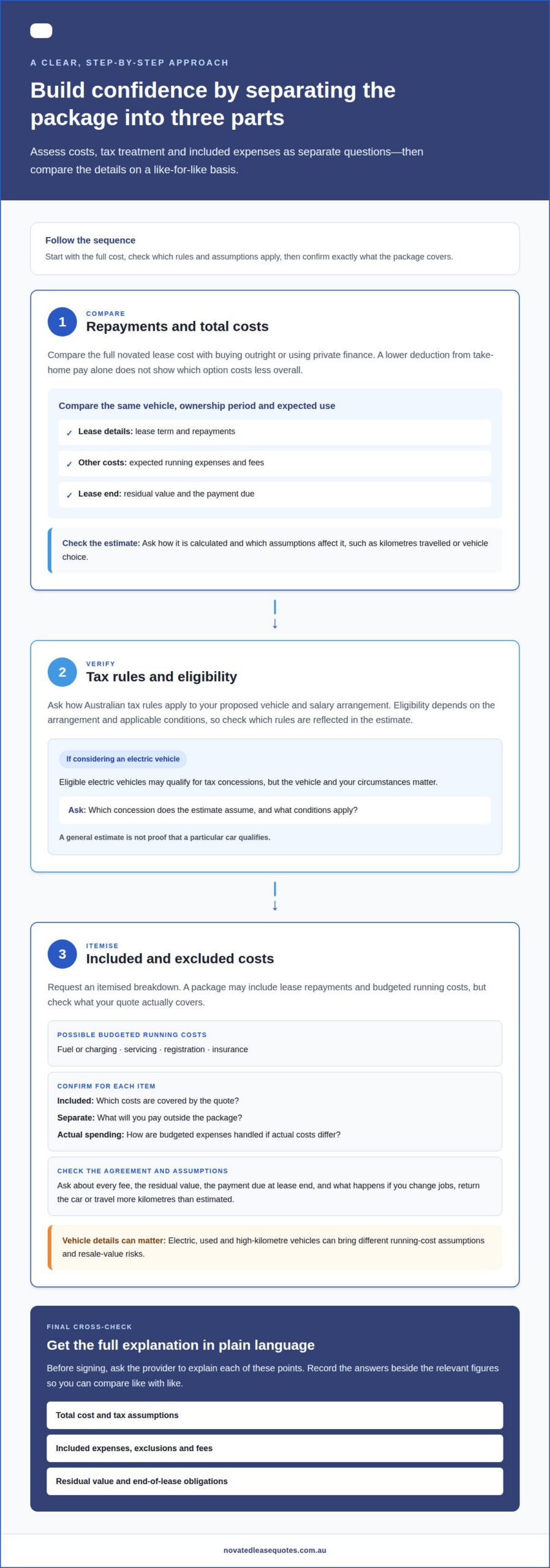
Build confidence by separating a challenging salary package into costs, tax treatment and decisions.
-
Compare repayments and total costs
Compare the full novated lease cost with buying outright or using private finance. Look beyond the repayment: consider the lease term, expected running expenses, fees, residual value and the payment due at lease end. Private ownership also has costs, so compare the same vehicle, ownership period and expected use. A lower deduction from take-home pay alone doesn’t show which option costs less overall.
Ask how each estimate is calculated and which assumptions affect it, such as kilometres travelled or vehicle choice. This makes the comparison more useful than relying on a single headline figure.
-
Check tax rules and eligibility
Ask how Australian tax rules apply to your proposed vehicle and salary arrangement. Eligibility depends on the arrangement and applicable conditions, so establish which rules are reflected in the estimate before using it to guide your decision. Eligible electric vehicles may qualify for tax concessions, but the vehicle and your circumstances matter.
For an electric vehicle, ask which concession the estimate assumes and what conditions apply. Don’t treat a general estimate as proof that a particular car qualifies.
-
List included and excluded costs
Request an itemised breakdown. A novated lease package may include lease repayments and budgeted running costs, such as fuel or charging, servicing, registration and insurance. Check which items your quote includes, what you’ll pay separately, and how budgeted expenses are handled if actual spending differs.
Check every fee, the residual value and the payment due at lease end. Ask what happens if you change jobs, return the car or travel more kilometres than estimated. Electric, used and high-kilometre vehicles can bring different running-cost assumptions and resale-value risks.
Before signing, ask the provider to explain the total cost, tax assumptions, included expenses, exclusions, fees, residual value and end-of-lease obligations in plain language. Record the answers beside the relevant figures so you can compare like with like.
Possible causes and situational triggers
Trace the uncertainty to a specific moment or decision. Naming the trigger gives your next learning step a clear focus. Overcoming fear of vehicle salary packaging complexity can begin by identifying the exact concern.
- Identify the exact point that feels difficult. Is it an unfamiliar term, uncertainty about take-home pay, or concern about committing to a lease? Write down the question in plain language, such as, “What happens to my repayments if my income changes?” A specific question is easier to address than the broad thought that salary packaging is too complicated.
- Notice what has triggered the concern. A past negative experience with a car purchase, a tight household budget, or a change in work circumstances can make a new financial decision feel more challenging. Separate what happened before from the decision in front of you. For example, if a previous car expense surprised you, focus on how the current estimate explains its assumptions.
- Match the trigger to a learning task. If unfamiliar terminology is the barrier, list each term and its everyday meaning. If changing circumstances are the worry, write down the scenarios you want explained. This approach helps you assess information in manageable pieces, rather than expecting yourself to understand every detail at once.
- Plan for a job or income change. If you change jobs, lose your job or take parental leave, payroll deductions can stop or change, while your lease obligations remain governed by the agreement. The contract and employer arrangements determine available options, such as continuing deductions through a new employer or making payments another way. Include this scenario in your questions before committing.
- Use a concrete example to test your understanding. Describe your situation, such as a possible job change during the lease, then ask what happens to payments and what choices follow. Treat overcoming fear of vehicle salary packaging complexity as a process of resolving specific uncertainties, not forcing an immediate decision. If you want to explore your options, work through a salary packaging example.
Understanding business and financial jargon
Translate each unfamiliar term into the part of the arrangement it describes. A simple map of the people, payments and estimates can make the figures easier to interpret.
-
Map how vehicle salary packaging works
Start by mapping the employee, employer and lease provider, then follow the money between them. In a novated lease arrangement, the employer makes agreed salary deductions and directs them towards lease costs under an arrangement with the employee and provider. The package may also budget for vehicle running costs.
For example, trace a deduction from your payslip to the lease and any budgeted expenses. Ask which figures are pre-tax or post-tax, what the estimate includes, and how actual expenses are handled. This helps you understand the process without assuming every employer or package works the same way.
-
Understand savings and benefit calculations
Ask for the assumptions behind each estimate rather than treating “GST saving” or “tax saving” as a guaranteed amount. GST estimates depend on the vehicle and expenses included; income tax estimates depend on your pay and how deductions are structured. Compare the projected take-home pay with private ownership using the same assumptions.
A reportable fringe benefits amount is separate from an estimated tax saving. Ask how it is calculated, where it appears in the breakdown, and how it may affect your circumstances. Don’t confuse it with a repayment or simply subtract it from a savings estimate.
- Build a working glossary. Write down terms such as “pre-tax deduction”, “running costs” and “reportable fringe benefits amount”. Beside each term, add a plain-English meaning and an example from your quote. This develops practical financial skills: you can explain what a figure represents, what it depends on, and which question remains unanswered.
Then test your understanding by explaining one line in your own words. If you can describe how a deduction affects your pay or what an estimate includes, you’re better equipped to discuss the arrangement clearly.
To expand your glossary, note key terms and acronyms, then ask colleagues or mentors to explain concepts in plain language. Reading business news, reports and books can also build familiarity with industry terminology.
Validating fears
- Name the concern without judging it. Write one sentence describing what feels difficult, such as “I’m worried I won’t understand the deductions.” Treat that reaction as understandable, not as proof that you lack financial ability. A specific concern gives you something practical to address, while a broad fear can make every part of the decision feel equally risky.
- Separate the feeling from the question underneath. If you’re worried about unexpected costs, identify the amount or assumption you need explained. If you’re concerned about a future change, such as leaving your job, write that scenario down. This helps distinguish an unanswered question from a risk you’ve already identified. Both deserve attention, but they call for different conversations.
- Set a clear decision boundary. Before considering an agreement, list the points you need to understand, such as the repayment structure, budgeted expenses and end-of-lease obligations. Mark each item as clear or still unclear. For example, if you understand the regular deduction but not the final payment, focus your next discussion on that payment rather than restarting the whole decision.
- Practise explaining the arrangement in your own words. Try a short explanation, such as, “My employer deducts an agreed amount from my salary for the lease arrangement.” Then note where you hesitate. That pause identifies a useful learning task. Developing the ability to ask a precise follow-up question is more useful than pretending to understand unfamiliar wording.
- Use a second perspective to test your understanding. Share the figures and your questions with someone you trust, and ask them to explain what they think each part means. Focus on the specific point that concerns you, not on seeking automatic approval. If seeing comparable figures would help you assess your decision, compare novated lease quotes and use the differences to guide your questions.
Allow the feeling to be present without treating it as a verdict. Feelings can be normal, acceptable and understandable, even when they make a decision feel difficult. Recognising that doesn’t mean dismissing the concern or resolving it immediately. It gives you room to consider the question calmly and decide what information would help.
Novated Lease Quotes
Novated Lease Quotes helps Australian employees understand vehicle salary packaging through quote comparison and calculator tools. Use them when you’ve identified the figures or terms you need clarified and want to compare potential arrangements.
Use the Novated Lease Calculator to estimate potential packaging costs and tax savings, then compare those estimates with quote details. The Novated Lease Quote Comparison Service lets you review quotes from multiple providers and spot differences in assumptions and inclusions. Keep your questions specific, such as which costs are budgeted or how the estimate treats your expected vehicle use.
Contact Novated Lease Quotes to discuss your vehicle salary packaging questions and explore the available quote options.
Make your next step a considered one
Overcoming fear of vehicle salary packaging complexity doesn’t mean forcing an immediate yes or no. Treat your next conversation as a chance to assess whether the arrangement fits your priorities, budget and possible changes at work or home. You remain in control of the decision. Resolving one important uncertainty can be more useful than gathering information without a clear purpose.
Before moving ahead, define what a workable outcome means for you. It might mean understanding the effect on your take-home pay, knowing your commitments, or knowing what options matter if your circumstances change. Rank those priorities and use them to guide your decision. If an explanation doesn’t address them, ask for the relevant detail in plain language.
When you’re ready to discuss your next step, contact Novated Lease Quotes. Take your questions at your own pace and make a decision that reflects what matters to you.
Frequently Asked Questions
How can I estimate vehicle salary packaging costs and savings using an Australian novated lease calculator?
Use a novated lease calculator to estimate potential packaging costs and tax savings for your circumstances. Enter the requested details, then review the assumptions behind the result, including the vehicle and salary information used. Model different vehicle choices, such as an electric vehicle and a petrol vehicle, to compare the estimates. Treat the figures as a starting point for reviewing personalised quotes.
How are GST savings, income tax savings, and reportable fringe benefits calculated for a novated lease?
GST estimates depend on the vehicle and expenses included. Income tax estimates depend on your pay and how deductions are structured. A reportable fringe benefits amount is a separate figure; ask how it is calculated and where it appears in the breakdown.