The headline deduction isn’t the whole affordability test. Salary packaging a family SUV without household budget stress means checking whether your take-home pay can still cover household bills, savings and unexpected expenses after the package is accounted for. The arrangement is more suitable when the full costs and their effect on your pay are clear, not just the advertised vehicle figure.
It makes sense to want a family SUV that works for everyday life without putting pressure on the rest of your budget. Salary packaging can change your take-home pay, so compare the estimated deductions and bundled vehicle costs with your household income and regular expenses before deciding.
This guide explains what information to prepare, which income and expenses to include, and how to assess costs bundled with the vehicle. You’ll also learn how to use a quote to judge whether the SUV fits your budget, or whether the figures suggest another option.
Key Takeaways
- Bring income and household outgoings together to see how a proposed package could affect day-to-day cash flow.
- Look beyond the lease payment by accounting for the vehicle costs bundled into the quote and the running costs your household may still need to cover.
- Understand how eligibility and the SUV’s tax treatment can shape the figures, including differences to assess between electric and petrol vehicles.
- Use a tailored quote comparison to weigh the estimated impact against your household budget before deciding whether to proceed.
Comparing income with outgoings
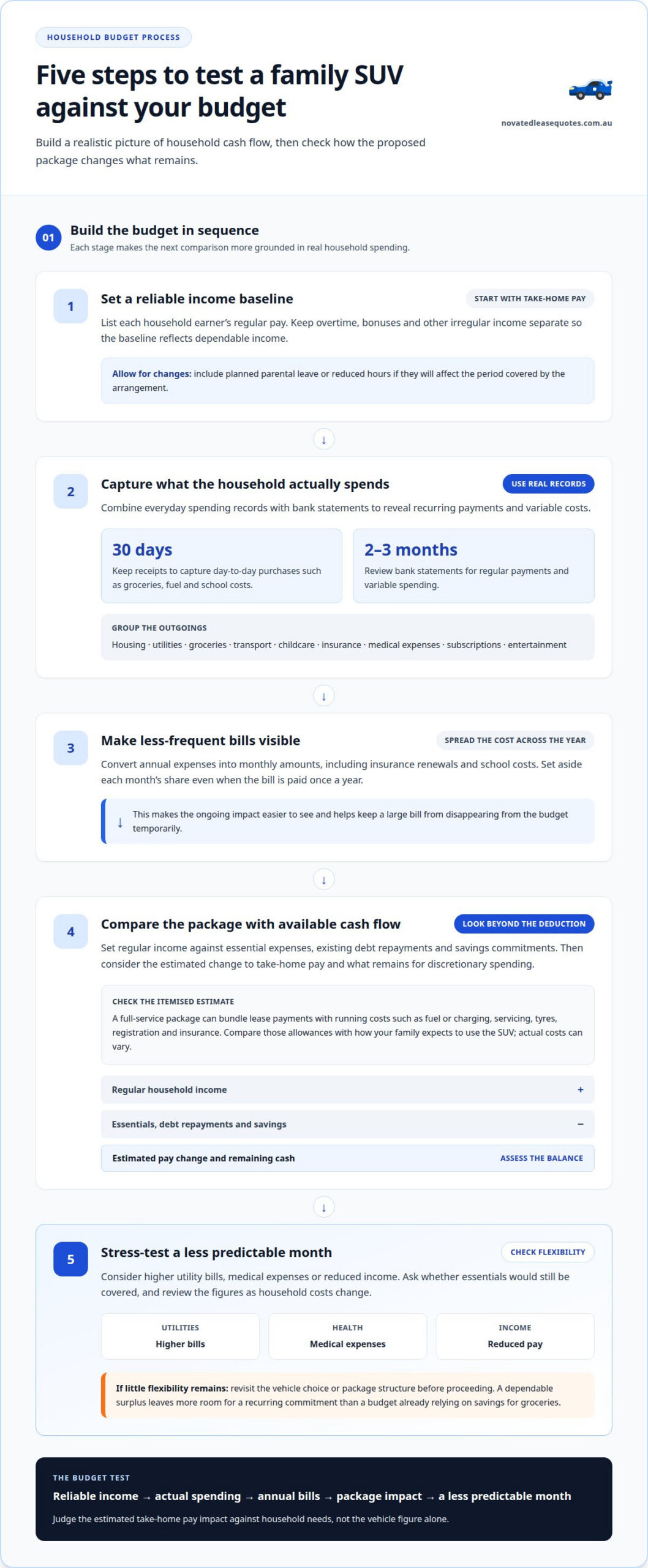
- Start with reliable take-home income. List each household earner’s regular pay, separating overtime, bonuses and irregular income. If parental leave or reduced hours are planned, include the expected change. This gives you a realistic income baseline. To assess salary packaging a family SUV without household budget stress, use income figures that reflect the period your arrangement will affect.
- Build an expense picture from actual spending. Keep receipts for 30 days to capture everyday purchases, including groceries, fuel and school costs. Then review two to three months of bank statements for recurring payments and variable spending. Categorise housing, utilities, groceries, transport, childcare, insurance, medical expenses, subscriptions and entertainment. These records can show where a quick estimate misses regular household costs.
- Account for bills that arrive less often. Convert annual expenses into monthly amounts, including insurance renewals and school costs. Set aside that share each month, even if you pay the bill once a year. Dividing an annual premium across the year, for example, makes its impact easier to see. This helps prevent a vehicle deduction from seeming affordable simply because a large bill is temporarily out of view.
- Compare the proposed package with available cash flow. Set regular income against essential expenses, existing debt repayments and savings commitments. Then consider the estimated change to take-home pay and what remains for discretionary spending. A household already relying on savings for groceries has less room for another recurring commitment than one with a dependable surplus.
- Test the budget against a less predictable month. Consider higher utility bills, medical expenses or reduced income, and assess whether essentials remain covered. Review the figures monthly as household costs change. Use this budget test to assess salary packaging a family SUV without household budget stress, rather than relying on an ideal month. If little flexibility remains, revisit the vehicle choice or package structure before proceeding.
Bundled vehicle payments and running costs
Assess the whole package, not just the vehicle payment in a quote. A useful comparison shows the estimated change to take-home pay and the ongoing costs included in the package.
-
Understand how a quote provider assesses bundled vehicle costs
Use an itemised estimate to see the vehicle payments, running costs and included expenses. A full-service package can bundle costs such as fuel or charging, servicing, tyres, registration and insurance with lease payments. Compare the allowances with how your family expects to use the SUV. For example, frequent long-distance trips may affect fuel and servicing needs. Remember that actual costs can vary, so a bundled estimate is not necessarily a fixed bill.
-
Compare the total cost of each option with a quote provider
Compare a novated lease with buying the same family SUV using cash or a car loan. Include purchase or finance payments, running costs, fees shown in the quote and the estimated tax effect. The total cost depends on the vehicle, financing, lease terms, expenses and tax treatment, so one payment figure cannot settle the comparison. Use similar assumptions for each option, including annual kilometres and ownership period.
-
Assess the effect on take-home pay with a quote provider
Ask for the estimated pay impact using your salary, tax bracket and proposed lease term. Salary affects the amount available for deductions, while tax treatment influences how pre-tax and post-tax deductions affect take-home pay. The lease term changes the timing and size of payments across the arrangement. Compare the estimated pay outcome with your household’s available cash flow, rather than assuming a tax benefit means the SUV is affordable.
-
Review fees, risks and end-of-lease options with a quote provider
Ask for fees to be itemised and for the end-of-lease choices and costs to be explained in the quote. Review any final payment, payout or other amount due, plus the effect of changing jobs or driving more than budgeted. These details can change the total commitment, even if regular deductions initially fit your budget. A novated lease quote comparison can help you assess the figures side by side.
How does salary packaging a family SUV work in Australia?
- Confirm the employment arrangement. Establish whether your employer supports salary packaging through a novated lease. The arrangement connects your employment, salary deductions and vehicle lease. Provide your employment and pay details to get an estimate based on your circumstances, rather than a generic example.
- Choose the SUV to assess. Provide the make, model, year and purchase details for the family vehicle you’re considering.
- Set the proposed lease structure. Ask for the quote to show the lease term and payment approach being assessed. These details affect how costs are allocated and how deductions appear against your salary. Check that the proposed vehicle and term match your intended use, rather than relying on figures for a different SUV or timeframe.
- Review how payments flow. A novated lease connects the employee, employer and vehicle lease. Salary packaging directs agreed deductions from pay towards the arrangement. Review the quote’s pre-tax and post-tax deductions, then compare the resulting take-home pay with what your household needs for regular expenses.
- Check what the package covers. Read the itemised estimate to distinguish lease payments from included running costs. A full-service package can include fuel or charging, servicing, tyres, registration and insurance. For example, if your family expects frequent long-distance trips, assess whether the fuel and servicing allowances suit that use.
- Use the figures to make a decision. Consider the estimated impact on your pay, included expenses and lease-end obligations together. An SUV is not automatically affordable just because it meets vehicle criteria. Compare the package with your household’s available cash flow, then decide whether it supports both your family’s transport needs and other financial commitments.
What are the Australian FBT rules for salary-packaged electric and petrol SUVs?
- Identify the exact vehicle before comparing tax treatment. Provide the SUV’s make, model, variant and powertrain. An electric SUV and a petrol SUV are not interchangeable examples. Ask for the quote to explain how the vehicle’s details affect its fringe benefits tax (FBT) assessment and the estimated impact on your pay.
- Ask for the FBT treatment to be explained in the quote. An electric vehicle does not automatically receive a particular tax outcome, and petrol SUVs may have different assessments. The quote needs to reflect the vehicle and salary-packaging arrangement. If it shows an FBT-related adjustment, review how that figure affects deductions and take-home pay.
- Compare electric and petrol options using matching assumptions. Ask for both quotes to use the same lease term, employment details and expected vehicle use. Compare estimated deductions and package costs, not just an FBT label or headline saving. A lower estimated tax impact, for example, does not show the full picture if the SUVs have different lease payments or running-cost allowances.
- Check which vehicle details affect the assessment. Review the vehicle’s eligibility basis and any conditions used in the calculation. For an electric SUV, confirm the specific vehicle being assessed rather than relying on its advertised powertrain description. For a petrol SUV, use its own vehicle details and package figures. This avoids applying assumptions from one model to another.
- Use the assessed figures in your household comparison. Review the FBT treatment alongside deductions, running costs and the resulting take-home pay. Compare that outcome with your household’s available budget, not an assumed tax benefit. If the quote doesn’t make the electric or petrol vehicle’s treatment clear, request a revised explanation before using its estimate to choose an SUV.
FBT treatment depends on the particular SUV and salary-packaging arrangement, including the vehicle’s eligibility and any conditions used in the assessment. An electric or petrol powertrain alone does not determine the tax outcome. Assess the quoted FBT impact alongside deductions, package costs and take-home pay.
Novated Lease Quotes
Novated Lease Quotes helps Australian employees assess whether salary packaging a family SUV fits their budget. Its Novated Lease Quote Comparison Service lets you obtain and compare quotes from multiple providers. The Novated Lease Calculator can estimate potential tax savings and packaging costs.
Use these tools once you understand your income, household outgoings and preferred SUV. Comparing quotes helps you examine the estimated pay impact, bundled vehicle costs and differences between options before deciding whether to proceed. The figures give you a practical basis for weighing the arrangement against your family’s priorities and budget.
If you’d like support assessing your options, contact Novated Lease Quotes.
Make your next step a clear budget decision
A plan for salary packaging a family SUV without household budget stress starts with a clear spending limit. Decide how much flexibility your household needs for changing expenses, family plans and unexpected bills. Use that limit to assess the proposed arrangement rather than reshaping your budget around a vehicle you have already chosen.
If the figures work only under ideal conditions, pause before committing. A different SUV or package structure may better match your priorities. If the estimate leaves room for your household’s other goals, you can proceed with a clearer understanding of the trade-offs.
For help assessing your options and comparing quotes, contact Novated Lease Quotes. Take the next step when the numbers support the choice, and you’ll be better placed to make a confident decision for your family.
Frequently Asked Questions
How much does it cost to salary package a family SUV per fortnight in Australia?
There’s no standard fortnightly deduction for a salary-packaged SUV. The estimate depends on the vehicle, lease term, salary, tax treatment and costs included in the package. A personalised quote projects the impact on your pay using those details. Compare the fortnightly figure with your household’s pay cycle and planned bills, rather than treating a monthly estimate as equivalent.
Which family SUVs have the lowest running costs and novated lease payments in Australia?
The lowest-cost choice is the SUV with the most suitable combined quote and running-cost estimate for your household’s use. Compare specific vehicles using consistent assumptions for kilometres, lease structure and included expenses. Fuel or charging needs, servicing, insurance and tyres all affect the estimate. A low payment alone doesn’t establish the lowest overall cost, particularly if the vehicle’s running-cost budget differs.
What SUV running costs are included in a novated lease budget in Australia?
An all-inclusive package can cover fuel or charging, finance repayments, servicing, maintenance, registration, CTP insurance, tyres, accident management and comprehensive insurance. Check the package option: fuel is not included with a non-maintained option. Tolls, traffic fines, parking fees and personal vehicle modifications are excluded. Account for these expenses separately in your household budget.
How can a quote provider check whether a salary-packaged SUV fits your household budget?
A quote provider can assess your salary and expected deductions alongside the household commitments that may change during the lease. For example, include a planned period of parental leave or a change in childcare arrangements in the assessment. This helps distinguish a package that fits current pay from one that remains workable after a foreseeable change to household income or expenses.
Where can Australians compare novated lease quotes and have employer eligibility checked?
Novated Lease Quotes offers a Novated Lease Quote Comparison Service to compare quotes from multiple providers, along with a Novated Lease Calculator for estimates. You must be an employee of a participating employer willing to process salary deductions to be eligible. Share your employment details when requesting a quote so they can be considered alongside the vehicle figures.