High annual kilometres don’t automatically rule out salary packaging a vehicle. Salary packaging means allocating part of your salary to eligible expenses before income tax is calculated, so tax is based on the remaining salary. For example, an employee earning A$70,000 who packages A$10,000 of eligible expenses may have tax calculated on A$60,000. That can bring salary packaging peace of mind for high annual mileage drivers, provided the vehicle budget reflects how much they’ll drive.
If you’re considering salary packaging for a car, it’s reasonable to want clear costs and fewer surprises down the track. Annual kilometres affect estimated running costs, while the lease term determines how those costs are spread across your budget.
This guide explains how salary packaging works, how it may affect taxable income and what to consider when estimating a vehicle budget for high annual mileage. It also explains how novated leasing fits into salary packaging, so you can assess whether the numbers suit your driving needs.
Key Takeaways
- Use the Fringe Benefits Tax year, which runs from 1 April to 31 March according to the Australian Taxation Office, to understand the timing of salary packaging.
- Build a vehicle budget around your expected annual kilometres, as driving patterns shape estimated running costs.
- Consider the lease term alongside your kilometre estimate to see how vehicle expenses are spread through the budget.
- Explore how novated leasing can package vehicle costs, then use a calculator or quote comparison to assess the options.
What is salary packaging?
In Australia, salary packaging for a car uses employer-arranged deductions for a lease and agreed running costs. Income tax is calculated on the remaining salary, while the Fringe Benefits Tax year runs from 1 April to 31 March, according to the Australian Taxation Office.
Bundling vehicle running costs
Regular payments can bundle lease costs with agreed vehicle expenses, such as servicing, registration and insurance. This brings planned costs together in a consistent salary deduction instead of separate bills throughout the year. Because the budget is based on estimates, compare them with actual spending as the arrangement progresses. If costs differ, contributions may need to be adjusted. Higher expenses can strain the budget, while lower expenses may leave an amount to reconcile. If your employment or driving needs change, the lease obligation doesn’t automatically end. Early termination may involve a payout and fees under the lease terms.
Using pre-tax income for costs
Salary packaging directs an agreed portion of your income towards eligible costs before income tax is calculated. For a packaged vehicle, this can include lease payments and running costs covered by the arrangement. Your employer deducts the agreed amount from your salary, so make sure you understand which expenses the budget includes. Separate predictable costs, such as scheduled servicing, from those that vary with use. Then compare the estimate with actual payments and adjust contributions where needed. This helps keep the packaged amount aligned with the vehicle’s operating costs.
Including fuel and EV charging
A vehicle budget may include fuel or electric vehicle charging when these are part of the arrangement. High annual kilometres can increase fuel use or charging needs, so base the estimate on your usual routes and driving patterns. For an EV, consider whether you’ll charge at home or at public charging points, as the mix affects spending. Compare expected costs with the amount included in regular payments. If actual use differs from the estimate, review your contributions so the budget doesn’t rely on an outdated forecast.
How salary packaging reduces taxable income
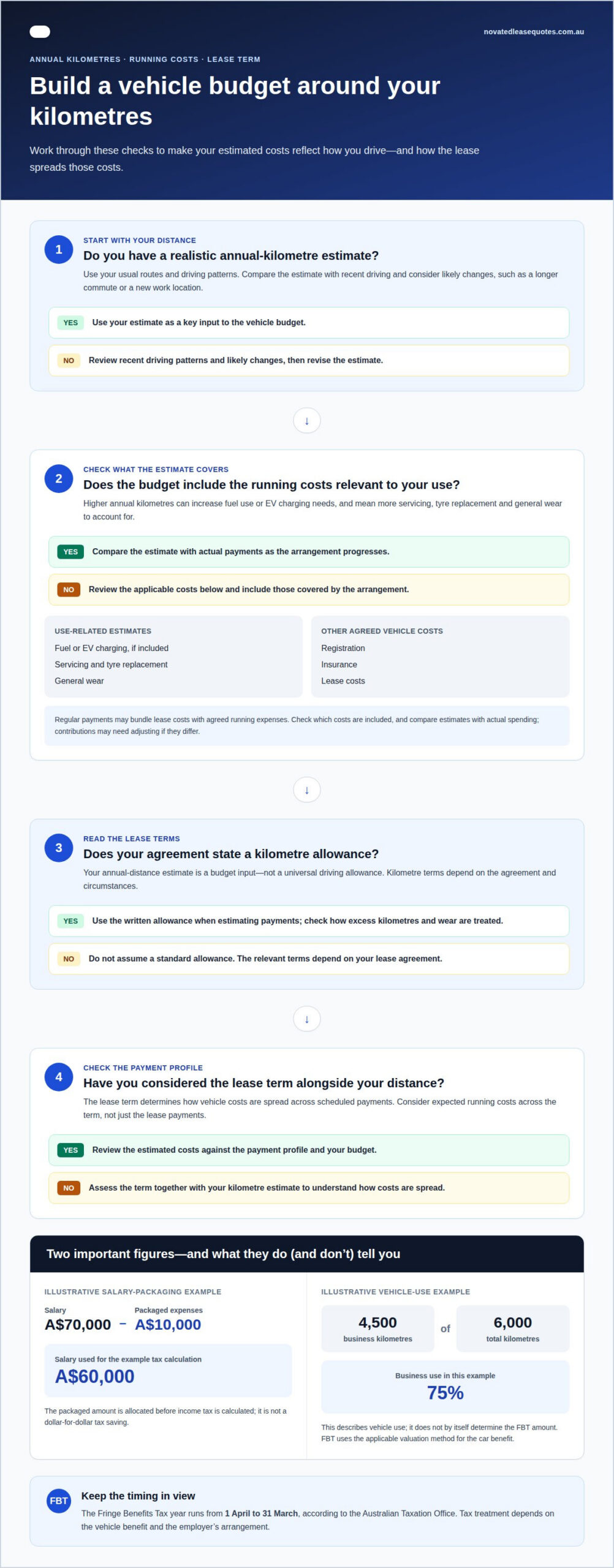
Salary packaging changes how part of an employee’s pay is allocated before income tax is calculated. The packaged amount goes towards eligible expenses, and tax is calculated on the remaining salary. For example, an employee earning A$70,000 who packages A$10,000 of eligible expenses may have tax calculated on A$60,000. The A$10,000 is not a dollar-for-dollar tax saving; it is the amount allocated before tax calculation.
With a novated lease, an employer can arrange salary deductions towards vehicle finance and agreed running costs. This means some vehicle expenses are funded from pre-tax income rather than paid entirely from take-home pay. However, reducing taxable income is not the same as reducing the vehicle’s total cost. Salary packaging changes the income used to calculate tax, while the lease and running costs remain expenses in your budget.
Tax treatment depends on the vehicle benefit and your employer’s arrangement. A packaged vehicle is not simply a personal expense claimed as a tax deduction. Instead, your employer administers the agreed payments through salary packaging, and the benefit’s tax treatment forms part of the arrangement. Before assessing the effect, identify which expenses are included, how payments are split and whether the figures are pre-tax or after-tax contributions. These details help show how much income remains subject to income tax.
For high-mileage drivers, include the anticipated running costs in the calculation rather than looking only at lease payments. Fuel, charging, servicing and other included expenses affect the packaged amount, while actual use can differ from the estimate. A practical comparison is to review the estimated vehicle expenses alongside take-home pay and the salary remaining taxable. A novated lease quote comparison can help you assess the packaged vehicle costs against your budget before deciding.
Estimating budgets using annual kilometres and lease term
Estimate your annual kilometres before setting a novated lease budget, because distance affects expected running costs. Then consider the lease term, which determines how those costs are spread across scheduled payments.
Checking kilometre limits and eligibility
For the statutory formula, eligibility depends on whether the vehicle qualifies as a car fringe benefit under the relevant rules. Annual kilometres are not a universal driving allowance set by a lease. Treat your distance estimate as a key budget input, separate from any kilometre terms in the lease. Those terms depend on the agreement and circumstances, so use the written allowance when estimating payments.
For example, 4,500 business kilometres out of 6,000 total kilometres represent 75% business use. This can help describe how the vehicle is used, but it doesn’t by itself determine the FBT amount. FBT for a novated lease car is calculated using the applicable valuation method for the car benefit. The method and relevant vehicle and usage details affect the calculation.
Planning for wear and maintenance
Higher kilometres mean more use to account for when estimating servicing, tyre replacement and general wear. Review the lease terms for any kilometre allowance and how excess kilometres or wear are treated at the end. Include servicing and tyres in your running-cost estimate rather than treating them as unexpected extras. If you use the vehicle for both work and personal trips, base the forecast on your total annual distance.
Compare your estimated annual distance with your recent driving patterns and likely changes, such as a longer commute or a new work location. Then consider expected running costs across the lease term to understand the payment profile. A longer term spreads costs over more scheduled payments, while a shorter term concentrates them. Use a calculator to model kilometres and lease term together, then review the result against your circumstances and expected take-home pay.
Novated leasing and salary packaging a vehicle
A novated lease links an employee, employer and vehicle lease arrangement. The employer deducts agreed lease and running costs from salary, and the employee uses the vehicle. This can bring vehicle finance and budgeted expenses together in regular payments rather than leaving each cost as a separate bill.
For high annual mileage, the key question is whether the arrangement suits both your distance and your budget. A driver making regular work trips may use more fuel, need more frequent servicing and replace tyres sooner than someone covering shorter distances. Include those expenses in your estimate, alongside the lease term and any kilometre allowance. An estimate based on lighter use can understate the cost of running the vehicle.
Novated leasing may offer tax advantages because eligible packaged amounts are allocated before income tax is calculated. That doesn’t mean every dollar is a saving. The lease, running costs and applicable tax treatment all affect the overall result. Compare expected take-home pay and vehicle expenses under the arrangement, rather than judging it by pre-tax deductions alone.
How does novated leasing compare with buying or financing? Buying outright means paying the vehicle price without a lease, while finance involves repayments under a separate loan arrangement. A novated lease includes employer salary packaging and may bundle running costs. For a high-mileage driver, compare the overall budget, including usage-related costs and the lease terms.
Before choosing, bring the key figures together: expected annual kilometres, vehicle expenses, lease term and the effect on take-home pay. Compare these with the costs and payment structure of buying or financing. The right option depends on how it fits your employment, driving pattern and budget. Tax treatment and potential savings also depend on the vehicle and your circumstances, so don’t assume every driver will get the same result.
To assess how a novated lease could fit your driving and salary budget, explore novated lease options.
Novated Lease Quotes
Novated Lease Quotes helps Australian employees assess how annual kilometres, running costs and lease term fit a salary-packaging budget. Use the Novated Lease Calculator to estimate potential tax savings and packaging costs, and compare personalised novated lease quotes through the quote comparison service.
This can help if you’ve estimated your annual distance and want to understand how vehicle costs may affect take-home pay. Bring your assumptions together to assess whether a proposed arrangement suits your circumstances before deciding how to proceed.
For help exploring your options, contact Novated Lease Quotes.
Set your next budget decision in motion
A practical next step is to turn your driving pattern into a working budget. Consider your usual routes, how often you’ll use the vehicle and whether your work or commute may change. These details help frame an estimate around your actual needs rather than a generic assumption. Revisit it if your circumstances shift, so the vehicle budget remains relevant.
For salary packaging peace of mind for high annual mileage drivers, focus on whether the arrangement fits your everyday driving as well as your pay. Comparing a personalised estimate with your expected vehicle costs can help you decide what to consider before committing.
Start a conversation with Novated Lease Quotes about your driving needs and next steps. With a considered budget, you can move forward with greater clarity.
Frequently Asked Questions
How does salary sacrifice work?
Salary sacrifice is an arrangement with your employer to receive part of your remuneration as benefits instead of cash salary. For a car, payroll deductions fund agreed lease or vehicle expenses. This changes the cash salary you receive, so compare your payslip and household budget before committing. The packaged amount and deductions should match the arrangement you’ve agreed to.
What are cap limits?
Cap limits are maximum amounts that eligible employees can salary package under particular benefit rules. For example, employees of eligible rebatable organisations may package up to A$15,900 per FBT year for concessionally taxed benefits. Eligible health employees may have a separate A$9,010 cap, while meal entertainment has a separate A$2,650 limit. The applicable cap depends on the employer and benefit type.
What are the running costs of a novated lease?
When bundled into the payment, running costs can include fuel or charging, servicing, maintenance, registration, CTP insurance, tyres, accident management and comprehensive insurance. Check the package structure: fuel may be excluded under a non-maintained option. Tolls, traffic fines, parking fees and personal vehicle modifications are excluded. Knowing the difference helps you identify which bills remain separate from regular lease payments.
What are the tax benefits of salary packaging a car under a novated lease in Australia?
Packaging eligible vehicle expenses from pre-tax salary can reduce the income on which income tax is calculated. The overall tax treatment also depends on the vehicle benefit and its fringe benefits tax treatment. Compare the tax effect with total lease and running expenses rather than treating potential tax savings as the whole value.
How does annual mileage affect the cost and value of a novated lease?
More kilometres can mean higher fuel or charging use, faster tyre wear and more frequent servicing. They can also affect the vehicle’s condition and end-of-lease obligations. For high annual mileage drivers, salary packaging peace of mind starts with matching the kilometre estimate and lease terms to likely use. If your travel pattern changes, the original budget may no longer reflect actual vehicle expenses.
What are typical novated lease costs and running expenses for high-mileage drivers in Australia?
There isn’t one typical cost for every high-mileage driver. Your budget depends on the vehicle, lease structure, annual distance and which expenses are bundled. Fuel or charging, maintenance, servicing, tyres, registration and insurance may form part of the packaged costs. A quote based on your expected kilometres and chosen vehicle gives a more relevant estimate than a broad average.