A luxury car’s price doesn’t automatically rule out salary packaging, but the tax treatment depends on the vehicle and lease arrangement. A novated lease is a three-party agreement between you, your employer and a salary packager. For 2026-27, the Luxury Car Tax thresholds are A$91,661 for fuel-efficient vehicles and A$80,909 for other vehicles. The salary-package luxury-car tax guilt-versus-savings decision starts with understanding how those limits and the lease costs affect your numbers.
It’s reasonable to weigh potential tax and GST effects against the cost of a premium vehicle, its running expenses and the lease-end obligations. This guide explains who can salary package a car through a novated lease, how running costs and tax treatment affect the comparison, and how leasing differs from buying outright or using a car loan. It also clarifies why electric vehicle tax concessions are a separate consideration from whether a luxury car can be packaged. The goal is to assess the full cost, not focus on the vehicle’s price alone.
Key Takeaways
- Assess eligibility based on your employer’s salary packaging arrangement and the vehicle’s tax treatment, not its price tag alone.
- Check whether an electric vehicle meets the conditions for the Fringe Benefits Tax exemption, as the rules differ for plug-in hybrids.
- Factor GST savings and packaged running costs into the vehicle’s overall cost, while accounting for relevant tax limits.
- Compare the full novated lease cost, including its residual value, with the total cost of buying outright or using a car loan.
Am I eligible to start a salary sacrifice for a car?
You may be able to salary package a car through a novated lease if you’re an employee whose employer participates and agrees to the arrangement. Most vehicles are funded through a mix of pre-tax and post-tax salary deductions. Eligible electric vehicles priced below the applicable FBT threshold may qualify for the full FBT exemption. Your income, vehicle and lease terms all affect the calculation. That’s the starting point for weighing salary package luxury car tax guilt vs savings.
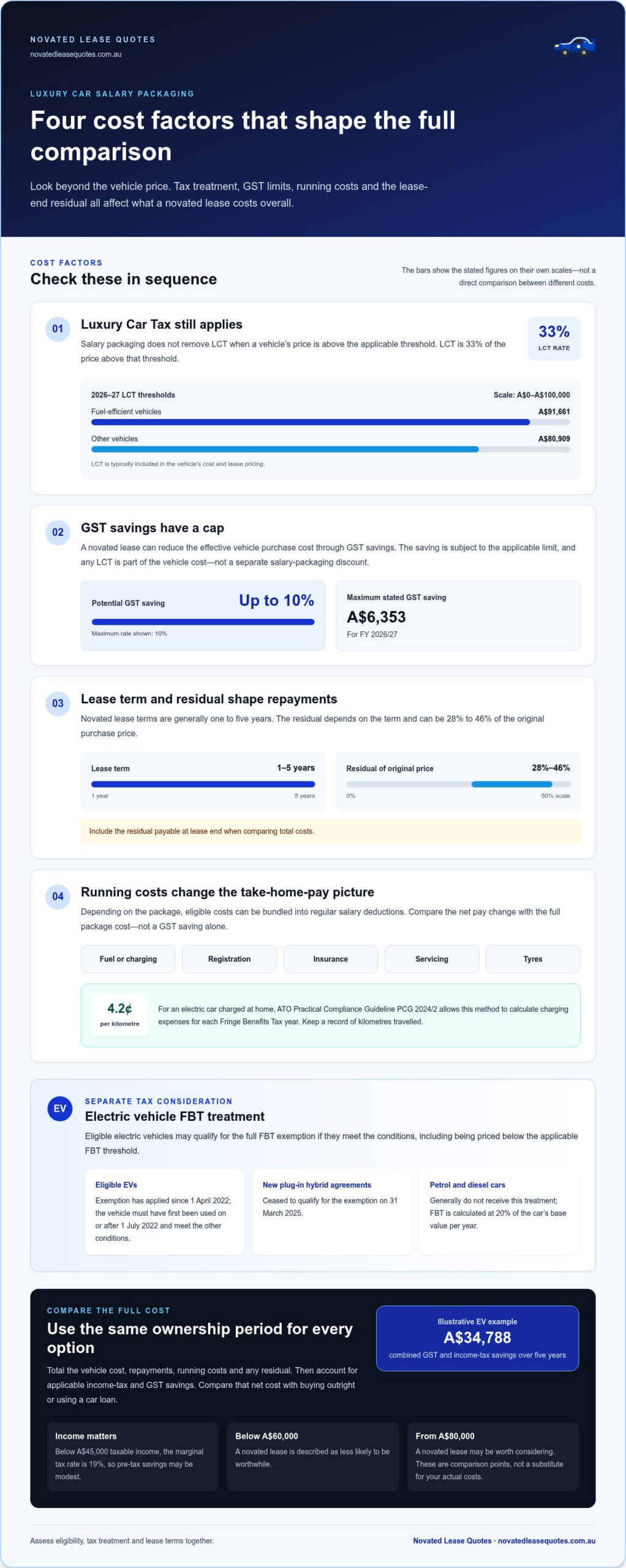
For an electric car, the Fringe Benefits Tax (FBT) exemption can materially change the comparison. Eligible electric vehicles have been exempt from FBT since 1 April 2022, provided the vehicle was first used on or after 1 July 2022 and meets the other eligibility conditions. New plug-in hybrid agreements ceased to qualify for the exemption on 31 March 2025. Petrol and diesel cars generally don’t receive this treatment: FBT is calculated at 20% of the car’s base value per year.
Does luxury car tax apply when an employer provides a car through a salary package? Yes. Salary packaging doesn’t remove Luxury Car Tax (LCT) if the vehicle’s price exceeds the applicable threshold; LCT is typically included in the vehicle’s cost and lease pricing. In 2026-27, the LCT thresholds are A$91,661 for fuel-efficient vehicles and A$80,909 for other vehicles.
How is luxury car tax calculated on a car purchase in Australia? LCT is 33% of the vehicle price above the applicable threshold. A novated lease may also provide GST savings of up to 10% on the purchase price, subject to the applicable limit; the maximum stated GST saving for FY 2026/27 is A$6,353. The Luxury Vehicle Limit is a separate measure from the LCT thresholds.
Its EV lease showed A$34,788 in combined GST and income-tax savings over five years. This example puts the luxury-car tax guilt-versus-savings question in practical terms: weigh the potential tax benefits against the vehicle’s total cost and your priorities.
GST savings on vehicle purchase and running costs
A novated lease can reduce the effective vehicle purchase cost because GST savings apply to the purchase. For 2026/27, the maximum GST saving on a packaged vehicle is A$6,353. The saving is capped, so the vehicle’s price and the applicable threshold matter. Any Luxury Car Tax (LCT) is factored into the vehicle’s cost and lease repayments, rather than treated as a separate salary-packaging discount.
A novated lease can bundle eligible vehicle expenses into regular salary deductions, making costs easier to budget. Depending on the package, included costs can cover fuel or charging, registration, insurance, servicing and tyres. The deductions affect your take-home pay, so compare the net pay change with the full package cost rather than focusing on a possible GST benefit alone.
What salary packaging costs and fees apply to a luxury car in Australia? Costs depend on the vehicle, lease term, running-cost budget and packaging arrangements. A personalised quote can show the proposed costs and deductions.
Running costs, residual value and lease term all shape the package total. Novated lease terms are generally one to five years, and the residual can be 28% to 46% of the original purchase price, depending on term. A longer term changes the repayment period and residual balance; higher running-cost budgets also increase deductions. Compare those amounts alongside GST savings and any LCT included in repayments.
For an electric car charged at home, ATO Practical Compliance Guideline PCG 2024/2 allows one method of calculating charging expenses: 4.2 cents per kilometre travelled during each Fringe Benefits Tax year. Keep a record of kilometres travelled to apply this method. It gives a consistent basis for including home charging in running costs, rather than treating electricity as an untracked household expense.
What happens to a novated lease if you change jobs or leave your employer? The salary deductions through that employer stop, but the lease obligation remains. Payments need a new arrangement, such as salary packaging through a new employer or paying them personally, according to the lease terms. To compare how repayments, running costs and GST savings affect your figures, use a novated lease quote comparison.
Comparing a novated lease with a car loan or cash purchase
Compare each option’s total cost, including tax treatment, running expenses and the residual payable at lease end. To assess whether packaging works out cheaper, compare the net cost over the same period, not just the regular deductions.
Salary sacrifice through a novated lease
A novated lease involves you, your employer and a leasing provider, with agreed lease costs deducted from your salary. Pre-tax deductions can reduce taxable income, while post-tax contributions may also apply to manage FBT. Eligible electric vehicles priced below the applicable threshold may receive an FBT exemption, which changes the comparison with a petrol or diesel vehicle. Include the package’s running costs, then compare the effect on take-home pay with other ways of buying a car.
Drawbacks for lower-income earners
A lower taxable income can mean less benefit from deductions made before tax. For taxable income below A$45,000, the marginal tax rate is 19%, so pre-tax novated-lease savings may be modest. A novated lease is less likely to be worthwhile below A$60,000, while it may be worth considering from A$80,000. These are comparison points, not a substitute for adding the actual vehicle, running costs and residual to your figures.
Calculating overall savings
Set the same ownership period for all options, then total the vehicle cost, repayments, running costs and any residual. Subtract applicable income-tax and GST savings from the lease total. The comparison assumed an 8.00% annual loan interest rate and no loan fees.
The lowest regular deduction does not necessarily mean the lowest total cost. Include the residual payable at lease end and account for the tax treatment of an eligible electric vehicle. Compare like with like by using the same vehicle, lease term and running-cost assumptions. Paying cash avoids lease repayments, but you still need to include the vehicle’s purchase price and ongoing costs.
Novated leasing and salary packaging
In Australia, salary packaging a vehicle through a novated lease connects your employment income with vehicle finance. The arrangement involves you, your employer and a leasing provider. Your employer deducts agreed costs from your pay, and the package can cover vehicle finance and eligible running expenses.
Lease terms are generally one to five years, with a residual value of 28% to 46% of the original purchase price, depending on the term. That residual is payable or otherwise dealt with at the end of the lease. Compare it with the repayments across the term, rather than treating the regular deduction as the entire cost.
Luxury status doesn’t automatically exclude a vehicle from packaging, but tax limits still shape the numbers. For FY 2025-26, the Luxury Car Tax limit for an eligible fully electric vehicle purchased through a novated lease is A$91,387. The purchase price, vehicle eligibility and tax treatment affect the overall comparison. A standard finance or credit arrangement doesn’t provide the same salary-deduction structure.
Taxable income also influences the value of salary sacrifice. For a taxpayer in the 37% marginal tax bracket, packaging a A$15,000 annual lease cost reduces tax liability by approximately A$5,550 per year. That example shows why the tax effect belongs beside the purchase price, running costs and residual when assessing a luxury vehicle.
Scale matters too. The minimum novated lease amount is generally between A$5,000 and A$10,000. Agreements may exceed A$100,000 but very rarely exceed A$150,000. A higher purchase price increases the amount financed, so compare the total deductions and end-of-term residual against buying outright or using a separate loan.
To assess the trade-off, calculate the full lease cost, applicable tax savings and residual together. An electric vehicle’s treatment can change that calculation, while a high purchase price can increase the financial commitment. Use the Novated Lease Calculator to estimate packaging costs and compare the figures before choosing a lease structure.
Novated Lease Quotes: Novated lease quotes
Novated Lease Quotes helps Australian employees compare salary packaging options through novated lease quotes, a Novated Lease Calculator and a Novated Lease Quote Comparison Service. Use these tools when weighing a luxury vehicle’s price, tax treatment, running costs and lease-end residual against buying outright or using a car loan.
The calculator estimates potential tax savings and packaging costs, while quote comparisons let you review options from multiple providers. Use the estimates to compare the full package cost, not just the regular deduction, and consider how the figures relate to your vehicle and employment arrangements.
If you’re ready to compare your options, contact Novated Lease Quotes.
Choose a package that fits your priorities
A luxury car decision is easier to assess when you separate the vehicle’s appeal from how you’ll pay for it. Consider what matters most: predictable cash flow, flexibility to change vehicles, or avoiding a lease commitment. To decide whether to salary package a luxury car, weigh potential tax effects against the full cost and your priorities.
Compare the same vehicle over the same period before choosing. Look beyond headline savings to the impact on take-home pay and the obligations that continue throughout the lease. This makes the salary-package luxury car question less about guilt and more about whether the tax treatment justifies the total cost.
If you’re ready to explore your options, contact Novated Lease Quotes. A considered decision can make room for the vehicle you want while keeping your wider financial priorities in view.
Frequently Asked Questions
Can you avoid LCT in your lease?
No. A novated lease does not by itself remove Luxury Car Tax (LCT). If a vehicle’s price exceeds the applicable threshold, LCT may still apply and is generally reflected in its cost. Other tax or GST effects do not cancel the LCT calculation. If a vehicle is near the threshold, compare its price and tax treatment before deciding whether to lease it.
How does car salary packaging affect my take-home pay?
Your take-home pay falls by the package deductions, but the net effect depends on how much is deducted before and after tax. Pre-tax deductions reduce taxable salary, while post-tax contributions come from income after tax. For a practical comparison, consider expected take-home pay alongside the package cost and household budget, rather than comparing the deduction with a loan repayment alone.
Is the payment entirely deducted from my pre-tax salary?
Usually, no. Most vehicle packages use a mix of pre-tax and post-tax deductions. An eligible electric vehicle priced below the applicable threshold may be funded entirely from pre-tax earnings under its tax treatment. The split affects taxable income and take-home pay. Don’t assume a petrol vehicle receives the same pre-tax treatment as an eligible EV just because both use novated leasing.
What is Australia’s luxury car tax rate and threshold for 2025-26?
For 2025-26, the LCT threshold for other vehicles is A$80,567, and the tax rate is 33% of the vehicle’s price above the applicable threshold. The threshold is not the amount of tax payable: LCT applies to the value above it. A vehicle’s classification matters, so fuel-efficient vehicles may have a different threshold from other vehicles.
How does novated leasing affect luxury car tax in Australia?
A novated lease does not automatically exempt a vehicle from LCT. The tax treatment depends on the vehicle and the applicable threshold, and any LCT is generally reflected in the vehicle cost used to price the lease. Consider LCT separately from GST: a GST reduction does not mean LCT has been waived or removed.
How does a luxury car salary package compare with buying the car using savings?
Buying with savings avoids lease repayments and interest, but uses cash that could remain available for other priorities. A novated lease spreads vehicle finance and eligible running costs through payroll, while its overall value depends on tax treatment, deductions and the residual payable at lease end. Compare the total package cost over the same period with the cash purchase price and ongoing expenses, including how important it is to keep your savings accessible.