Choosing the wrong car for your salary packaging agreement could cost you more in Fringe Benefits Tax than you save in GST. While many Australians assume any new car is on the table, the reality is that the ATO has strict definitions for what qualifies as a “car” and what is classed as a commercial vehicle. Identifying the right novated lease eligible vehicles is no longer just about picking a brand; it’s about navigating 1-tonne payload limits and the latest Luxury Car Tax (LCT) thresholds for 2026.
You probably feel the pressure to make a smart financial decision while dealing with confusing rules about used car age limits and shifting EV incentives. We understand that the complexity of the $91,661 LCT limit for fuel-efficient vehicles can make the process feel like a minefield. This article promises to clarify exactly which vehicles qualify for salary packaging in Australia and how you can maximise your tax savings under the current 2026 rules.
We will provide a clear checklist of eligible vehicle types, explain the specific tax benefits of electric vehicles versus petrol models, and simplify the technical requirements for utes and used cars. By the end, you’ll have the confidence to compare quotes and select a vehicle that genuinely optimises your take-home pay.
Key Takeaways
- Learn how the ATO distinguishes between standard cars and commercial vehicles based on load and passenger capacity to ensure your chosen model is compliant.
- Master the one-tonne rule for dual-cab utes and vans to avoid unexpected tax liabilities on popular commercial models.
- Understand the 2026 FBT exemption rules for electric vehicles and plug-in hybrids, including the critical Luxury Car Tax (LCT) thresholds.
- Discover the age and condition requirements for novated lease eligible vehicles to see if a used car or your current vehicle can be salary packaged.
- Use our specialised calculator to determine how different models impact your take-home pay before comparing quotes from national providers.
Understanding the ATO Definition of a Car for Novated Leasing
The Australian Taxation Office (ATO) applies a rigid set of criteria to determine which vehicles qualify for salary packaging. It isn’t enough for a vehicle to be used for personal travel; it must meet the technical definition of a “car” to trigger the specific tax treatments associated with a novated lease. If you’re researching novated lease eligible vehicles, you must look beyond the marketing brochures and focus on technical specifications like gross vehicle mass and seating configuration. Understanding What is a Novated Lease? involves recognising that the agreement is built upon these specific tax classifications.
Failing to meet these definitions means the vehicle is treated as a commercial asset or a general fringe benefit. This distinction is vital because it changes how your employer reports the benefit and how your GST credits are claimed. Most confusion arises when a vehicle sits on the border of personal and commercial use, such as a large SUV or a dual-cab ute. Accurate tax savings calculations depend entirely on this initial classification.
The Core Criteria: Load and Passengers
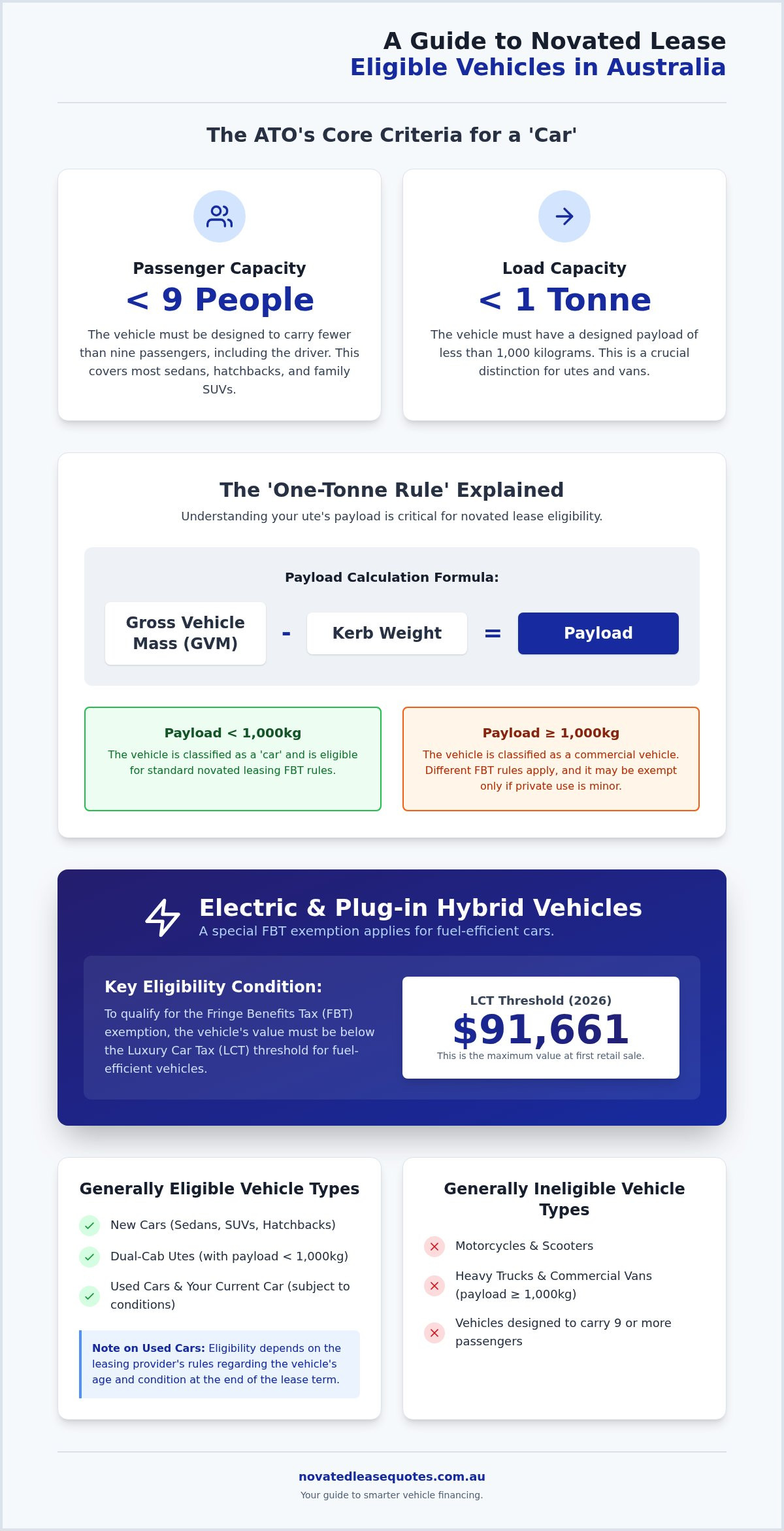
The ATO sets two primary boundaries for eligibility. For a vehicle to be classified as a car, it must be designed primarily to carry a load of less than one tonne (1,000kg) and fewer than nine passengers. This specific threshold ensures that standard sedans, hatchbacks, and most family SUVs are automatically eligible. To be considered an eligible car, the vehicle must have a carrying capacity of less than 1,000kg and be designed to transport fewer than nine people.
If a vehicle exceeds either of these limits, it falls into a different tax category. For example, a commuter van designed to carry 12 people is no longer a “car” in the eyes of the tax office. Similarly, a heavy-duty work van with a massive payload capacity won’t qualify for the standard novated leasing benefits. These rules are non-negotiable and form the foundation of your salary packaging agreement.
Excluded Vehicle Types
Certain modes of transport fall outside the scope of standard salary packaging. Motorcycles and scooters are generally ineligible because they don’t meet the four-wheel requirement of the ATO’s car definition. While they’re efficient for commuting, they don’t allow for the same pre-tax salary deductions that novated lease eligible vehicles provide. Heavy trucks and large commercial vans with a payload exceeding one tonne are also excluded from these specific rules.
How “non-car” vehicles are handled by payroll departments differs significantly. These assets are often processed as business tools rather than employee benefits, which removes the personal tax advantages associated with novated leasing. If you’re looking to optimise your take-home pay, sticking to vehicles that fit the ATO’s “car” definition is the most straightforward path to success.
The One-Tonne Rule: Eligibility for Utes and Vans
Dual-cab utes dominate the Australian landscape, yet they remain the primary source of confusion regarding novated lease eligible vehicles. The critical factor isn’t just the model name; it’s the payload capacity. If a vehicle is designed to carry a load of one tonne or more, the ATO no longer classifies it as a “car” for FBT purposes. This shift changes the tax landscape completely. While traditional cars attract standard FBT, these heavier commercial vehicles can be exempt if their private use is strictly limited.
Payload calculations are often where drivers get caught out. It isn’t just about the cargo in the tray. The ATO’s formula includes the weight of passengers, fuel, and any permanent accessories. If your work-ready van or ute is modified with heavy shelving or a canopy, you might inadvertently push it into the commercial category. Finding novated lease eligible vehicles that fit your specific payload needs requires a careful look at the manufacturer’s spec sheet. Many buyers are now weighing these commercial benefits against the current FBT exemption for electric cars to determine which path offers the greatest long-term savings.
Calculating Your Ute’s Eligibility
To determine where your vehicle sits, you need to find the Gross Vehicle Mass (GVM) and the Kerb Weight. The payload is the difference between these two figures. It’s a precise science. For example, a base-model ute might have a payload of 1,050kg, making it a commercial vehicle. However, the top-tier luxury trim of the same model might have a Kerb Weight that is 100kg heavier due to leather seats and advanced tech, dropping its payload to 950kg. This puts it back in the “car” category for salary packaging.
Adding heavy accessories like bullbars, winches, or tow bars further complicates this. These additions increase the Kerb Weight and reduce the remaining payload capacity. You must check the specific specifications for your exact trim level before signing a lease. To see how these weight limits affect your potential savings, you can use a novated lease calculator to model different scenarios.
Commercial Use vs Private Use
If your ute or van is classified as a commercial vehicle due to the one-tonne rule, the ATO is very specific about private travel. It must be “minor, infrequent and irregular.” This typically covers things like commuting between home and work or a quick stop at the shops. If you use a commercial ute for a long-distance family holiday, you may lose the tax-exempt status. Logging your kilometres is a smart way to protect your benefits and prove compliance during an audit. If you’re ready to see how a specific model fits your budget, it’s worth comparing novated lease quotes to find the best deal.
Electric Vehicles and the FBT Exemption: 2026 Eligibility
The Australian government’s Electric Car Discount continues to be the most significant incentive for salary packaging in 2026. By choosing specific novated lease eligible vehicles that run on electricity, employees can bypass Fringe Benefits Tax (FBT) entirely. This exemption is a powerful tool for increasing take-home pay, as it removes the need for post-tax contributions that typically offset FBT on petrol or diesel models. To qualify, the vehicle must have been held and used for the first time on or after 1 July 2022, ensuring that the benefit targets modern, efficient technology.
The impact on your disposable income is substantial. For a mid-range electric vehicle, the tax savings can often exceed several thousand dollars per year compared to a traditional internal combustion engine car. This policy has transformed the market, making premium electric models more affordable than their entry-level petrol counterparts when viewed through the lens of a total packaging cost. However, eligibility is not universal. You must ensure the vehicle meets strict value and technology requirements set by the ATO.
The Luxury Car Tax (LCT) Threshold for EVs
A car’s value at its first retail sale is the deciding factor for FBT-free status. For the 2026-27 financial year, the Luxury Car Tax threshold for fuel-efficient vehicles is $91,661. This is significantly higher than the threshold for standard vehicles, giving you more room to choose a high-specification electric model without losing your tax benefits. If the vehicle’s value, including GST and accessories but excluding registration and stamp duty, exceeds this limit, the FBT exemption no longer applies.
It is also important to prepare for upcoming legislative shifts. From 1 April 2027, the full FBT exemption will be restricted to vehicles valued at $75,000 or less, with higher-value models receiving only a partial discount. For a detailed breakdown of how these thresholds impact your choice, visit our guide on EV novated lease Australia for FBT-free packaging.
Eligible EV Types: BEV vs PHEV
Battery Electric Vehicles (BEVs) remain the gold standard for novated lease eligible vehicles in 2026. These cars, powered solely by electricity, enjoy the full support of current tax incentives. Hydrogen fuel cell electric vehicles (FCEVs) also qualify, though they remain a niche option due to limited refuelling infrastructure. Both types are exempt from FBT until at least 31 March 2027, after which the benefit will begin to transition into a 25 per cent discount.
Plug-in Hybrid Electric Vehicles (PHEVs) have a different status in 2026. As of 1 April 2025, new PHEV leases are no longer eligible for the FBT exemption. The only way to package a PHEV with these tax benefits today is if you had a binding commitment in place before that 2025 deadline. If you are starting a new lease now, a pure BEV is the most effective way to maximise your salary packaging savings.
New, Used, or Your Current Car: Age and Condition Rules
A common misconception is that salary packaging is reserved for brand-new showroom models. In reality, novated lease eligible vehicles include a wide range of second-hand cars and even the vehicle currently sitting in your driveway. Opting for a used car can be a savvy financial move, as it often results in lower depreciation costs and a smaller initial lease amount. However, financiers are not willing to lease any vehicle regardless of its history. They apply strict standards to ensure the car remains a reliable asset throughout the agreement.
The “Leaseback” Option: Packaging Your Own Car
If you already own a vehicle and want to access the tax benefits of salary packaging, a sale and leaseback arrangement is the solution. Under this agreement, a leasing provider purchases the car from you at its current market value. This provides you with an immediate cash injection while allowing you to keep driving the vehicle. Your employer then pays the lease and running costs from your pre-tax salary, just as they would with a new car. It is a highly efficient way to unlock equity without needing to sell your car on the open market.
Not every car qualifies for this arrangement. Most providers require that your vehicle is less than 10 years old at the start of the lease and has an odometer reading within acceptable limits, usually under 200,000 kilometres. If your current car is nearing these milestones, it is wise to compare novated lease quotes to see if a leaseback is still viable for your specific model.
Used Car Eligibility Criteria
When shopping for a used car to package, the age of the vehicle at the end of the lease is the most important metric. Most financiers mandate that the car must not be older than 10 to 12 years when the lease expires. This means if you want a five-year lease, the car you buy cannot be older than five to seven years at the time of purchase. Sticking to these age limits ensures the vehicle still has a predictable resale value when the term ends.
- Licensed Dealers: Buying from a dealer is the most streamlined path. They provide a tax invoice and guarantee a clear title, which financiers require for novated lease eligible vehicles.
- Private Sales: While private purchases are allowed, they require a PPSR check to prove the car has no outstanding debt or “stolen” status.
- Mechanical History: A vehicle with a history of being a “repairable write-off” is almost always excluded from novated leasing.
Financiers also look for a consistent service history. A well-documented logbook proves the car has been maintained, reducing the risk of expensive, unbudgeted repairs during your lease term. Ensuring your chosen vehicle meets these criteria is the first step toward a successful salary packaging arrangement.
How to Confirm Eligibility and Compare Quotes
Identifying novated lease eligible vehicles is the foundation of a successful salary packaging arrangement, but it’s only the first step toward significant tax savings. Once you have a specific model in mind, you must move from general research to precise financial modelling. The market is not a monolith; different leasing providers have varying appetites for specific vehicle types, ages, and usage profiles. Some specialise in new electric vehicles, while others offer more competitive terms for used cars or commercial utes. Navigating this landscape requires an objective view to ensure you don’t overpay on interest rates or management fees.
Steps to Finalise Your Vehicle Choice
Before committing to a lease, conduct a final technical audit of your chosen car. If you’re looking at a dual-cab ute, double-check the manufacturer’s specification sheet to confirm the payload is strictly under the one-tonne limit to avoid standard FBT. For those targeting a premium EV, verify that the total retail price stays below the 2026-27 LCT threshold of $91,661. Even a small addition of optional extras can inadvertently push a vehicle over this limit, stripping away your FBT-free status.
Once the technical specifications are cleared, obtain a formal quote based on your specific salary and expected annual kilometres. A formal quote provides a transparent look at how the lease impacts your take-home pay. It accounts for your exact marginal tax rate and any reportable fringe benefit amounts that might influence other government obligations. This level of detail is essential for making an informed financial decision.
Why Comparison Matters
Relying on a single provider or a brand-specific search tool often leaves money on the table. An independent novated lease comparison allows you to see how different financiers treat the same vehicle. Interest rates and administrative charges can vary significantly between companies, and these small percentages add up to thousands of dollars over a five-year term. By comparing multiple offers, you ensure that the tax savings you’ve worked hard to identify aren’t eroded by high management costs.
You should also look beyond the monthly lease payment to the total package value. Understanding novated lease running costs is vital for accurate budgeting. A provider that offers better discounts on tyres, fuel, and servicing can often be more cost-effective than one with a slightly lower interest rate but higher maintenance fees. If you’re ready to see the numbers for your chosen model, get your competitive novated lease quotes today to secure the best possible deal for your 2026 salary packaging agreement.
Maximise Your Salary Packaging Potential
Identifying novated lease eligible vehicles is the vital first step toward meaningful financial optimisation in 2026. Whether you are targeting a high-performance electric vehicle under the $91,661 LCT threshold or a versatile dual-cab ute that adheres to the one-tonne payload limit, technical compliance is the key to unlocking tax benefits. By matching your vehicle choice to current ATO definitions and financier age standards, you can significantly increase your annual take-home pay while reducing the stress of car ownership.
Our independent Australian comparison service provides expert salary packaging advice and precise 2026 tax-optimised calculations tailored to your specific situation. Accessing multiple national leasing providers ensures you secure the most competitive interest rates and management fees available in the market. Compare Novated Lease Quotes for Your Eligible Vehicle today to see exactly how much you can save. Taking the time to verify eligibility now puts you in the driver’s seat for a smarter, more cost-effective financial future.
Frequently Asked Questions
Can I get a novated lease on a used car from a private seller?
Yes, you can lease a used car from a private seller, though the process involves more paperwork than a dealer purchase. The financier will require a PPSR certificate to ensure the vehicle has no outstanding debt and a clear title. You also need a formal valuation to confirm the purchase price is fair. Many people find dealer sales simpler because they provide a GST invoice and guaranteed title automatically.
Is a Tesla Model 3 eligible for the FBT exemption in 2026?
A Tesla Model 3 is eligible for the FBT exemption in 2026 as long as its value at first retail sale was below the $91,661 Luxury Car Tax threshold for fuel-efficient vehicles. As a battery electric vehicle (BEV) first held and used after 1 July 2022, it remains one of the most tax-effective novated lease eligible vehicles available. This exemption can save employees thousands in annual tax.
What happens if the vehicle I want exceeds the one-tonne payload limit?
If a vehicle exceeds the one-tonne payload limit, the ATO classifies it as a commercial vehicle rather than a “car” for FBT purposes. This means you won’t pay standard FBT, provided your private use is strictly minor, infrequent, and irregular. If you plan to use a heavy-duty ute for extensive personal travel, it may not qualify for the same exemptions as a standard passenger vehicle.
Are there any restrictions on the type of fuel my novated lease vehicle uses?
There are no restrictions on fuel types, but the tax outcomes differ significantly. You can package petrol, diesel, hybrid, or electric vehicles. However, battery electric and hydrogen fuel cell vehicles currently enjoy a full FBT exemption until March 2027. Traditional internal combustion engines attract FBT, which is usually managed through a combination of pre-tax and post-tax salary deductions to minimise the liability.
Can I salary package a car that is already under a personal loan?
You can salary package a car currently under a personal loan through a process known as a sale and leaseback. The leasing provider purchases the vehicle from you, allows you to pay off the existing loan, and then leases the car back to you as part of a salary packaging agreement. The vehicle must still meet the financier’s standards for age and condition to be eligible for this arrangement.
Do luxury cars have different eligibility rules for novated leasing?
Luxury cars are eligible for novated leasing, but they are subject to the Luxury Car Tax (LCT) if their value exceeds specific thresholds. For the 2026-27 financial year, the threshold is $91,661 for fuel-efficient vehicles and a lower amount for standard cars. While you can package these vehicles, the LCT increases the total cost of the lease, which may impact your overall tax savings.
Is there a limit on how many kilometres an eligible used car can have?
Most financiers impose a limit of 200,000 kilometres at the start of the lease for a used car to be eligible. They also look at the projected odometer reading at the end of the lease term. The goal is to ensure the car remains a reliable asset with a predictable resale value. If a car has excessively high kilometres, it may be rejected by the credit provider.
Can I lease a van for personal use if it only has two seats?
You can lease a two-seat van for personal use, but its tax status depends on the payload capacity. If the van is designed to carry less than one tonne, the ATO treats it as a standard car. If the payload is one tonne or more, it is a commercial vehicle. In that case, you only maintain tax benefits if your personal use remains minor and infrequent.


