
The lower headline interest rate may not mean the lower-cost car. In NLC vs a credit union car loan, compare the effect on your whole pay cycle, not just the repayment or rate shown on a quote.
The figures can be difficult to line up because the payment structures differ. A novated lease may package finance and eligible running costs, with salary deductions and tax treatment affecting your take-home pay. A credit union loan is repaid from after-tax income, while costs such as servicing and insurance are generally managed separately. Fees, a lease residual and what happens if you change jobs can also alter the comparison.
This guide shows how to compare both options for the same vehicle, timeframe and running costs. You’ll see why take-home pay, employment changes and end-of-term obligations matter, and how to assess a personalised novated lease quote alongside a credit union loan estimate. A calculator can help you model potential costs and tax effects using your circumstances, but its results are estimates rather than guaranteed savings.
Key Takeaways
- NLC vs a credit union car loan compares a novated lease quote service with a loan from a lender, not two finance products from the same provider.
- Trace where each payment comes from and which running costs sit inside or outside the regular payment.
- Keep the vehicle, deposit, ownership period and annual kilometres consistent to make your comparison more useful.
- Look beyond the rate: consider take-home pay, end-of-term responsibilities and how a change in employment could affect the arrangement.
- Use a novated lease calculator and quotes from multiple providers to model your circumstances, then compare the results with a credit union loan estimate.
NLC vs a credit union car loan: what are you actually comparing?
These are different ways to fund and pay for a vehicle. In NLC vs a credit union car loan, NLC means Novated Lease Quotes, an Australian comparison service, not a finance product or lender. It connects employees with novated lease providers so they can compare quotes. A credit union car loan, by contrast, is money borrowed from a lender and repaid over an agreed term, with interest and any applicable fees.
A novated lease combines vehicle leasing with salary packaging arranged through an employer. The finance provider supplies the lease, while the employer facilitates salary deductions under the arrangement. The details matter: an employer needs to participate, and tax outcomes depend on your circumstances and current rules. For background on the structure, see What is a Novated Lease?
At a glance
- Borrower or lessee: A credit union customer borrows from the lender. A novated lease involves an employee, their employer and a lease provider.
- Payment route: Loan repayments are paid to the lender, usually from take-home pay. Lease payments are handled through employer salary packaging.
- Vehicle costs: A loan generally covers vehicle finance, with running costs paid separately. A lease arrangement may package selected vehicle expenses with finance.
How does a novated lease differ from a car loan?
With a novated lease, the employee and employer arrange for lease payments to be deducted through payroll. Depending on the arrangement, the package may also budget for costs such as fuel, servicing or insurance. This changes how expenses appear across your pay cycle, but it doesn’t make them disappear. Before comparing totals, identify what the quote includes and how the agreement handles the end of the term.
The employer’s role is essential to the payroll arrangement, and participation isn’t automatic across all workplaces. Tax treatment can also vary with the vehicle, package and your personal circumstances, so don’t treat a projected tax saving as guaranteed. Model the quote using your own details.
What does a credit union car loan involve?
A credit union lends you money to buy a vehicle. You repay the amount borrowed, plus interest and applicable fees, through scheduled repayments over the agreed term. The vehicle and running costs are generally handled separately, so the loan repayment won’t necessarily show the full amount you spend on motoring.
Loan structures differ between credit unions. Options may include secured or unsecured lending, and fixed or variable rates, each with its own terms. Membership requirements, fees and repayment conditions also vary. Compare the actual loan offer rather than assuming every credit union uses the same structure.
The key distinction is the payment and responsibility path, not simply the provider’s name. A comparison service helps you assess novated lease quotes; it doesn’t lend money. A credit union loan is direct borrowing. Understanding that difference gives you a clearer starting point for comparing costs on equal terms.
How payments, ownership and running costs differ
The clearest comparison follows the money from your pay to the vehicle and its expenses. With a novated lease, your employer arranges payroll deductions under the salary packaging arrangement. Depending on the lease, those deductions may cover finance and selected running costs. With a credit union loan, you make scheduled repayments to the lender, while costs such as fuel, servicing, insurance and registration are usually managed separately.
That difference can make amounts on two quotes look deceptively unlike. A lease deduction taken before tax isn’t the same as an equivalent amount saved from take-home pay. Compare the effect on your net pay, then account for expenses that are bundled or left for you to pay directly. Tax treatment and which expenses can be packaged depend on the arrangement, your circumstances and current rules. Check relevant details against current ATO guidance rather than relying on a generic estimate.
Which costs belong in a fair comparison?
Set up both options around the same vehicle specification and comparison period. Include the vehicle price, deposit assumptions, finance charges and applicable fees, then add expected running costs where available. Use the same annual kilometres and driving pattern for items such as fuel and servicing. This helps prevent a quote with more costs bundled into it from appearing more expensive simply because the other option leaves those bills outside its repayment.
- Finance: Compare the total scheduled repayments and charges over the same period, not just the headline rate.
- Running costs: Include fuel or charging, servicing, insurance and registration, whether paid through a package or separately.
- Pay impact: Compare estimated take-home pay after deductions with loan repayments made from after-tax income, while keeping other costs visible.
The Consumer Financial Protection Bureau’s Understanding and Comparing Auto Loans guide highlights factors such as loan length and contract terms alongside interest. Use it as a general comparison prompt, and rely on Australian lender terms and current ATO guidance for decisions specific to your circumstances.
How do ownership and end-of-term choices compare?
With a car loan, you borrow to buy the vehicle and remain responsible for the scheduled repayments. Once the loan is repaid, the debt is settled; if the loan is secured, the lender’s interest in the vehicle is governed by the loan terms. A novated lease is different: you lease the vehicle, and what happens at the end depends on the agreement, including any residual value and the options available under its terms and applicable rules.
Example framework, no amounts assumed: For one chosen vehicle, record the loan deposit, repayment schedule, fees and separate running costs. Beside these, record the lease deductions, included expenses, costs paid outside the package and end-of-term obligations. Compare the estimated impact on take-home pay over the same period, and note any costs or assumptions that are still unclear.
For the lease side, compare novated lease quotes using your circumstances, then line up the figures against the loan’s full repayment and running-cost picture.
NLC vs a credit union car loan: compare more than the rate
A headline rate and a payroll deduction measure different things. A loan rate applies to borrowed money under the lender’s terms. A novated lease deduction may reflect finance and selected packaged expenses, while the effect on take-home pay is also influenced by tax treatment. Comparing those figures alone can make one option look cheaper without showing the full cost of running the car.
Build the comparison around the same vehicle, deposit assumptions, ownership period and annual kilometres. Then include finance charges, fees and expected running costs, whether they’re bundled or paid separately. Use the figures below as a framework, and rely on personalised quotes and actual loan terms for the numbers.
| Comparison point | Novated lease | Credit union car loan |
|---|---|---|
| Payment source | Salary deductions arranged through the employer packaging arrangement. | Scheduled repayments made by the borrower to the lender. |
| Costs to compare | Finance and any running costs included in the package, plus expenses paid separately. | Repayments, interest and applicable fees, plus running costs managed outside the loan. |
| Flexibility | Depends on the lease agreement and employer arrangements. | Depends on the lender’s loan terms, including repayment conditions. |
| Key responsibilities | Follow payroll and lease requirements, and understand the agreement’s end-of-term terms. | Meet the repayment schedule and manage vehicle expenses not covered by the loan. |
Compare the estimated change to take-home pay, not one figure alone. For each option, estimate the net effect over the same period: what leaves your pay, what you pay separately, and what obligations remain at the end. This gives you a more useful view than lining up an advertised rate against a packaged deduction.
When might a credit union car loan fit better?
Direct borrowing may suit someone who prefers a separate loan with scheduled repayments and clear lender terms. It may also be the practical option if their employer doesn’t offer salary packaging. Before deciding, compare the actual loan’s interest structure, fees, repayment conditions and eligibility requirements. Membership and product terms can differ between credit unions, so assess the specific offer rather than relying on a typical rate.
When might a novated lease be worth comparing?
Payroll packaging and the option to include selected vehicle expenses may appeal if you want costs managed through one arrangement. But the vehicle and your tax circumstances can affect the estimate, and applicable rules matter. A quote based on your details helps show the potential pay impact. Treat it as one side of the comparison, not a guarantee that a novated lease will cost less.
In NLC vs a credit union car loan, the useful question isn’t which single number is lower. It’s which arrangement better fits your pay, vehicle costs, employment situation and end-of-term responsibilities when both options are assessed on matching assumptions.
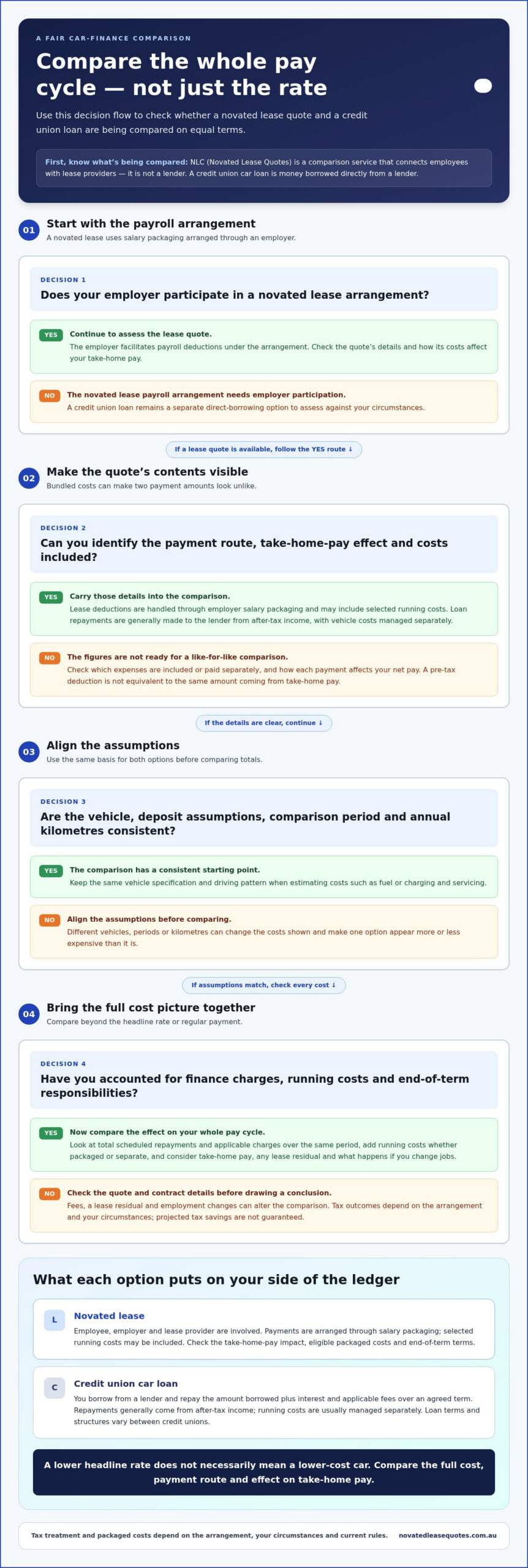
A practical checklist for comparing your two car-finance options
A like-for-like comparison starts with consistent inputs, then follows each option through your pay, running costs and end-of-term responsibilities. Use this checklist to keep assumptions visible and avoid mistaking a different payment structure for a lower overall cost.
- Choose the vehicle. Record the make, model, year and specification you’re considering, along with its purchase price. Use the same vehicle and price in both scenarios.
- Set shared assumptions. Keep the deposit, comparison period and expected annual kilometres consistent. Use the same estimates for fuel or charging, servicing, insurance and registration, and note which expenses are included in a lease package versus paid separately.
- Gather your personal and employer details. Record your salary information, whether your employer offers salary packaging, and the estimated vehicle expenses relevant to your driving. These inputs can affect a novated lease estimate and its tax treatment.
- Record the loan offer. Note the lender’s interest type, repayment schedule, loan term, applicable fees and any other conditions. Use the actual offer’s terms rather than an advertised rate alone.
- Calculate and document both outcomes. Compare the estimated effect on take-home pay, the total outlay over the chosen period, costs paid separately and any end-of-term obligations. Save the assumptions beside the results so you can see what each estimate includes.
What information should you gather before comparing?
Start with the vehicle price, intended term and annual kilometres. Then assemble the credit union’s loan terms, fees, interest structure and repayment schedule, alongside your salary details, employer packaging access and expected vehicle costs. For a lease estimate, identify which expenses are packaged and which remain outside it. Missing inputs can make two otherwise useful estimates difficult to compare.
How can you compare the results consistently?
Review the estimated take-home pay in each scenario, not just the repayment or salary deduction. Add expenses paid outside the arrangement to understand the broader outlay, and include end-of-term obligations in your notes. Label figures as estimates, record their assumptions and verify tax treatment against current ATO guidance. If a quote and loan calculation use different terms or kilometres, adjust the inputs before drawing a conclusion.
The result should be a clear, written comparison you can revisit, not a single winning number. In NLC vs a credit union car loan, individual circumstances and applicable rules can change the outcome, so keep the assumptions attached to every estimate.
To model the lease side using your own details, get a novated lease estimate and compare it with the loan figures you’ve gathered.
Get a novated lease quote and make your next step clearer
There isn’t a universal winner in NLC vs a credit union car loan. The better fit depends on your circumstances, the vehicle, total costs and how each option affects your pay and responsibilities. A personalised novated lease estimate gives you figures to assess beside your loan assumptions, rather than relying on a headline rate or a general claim about savings.
Novated Lease Quotes connects employees with novated lease providers and offers a calculator to model potential costs and tax savings. The calculator is a planning tool, not a guarantee: its estimates depend on your inputs, individual circumstances and applicable rules. Use the results to frame your comparison, then review the assumptions and terms attached to each quote.
What happens after you request a novated lease quote?
The platform connects interested employees with leasing specialists who can provide lease quotes for comparison. Use the quote details to see how the proposed arrangement treats finance and any packaged vehicle expenses. Compare those assumptions with your credit union loan figures, including costs you’ll pay separately, so the figures relate to the same vehicle and period.
As you review the information, record what each estimate includes, the assumptions used and any obligations at the end of the term. If a quote doesn’t make an item clear, mark it as an open question rather than assuming it’s included or excluded. This helps prevent an incomplete estimate from appearing to be the lower-cost option.
How can you decide with confidence?
Start with the priorities that matter to you. Do you value direct borrowing and a defined repayment schedule, or do payroll deductions and packaged vehicle expenses better suit how you manage your budget? Consider ownership, flexibility, employment arrangements and end-of-term responsibilities alongside the total estimated cost. The right choice should fit both your finances and the contract terms, not just appear attractive on a quote.
For a useful decision, line up comparable figures for the same vehicle, term and annual kilometres. Compare the estimated effect on take-home pay, expenses outside the arrangement and any final obligations. Consider tax estimates in light of your circumstances and current Australian rules, not as guaranteed savings. Keep the assumptions with your comparison so you can revisit them if your vehicle choice or circumstances change.
Use the comparison framework in this article to identify the figures to assess on the lease side alongside a credit union loan. Compare the same inputs, then judge each option against your priorities and the terms offered. A considered comparison is more useful than choosing on rate alone.
Ready to assess the lease side with your own details? Request a novated lease quote and compare the estimate with your loan assumptions.
Make your next car-finance decision with confidence
Before committing, treat your comparison as a decision checkpoint. Ask whether the figures still reflect the car you want, how you’ll use it and the responsibilities you’re comfortable taking on. In NLC vs a credit union car loan, a change to your assumptions can shift the result, so choose using estimates that reflect your circumstances rather than a general rule of thumb.
To assess the lease option, compare quotes from multiple providers through one platform and use the novated lease calculator to model potential costs and savings. These are estimates, not a promise of a particular outcome. Review the assumptions behind them and consider how applicable rules affect your situation before deciding.
Compare novated lease quotes for your circumstances and line up a personalised lease estimate with your loan assumptions. You’ll have a clearer basis for choosing the option that fits your plans and budget.
Frequently Asked Questions
Is a novated lease cheaper than a credit union car loan?
Not necessarily. In NLC vs a credit union car loan, the result depends on the vehicle, your salary, employer arrangements, loan terms and applicable tax treatment. Compare the same car over the same period, including finance charges, fees and running expenses, then assess the estimated effect on take-home pay. Treat quotes and calculator results as estimates based on their stated assumptions, not a promise that a lease will cost less.
Can I get a novated lease if my employer does not offer salary packaging?
Generally, a novated lease relies on your employer taking part in a salary-packaging arrangement. If that isn’t available, a conventional car loan may be more relevant to assess. Employer policies and eligibility conditions can differ, so establish what arrangement applies to your employment before relying on a lease estimate. Don’t assume participation is available, or that an estimate can be applied unchanged if your workplace arrangements differ.
What happens to a novated lease if I change jobs?
A job change can affect the payroll arrangements connected to your lease, but the outcome depends on your contract and any arrangements with a new employer. Don’t assume the lease automatically transfers, ends or continues on the same terms. Before changing roles, review the agreement for relevant conditions and possible costs, and consider how a change could affect your budget. The contract, not a general rule, determines the specific obligations.
Do I own the car with a novated lease?
A novated lease is a lease arrangement, so don’t assume you own the vehicle during the term or that ownership transfers automatically at the end. The agreement sets out the available end-of-term options and any obligations, which can differ between contracts. By comparison, a borrower financing a car with a loan is responsible for repaying that debt under the loan terms. Include the lease’s end-of-term requirements in your decision.
Can a credit union car loan be used for a new or used car?
Some credit unions offer loans for both new and used vehicles, but eligible cars and lending conditions vary by lender. For a used car, the vehicle’s age or condition may affect the terms available; security requirements, loan amounts and repayment conditions can also differ. Compare the specific offer for the car you intend to buy, rather than assuming a product advertised for one vehicle type applies to every purchase.
Does a novated lease quote include fuel and servicing?
It may include budgets for fuel and servicing, but inclusions and estimates vary between arrangements. Read the quote to identify which expenses are covered, how the budget is calculated and how any difference between the estimate and actual spending is handled. For example, if your driving changes and fuel use rises, the original budget may no longer reflect your costs. Compare excluded expenses with what you’d pay separately under a loan.


