
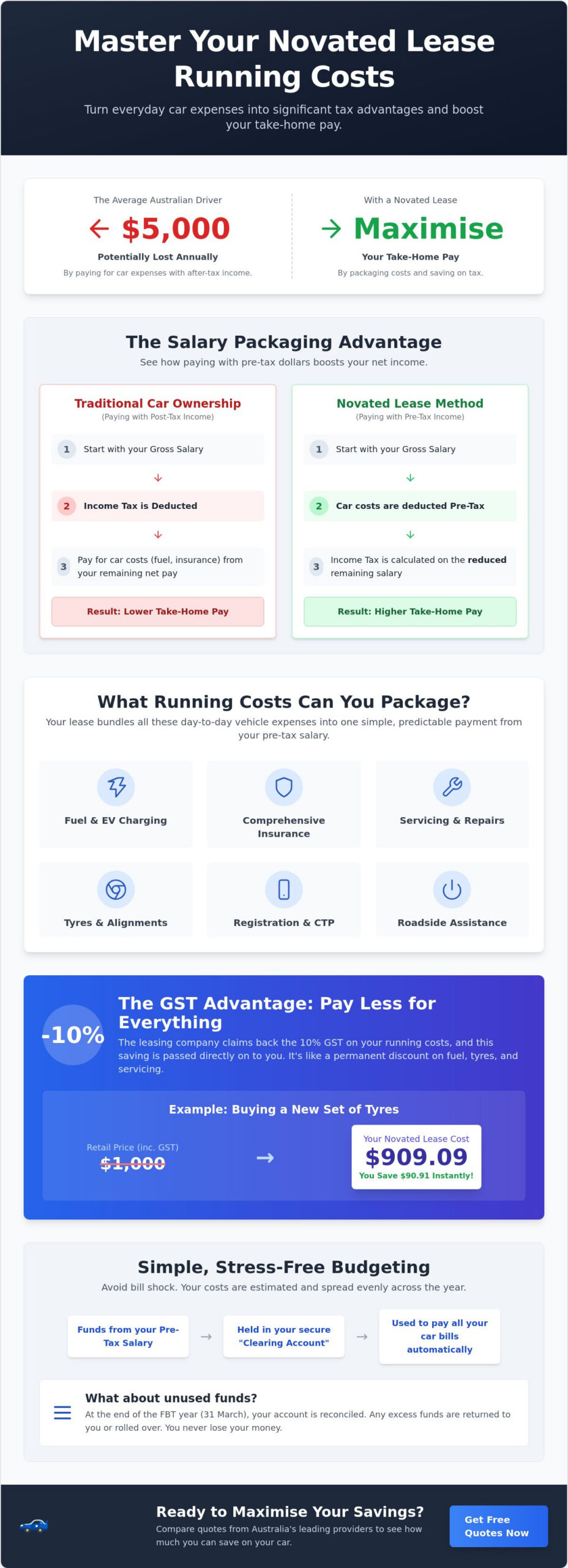
Did you know the average Australian could be losing up to $5,000 every year simply by paying for their car expenses with after-tax income?
It’s a common frustration for many professionals. You see your hard-earned salary disappear into petrol, insurance, and servicing, all while trying to decipher the complex world of pre-tax and post-tax deductions. You aren’t alone if you’re worried about over-budgeting for maintenance or feeling uncertain about how GST savings on tyres and fuel actually work.
This guide will show you how to master novated lease running costs to transform those everyday burdens into significant tax advantages. We’ll provide a clear list of packageable expenses and explain the mechanics of the GST Input Tax Credit benefit. By the end, you’ll have the confidence to build a realistic budget that maximises your take-home pay without the stress of hidden costs or excessive estimates.
Key Takeaways
- Understand the split between finance and operating expenses to gain full control over your monthly car budget.
- Learn how to claim back 10% GST on fuel, tyres, and servicing through the Input Tax Credit benefit.
- Identify exactly which ATO-approved expenses qualify as novated lease running costs to maximise your pre-tax salary savings.
- Clear up confusion regarding unspent funds and how the reconciliation process works at the end of the FBT year on 31 March.
- Discover how to compare provider quotes effectively by scrutinising management fees and budget estimates for the best financial outcome.
What are Novated Lease Running Costs?
Understanding What is a Novated Lease? is the best way to see how these arrangements differ from standard finance. Unlike a traditional car loan where you manage every bill as it arrives, novated lease running costs are the day-to-day operational expenses of your vehicle, all packaged into a single, predictable monthly payment. This bundle ensures your car stays on the road without you needing to manage multiple providers or payment dates.
Your lease is essentially split into two distinct parts. The finance component covers the vehicle’s purchase price, while the operating component covers its upkeep. It’s a comprehensive system designed to cover almost everything you need to keep the car running. Commonly packaged costs include:
- Fuel or electricity charging expenses
- Comprehensive car insurance premiums
- Scheduled servicing and mechanical repairs
- Annual registration and CTP insurance
- Replacement tyres and wheel alignments
- Roadside assistance memberships
These costs are estimated at the start of your lease based on your expected annual kilometres. If you plan to drive 15,000km a year, your provider calculates a tailored budget to cover that specific level of usage. This money is held in a “clearing account” managed by the lease provider. It acts like a dedicated savings pot for your car. When a bill arrives, such as a service invoice or a fuel charge, it’s paid directly from this account. You simply use a provided fuel card or submit a claim, and the provider handles the rest, ensuring you never have to dip into your personal savings for car maintenance.
For those planning frequent camping trips or remote exploration, engaging with a community like Adventurerz can help you better estimate the wear and tear associated with off-road travel, ensuring your lease budget remains accurate.
Pre-Tax vs Post-Tax: The Salary Packaging Advantage
Paying for petrol and registration with pre-tax dollars effectively lowers your taxable income. When you pay from your gross salary, you’re reducing the amount of income the ATO can tax. This significantly boosts your take-home pay compared to traditional car ownership where you pay for everything after tax. To manage Fringe Benefits Tax, providers usually use the Employee Contribution Method (ECM). This involves paying a portion of the novated lease running costs from your post-tax salary to offset the tax liability, which often results in a better financial outcome for most Australian taxpayers.
The “All-Inclusive” Convenience Factor
A novated lease helps you avoid “lumpy” annual bills that can wreck a monthly budget. Instead of finding $1,200 for registration or $800 for a major service in a single month, these costs are spread evenly across the year. It provides a psychological safety net. You won’t have to worry about finding the money for new tyres or an unexpected repair because the funds are already sitting in your clearing account. Running costs are a tax-effective budgeting tool for Australian professionals, and for those who also run a business, choosing a Good Budget Website ensures your online presence remains as cost-efficient as your vehicle expenses.
The GST Advantage: Why Running Costs Cost Less
The Input Tax Credit (ITC) mechanism is the engine room of lease savings. Most car owners don’t realise they’re paying a 10% premium on every litre of fuel and every service simply because they’re paying as individuals. Under a novated lease, your employer or the leasing company acts as a business entity that can claim back the GST on allowable running costs. This credit is passed directly to your lease account; effectively lowering the price of everything you buy for your car by 10% before you even consider the income tax benefits.
This makes a novated lease significantly more efficient than a standard car loan. With a loan, you’re paying the full retail price plus interest using your take-home pay. A novated lease bypasses the GST entirely on your operational budget. It is a structural advantage that turns the retail marketplace into a wholesale one for the driver. You can see the impact of these structural shifts by comparing novated lease quotes to see how they stack up against your current car expenses.
Calculating Your Novated Lease GST Savings
To understand the impact, look at a practical example. If you need a new set of tyres that retails for $1,000, a standard car owner pays the full $1,000 using after-tax dollars. In a lease package, that same set of tyres only costs your budget $909.09 because the GST is claimed back. You can learn more about these specific mechanics in our guide on Novated Lease GST Savings: How to Maximise Your Tax Benefits in 2026. Over a typical three-to-five-year lease term, these 10% savings on novated lease running costs like fuel, servicing, and parts can add up to thousands of dollars in retained wealth.
GST on the Purchase Price vs Running Costs
There is a distinction between the GST saved on the car’s purchase price and the GST saved on its upkeep. For the 2025/26 financial year, the maximum GST you can save on the purchase price is capped at $6,334. However, the GST savings on your ongoing novated lease running costs are generally uncapped. Whether it is a major mechanical repair or a weekly fuel stop, the 10% saving applies to almost all operating expenses. GST recovery is the “hidden discount” of the Australian novated leasing system. It ensures that every dollar you allocate toward your vehicle’s maintenance goes further than it ever could in a private ownership model.
What Expenses Can You Package in Your Lease?
Selecting which expenses to bundle is a critical step in tailoring your package. While most operational outgoings are eligible, the Australian Taxation Office guidelines on salary sacrificing dictate strict boundaries on what qualifies as a legitimate car-related expense. Your provider manages these payments through your clearing account, ensuring that novated lease running costs are paid on time without requiring you to manually track every invoice.
Accurate kilometre estimation is essential for a balanced budget. If you overestimate, you’ll have excess funds sitting idle. If you underestimate, you might face a shortfall. Most providers allow you to adjust your budget mid-lease if your driving habits change. However, some items remain strictly outside the packaging rules. You cannot package:
- Parking fines or speeding tickets
- Discretionary car washes or detailing (unless specified in the contract)
- Driver’s licence renewal fees
- Off-street parking or tolls (unless specifically allowed by your employer’s policy)
The Essential Five: Fuel, Tyres, Rego, Insurance, and Servicing
These five pillars form the core of most packages. Fuel is managed via a dedicated card, which automates tracking and ensures the 10% GST saving is applied instantly. Comprehensive insurance through a lease provider often includes “new for old” replacement terms that are more generous than standard retail policies. For tyres and servicing, you simply take the car to an authorised centre, and the provider pays the bill directly from your pre-tax funds. It’s a seamless process that removes the friction of car maintenance.
EV Running Costs: Charging vs Petrol
The rise of electric vehicles has shifted how we calculate novated lease running costs in 2026. Eligible EVs under the $91,387 Luxury Car Tax threshold for fuel-efficient vehicles remain exempt from Fringe Benefits Tax, making them exceptionally cost-effective. You can package home charging equipment, public charging network subscriptions, and even the electricity used for charging at home. Because EVs have fewer moving parts, your budget for mechanical servicing is typically much lower than a petrol equivalent, allowing more of your salary to stay in your pocket.
Roadside Assistance and Membership Fees
Many drivers don’t realise that professional memberships like the NRMA, RACV, or RACQ can often be included in the lease. Bundling these memberships ensures you have 24/7 protection without needing to manage separate annual renewals. Including roadside assistance or an extended warranty in the total cost provides an extra layer of financial security, protecting you from the “lumpy” expenses that often disrupt personal savings.
Managing Your Budget: What Happens to Unused Funds?
A common misconception among Australian employees is that lease providers pocket any unspent budget at the end of the year. This is simply not true. The funds held in your clearing account belong to you; the provider merely acts as a custodian to ensure your bills are paid on time. Transparency is a hallmark of a professional leasing arrangement, and you should always have clear visibility of your account balance.
The reconciliation process is the formal check-and-balance that occurs annually. Every year on 31 March, the Fringe Benefits Tax (FBT) year concludes, and providers review your account. They compare the total amount deducted from your salary against the actual novated lease running costs incurred during those twelve months. If your account is in surplus because you drove fewer kilometres than expected, those funds simply roll over into the next period to continue covering your expenses.
Flexibility is built into these agreements to account for life changes. If you start a new job with a longer commute or decide to take a road trip, your initial budget might no longer be accurate. You can adjust your deductions mid-lease to reflect your actual usage. This proactive management prevents you from building an excessive surplus or, conversely, falling into a deficit that requires a lump-sum payment later. To see how these budgets are structured for different driving profiles, you can compare novated lease quotes to model your potential spending.
The End-of-Lease Reconciliation
When the lease finally terminates or you decide to sell the vehicle, any surplus funds remaining in your clearing account must be accounted for. These funds are returned to your employer, who then pays them out to you through the payroll system. Understand the tax implications here. Because these funds were originally contributed from your pre-tax salary, they’re treated as assessable income when returned. You’ll pay your marginal tax rate on this amount. While some drivers aim for a zero balance, having a slight surplus is generally better than a deficit. It provides a financial buffer for those final expenses, such as a roadworthy certificate or a final detail before sale.
Monitoring Your Spending via Online Portals
Modern lease management has moved away from paper statements toward real-time digital tracking. Providers offer online portals or mobile apps that give you an instant snapshot of your financial position. These platforms allow you to track fuel consumption, monitor insurance renewals, and see exactly how much is left in your maintenance pot. If you ever need to pay for an emergency repair out-of-pocket, these apps usually feature a simple upload tool for manual claims. This ensures you’re reimbursed quickly from your pre-tax funds. Review your budget quarterly to avoid FBT surprises.
How to Compare Quotes for the Best Running Cost Outcomes
When you receive multiple quotes for the same vehicle, you’ll often notice that the estimated monthly deductions vary significantly. This discrepancy usually isn’t due to the car’s price, but rather the assumptions made about novated lease running costs. One provider might estimate your fuel spend based on a conservative price per litre, while another might use an aggressive, lower figure to make their quote appear more attractive on paper. It is essential to look past the “estimated saving” and examine the data driving those numbers. Our guide on how to compare novated lease quotes explains exactly which line items to scrutinise so you can identify the deal that genuinely maximises your tax savings.
A true comparison requires looking at the Total Cost of Ownership (TCO). This includes the interest rate, the purchase price, and the ongoing management fees. While interest rates in 2026 typically start around 7.00% p.a. for petrol vehicles, the management fees for administering your package can vary between providers. These fees cover the cost of maintaining your clearing account, providing fuel cards, and managing the GST reconciliation. Our comparison service helps you filter through these variables, ensuring you’re comparing “apples with apples” rather than just looking at the lowest monthly payment.
Identifying Hidden Fees in Running Cost Estimates
Scrutinise the fine print for brokerage fees, procurement fees, and monthly admin charges. Some providers “lowball” the novated lease running costs by underestimating tyre wear or servicing requirements, which can lead to a budget deficit later in the lease. You can learn more about these tactics in our detailed guide on Mastering Novated Lease Quotes: Your 2026 Guide to Comparing Salary Packaging. Choosing a provider that offers realistic, transparent budgets is always better than one that promises unrealistic monthly savings through under-budgeting.
Conclusion: Taking the Next Step with Confidence
Mastering your running costs is the key to unlocking the full potential of salary packaging. By bundling your fuel, insurance, and maintenance into a single pre-tax payment, you benefit from immediate 10% GST savings and a reduced taxable income. This structural advantage turns a standard car into a powerful tax-deduction vehicle. Whether you are looking at a petrol SUV or a high-performance EV, the goal is to ensure your budget is tailored to your specific driving profile rather than a generic template. Get a tailored quote and compare the best novated lease providers today.
Take Control of Your Car Expenses Today
Mastering novated lease running costs is one of the most effective ways to optimise your personal finances and increase your take-home pay. By shifting your vehicle upkeep from after-tax spending to a structured pre-tax arrangement, you instantly benefit from a 10% GST discount on fuel, tyres, and servicing. This structural shift ensures that every dollar you earn goes further while providing the convenience of a single, predictable monthly payment.
You now have the tools to scrutinise provider quotes and understand the long-term value of the Input Tax Credit mechanism. Whether you’re considering a fuel-efficient petrol car or a tax-exempt EV, the potential savings are significant. Our independent comparison service helps you filter through management fees and access quotes from Australia’s leading leasing specialists. You can also use our Novated Lease Calculator for precise GST-inclusive modelling tailored to your specific driving habits.
Stop overpaying for your daily drive and start benefiting from a smarter way to manage car ownership. Compare Novated Lease Quotes and Save on Running Costs to discover your potential savings today. Taking the next step is simple, and the financial rewards are waiting for you.
Frequently Asked Questions
Do I lose my unspent running cost money at the end of the lease?
No, you do not lose any surplus funds remaining in your clearing account when the lease ends. Any remaining balance is returned to your employer, who then pays it to you through payroll. Because these funds were originally deducted from your pre-tax salary, they are treated as assessable income and taxed at your marginal rate upon return.
Is insurance included in novated lease running costs?
Yes, comprehensive car insurance is a standard component of novated lease running costs. You can choose to use the provider’s preferred insurer or select your own through an insurance broker like allcover.au. Packaging your premiums allows you to pay with pre-tax dollars and claim back the 10% GST, which significantly reduces the effective cost compared to paying for insurance privately.
Can I package running costs for a used car on a novated lease?
You can certainly package the expenses for a used vehicle. This is typically achieved through a “sale and leaseback” arrangement for a car you already own or by leasing a used vehicle from a licensed motor dealer. The tax benefits and GST savings on running costs remain the same regardless of whether the car is new or used.
How are fuel costs calculated if I do not have a fuel card?
If you choose not to use a fuel card, you can manage your fuel budget through a reimbursement process. You pay for your fuel out of pocket at the service station and then submit the tax invoice to your leasing provider. They will then reimburse the full amount from your pre-tax clearing account, ensuring you still receive the income tax and GST benefits.
What happens to my running cost budget if I change jobs?
Your novated lease is fully portable between employers. If you change jobs, your new employer simply needs to sign a new novated agreement to continue the salary deductions. If your new employer doesn’t offer salary packaging, the lease reverts to a standard finance arrangement, and you will lose the ability to pay for novated lease running costs with pre-tax dollars.
Are electric vehicle charging costs packageable in a novated lease?
Yes, electric vehicle charging is a fully packageable expense. This includes subscriptions to public charging networks and the electricity used for charging at home. For the 2025/26 financial year, eligible EVs under the $91,387 threshold also benefit from an FBT exemption, which makes packaging these charging costs even more tax-effective for Australian drivers.
Can I include my existing car’s running costs in a new lease agreement?
You can include your current car’s expenses by entering into a sale and leaseback agreement. The leasing company buys the vehicle from you at its current market value and leases it back to you. This allows you to start packaging your registration, insurance, and fuel immediately, even if you’ve owned the car for several years.
Do novated lease running costs cover major repairs or just routine servicing?
The budget covers all legitimate maintenance required to keep your vehicle in a safe and roadworthy condition. This includes routine logbook servicing as well as major repairs like brake replacements, transmission work, or exhaust repairs. As long as the funds are available in your clearing account, the provider will pay the invoice directly using your pre-tax contributions.