
Most Australian employees view a novated lease as a simple car loan, but this misunderstanding is exactly why so many miss out on thousands in potential savings. A novated lease is actually a sophisticated tax strategy, and failing to treat it as such is the root cause of almost every common error. It’s easy to feel overwhelmed by the complexity of FBT calculations or anxious about what happens if you decide to change jobs. You shouldn’t have to guess whether hidden fees are eroding your benefit or if you’re making common novated lease mistakes to avoid that could cost you at tax time.
We’ve designed this guide to help you steer clear of costly salary packaging pitfalls and maximise your tax savings with our expert-led checklist. You’ll gain a clear framework for evaluating quotes and the confidence that you’ve truly optimised your take-home pay. This 2026 update identifies critical traps, from miscalculating mandatory residual values to ignoring the fact that PHEVs are no longer FBT exempt. We’ll walk through the current ATO thresholds and compliance rules so you can secure a lease that works for your bottom line.
Key Takeaways
- Understand why treating a lease like a standard car loan can hide the true cost of your finance and erode your potential tax benefits.
- Identify and bypass common novated lease mistakes to avoid, such as overestimating your annual kilometres and leaving “lazy” money in your packaging account.
- Capitalise on the 2026 EV FBT exemption to potentially save thousands compared to the costs of running a traditional internal combustion engine vehicle.
- Discover how to compare quotes effectively to uncover hidden procurement fees that some providers bake into the vehicle’s purchase price.
- Prepare for the future with a clear checklist that covers career changes and redundancy to ensure you aren’t left with an unexpected financial burden.
Why Treating a Novated Lease Like a Standard Car Loan is Your First Mistake
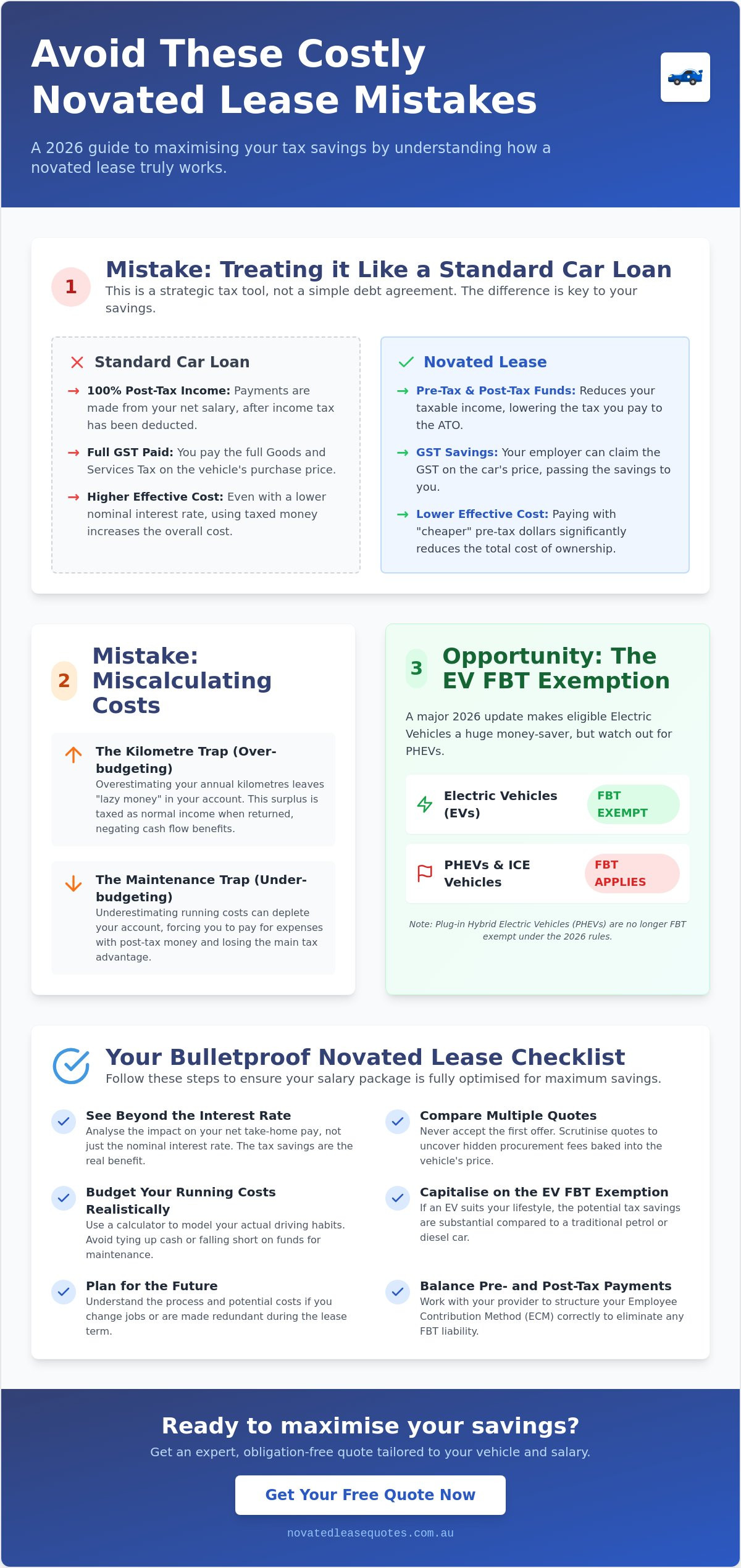
Many Australians approach a novated lease as if it were a standard car loan with a different name. This is the first of several critical novated lease mistakes to avoid. While a typical car loan is a simple debt agreement where you use your take-home pay to cover monthly instalments, a novated lease is a strategic tax tool. It involves a three-way agreement between you, your employer, and the finance provider. For a comprehensive overview of novated leases, it helps to view the arrangement as a way to restructure your total remuneration package rather than just a way to buy a vehicle.
The fundamental difference lies in the source of the funds. A standard car loan uses 100% post-tax income. In contrast, a novated lease uses a combination of pre-tax and post-tax salary. This structure reduces your taxable income, meaning you pay less income tax to the ATO while simultaneously funding your vehicle and its running costs. If you focus only on the monthly payment figure, you’ll miss the broader financial picture. You must look at how the lease affects your net take-home pay to understand its true value.
Ignoring the GST credit is another common oversight. When you take out a standard loan, you pay the full GST on the purchase price of the car. With a novated lease, your employer can generally claim the GST back on the vehicle’s purchase price (up to the luxury car limit) and pass that saving on to you. This immediately reduces the amount you need to finance, a benefit that no standard car loan can match.
The Trap of the Nominal Interest Rate
In the world of salary packaging, the “sticker price” interest rate can be deceiving. Many employees reject a lease because the nominal interest rate appears higher than a bank’s car loan rate. This is a mistake because it ignores the tax offsets. Compare the pair: a standard car loan at 5% interest uses money that has already been taxed at your top marginal rate, while a 7% novated lease uses pre-tax funds that effectively lower your taxable income. Because you’re paying with “pre-tax dollars,” the effective interest rate of the lease is often significantly lower than the loan. Always evaluate the total cost of ownership over the entire term rather than just the interest percentage.
Understanding Pre-Tax vs. Post-Tax Deductions
To maximise your savings, you need to understand how deductions are structured. Most leases use the Employee Contribution Method (ECM) to manage Fringe Benefits Tax (FBT). By paying a portion of the lease costs from your post-tax salary, you can often reduce the FBT liability to “nil.” Salary sacrifice is the process of diverting a portion of your gross income to pay for a benefit before tax is applied. Failing to balance these pre-tax and post-tax contributions correctly is one of the most common novated lease mistakes to avoid, as it can result in an unexpected tax bill at the end of the financial year.
Miscalculating Running Costs and Residual Values
Accuracy in your initial budget is the difference between a successful salary package and a financial headache. Many drivers fall into the habit of “setting and forgetting” their running costs, but this is one of the most frequent novated lease mistakes to avoid. Your lease budget covers everything from fuel and electricity to tyres and registration. If these figures are poorly estimated, you either tie up too much of your salary or find yourself paying for car expenses out of your own pocket with post-tax dollars.
The “Kilometre Trap” is a subtle but common issue. Many providers default your quote to 15,000 or 20,000 kilometres per year to ensure the account stays in credit. If you only drive 10,000 kilometres, you end up with “lazy money” sitting in your provider’s account. While this surplus is eventually returned to you, it’s taxed as normal income upon payout, meaning you’ve lost the immediate cash flow benefit. It’s highly effective to use a novated lease calculator to model how different driving distances impact your fortnightly take-home pay before you commit to a budget.
On the other hand, underestimating maintenance is equally risky. If you choose a premium European vehicle but set a budget designed for a budget hatchback, a single major service could wipe out your account balance. When your lease account hits zero, you lose the ability to pay for expenses using pre-tax funds. This negates the primary tax-saving advantage of the arrangement. Getting this balance right helps you sidestep common novated lease mistakes that often reduce the true net benefit of salary packaging.
The Danger of Overestimating Annual Kilometres
While there is no formal penalty for driving less than your contracted amount, over-budgeting is an inefficient use of your salary. This money could be better spent on your mortgage or daily living expenses rather than sitting idle in a lease account. We recommend checking your odometer against your contract every six months. If you are significantly behind your target, you can usually contact your provider to adjust your future deductions. This proactive approach ensures your tax savings are realised in every pay cycle rather than being locked away until the end of the term.
Ignoring the Impact of the Residual Value
The residual value, or balloon payment, is a mandatory requirement set by the ATO. It isn’t a fee invented by the leasing company. For a five-year lease, the minimum residual value is strictly 28.13% of the purchase price, while a three-year lease sits at 46.88%. Failing to plan for this end-of-lease requirement is a significant oversight. You essentially have three choices at the end of the term: pay the balloon to own the car, sell the vehicle to cover the payment (and keep any profit), or refinance the residual into a new lease. Before signing your contract, it’s worth getting a few novated lease quotes to see how different providers structure their running cost estimates and residual projections.
Missing Out on the Electric Vehicle (EV) FBT Exemption
The Australian Government’s Electric Car Discount has fundamentally changed the financial landscape for local drivers. It is the single biggest incentive in Australian automotive history, yet many employees still overlook its impact. One of the most significant novated lease mistakes to avoid in 2026 is defaulting to a petrol or diesel vehicle without modelling an electric equivalent. For eligible vehicles, the FBT exemption can save you up to $11,000 per year in tax. This isn’t just a minor perk; it’s a structural advantage that makes a premium EV more affordable than a mid-range petrol SUV.
Navigating these rules requires precision. For the 2026-27 financial year, the Luxury Car Tax (LCT) threshold for fuel-efficient vehicles is $91,661. If your chosen EV stays under this limit, it is exempt from Fringe Benefits Tax. This means the entire lease payment, including running costs, can be paid using 100% pre-tax salary. Given the complexity of these regulations, it is highly beneficial to focus on finding a novated lease specialist who understands the nuances of current EV legislation and can ensure your contract is fully compliant.
Failing to Model the Savings on an Eligible EV
The gap in take-home pay between a petrol vehicle and an EV is often startling. Consider a $70,000 petrol SUV compared to a $70,000 electric vehicle. Because the petrol car is subject to FBT, you must use the Employee Contribution Method (ECM) with post-tax dollars to offset the tax, which reduces your disposable income. The EV, being exempt, allows you to keep hundreds of extra dollars in your pocket every month. It is also vital to recognise that as of April 1, 2025, Plug-in Hybrid Electric Vehicles (PHEVs) are no longer eligible for this exemption. If you are reading older guides, you might mistakenly believe a PHEV still offers the same tax breaks as a full EV.
Overlooking Charging Infrastructure in the Package
A common oversight is failing to include home charging infrastructure in the lease agreement. You can often package the cost of a home charger installation into your salary sacrifice arrangement, allowing you to pay for it with pre-tax income. Charging costs themselves can also be packaged just like fuel. We suggest checking your employer’s specific policy on charging reimbursements early in the process. Some organisations require specific data from smart chargers to verify electricity usage, so setting this up correctly from day one prevents out-of-pocket expenses later. Missing these details is one of the novated lease mistakes to avoid if you want to truly minimise your cost of ownership.
Procurement Pitfalls: Accepting the First Quote Without Comparison
Accepting the first quote you receive is a shortcut that often leads to thousands of dollars in unnecessary expenses. Many Australian employees assume that because their employer has a “preferred provider,” the deal is pre-vetted for value. This passivity is one of the most frequent novated lease mistakes to avoid. The reality is that preferred provider arrangements are often established for administrative ease rather than financial competitiveness. If you don’t look beyond the initial offer, you have no way of knowing if the interest rate is inflated or if the vehicle price includes hidden margins. Understanding how to identify the best novated lease Australia has to offer requires a structured approach to comparing providers on a true apples-for-apples basis.
The fine print is where many providers hide their profit. Beyond the interest rate, you must scrutinise the “Doc Fee,” “Origination Fee,” or “Establishment Fee.” Some providers charge upwards of $800 just to set up the paperwork, while others keep these costs transparent and minimal. If these fees aren’t clearly itemised, they are likely being bundled into the total amount financed. This means you’ll pay interest on the fees themselves for the next several years. Transparency is the hallmark of a good provider. A thorough novated lease comparison strips back the marketing fluff to reveal the real interest rates and administration fees buried in the fine print, giving you the transparency you need to make a confident decision.
Accepting the “Default” Provider Without Question
You aren’t always locked into your employer’s sole provider. While some large corporations have strict policies, many smaller and mid-sized businesses allow employees to bring their own quotes. If your HR department suggests a default partner, ask if they are open to an external comparison. A difference of just 1% or 2% in the interest rate might seem minor, but over a five-year term, it can add significant costs to your total package. Use our guide to novated lease quotes to understand exactly how to benchmark these offers against the market.
The Hidden Cost of Fleet Discounts
One of the main selling points of a lease is the “fleet discount” on the vehicle’s purchase price. However, a common mistake is failing to verify that the full discount is being passed on to you. Some providers negotiate a deep discount with the dealership but only disclose a portion of it to the employee, pocketing the difference as a “brokerage fee.” Always ask for a line-by-line breakdown of the vehicle purchase price versus the Recommended Retail Price (RRP). If the provider is evasive about their procurement margin, it is a clear sign to look elsewhere. You deserve to see the exact price paid for the car before any packaging magic happens.
Taking the time to compare ensures you aren’t subsidising a provider’s bottom line at the expense of your own tax savings. To see how your current offer stacks up against the market, you can request a novated lease quote comparison to ensure you’re getting a fair deal.
The Final Checklist: Ensuring Your Salary Package is Bulletproof
Before you put pen to paper on the deed of novation, you need to verify that the theoretical savings on your screen match the reality of your bank account. The paperwork can be dense, and it’s easy to overlook a single line item that could negate your tax benefits. This final stage is about moving from the research phase to execution with total clarity. You’ve already looked at the tax structure and procurement fees, but the final hurdle is ensuring the agreement remains flexible enough to suit your life over the next several years. Passing the “Transparency Test” means you can see every cent of the management fee and understand exactly how your provider is being compensated for their service.
Career Continuity and Portability
Career path planning is a frequently ignored component of salary packaging. One of the most significant novated lease mistakes to avoid is signing a long-term, five-year contract when you only plan to stay with your current employer for another year or two. If you change jobs, the lease doesn’t simply disappear. It becomes a personal obligation until your new employer agrees to take over the payments, a process known as re-novation. Ensure your contract includes clear lease portability clauses. This gives you the flexibility to move your car and its tax benefits to a new company without being forced to pay out the lease or suffer heavy early termination penalties. If you are facing redundancy, you’ll generally be responsible for the lease payments from your post-tax income until you find new employment, so having a small emergency fund is a smart safeguard.
The 5-Minute Pre-Sign Checklist
Use this final checklist to ensure your package is robust and compliant before you commit. If your provider cannot answer these questions clearly, it is a sign that you should seek a second opinion.
- Check 1: GST Credit Application. Confirm that the GST credit on the vehicle’s purchase price has been fully applied to reduce your amount financed. For most vehicles under the luxury car limit, this should be a 1/11th saving on the price.
- Check 2: Budget Alignment. Does the running cost budget actually match your commute? If you’ve switched to a hybrid working model and drive less than 10,000 kilometres a year, ensure your fuel and maintenance budgets aren’t still set for a 20,000-kilometre lifestyle.
- Check 3: ATO Residual Compliance. Verify that the residual value is compliant with ATO minimums. For 2026, these are strictly set at 65.63% for a one-year lease, 46.88% for three years, and 28.13% for five years. Anything lower could trigger an ATO audit.
- Check 4: The Comparison Rule. Have you compared at least three novated lease quotes? Comparing multiple offers is the only way to ensure the interest rate and management fees are truly competitive.
A novated lease is a powerful tool for increasing your take-home pay, but it requires active management. By following this checklist, you ensure your salary package is built on facts rather than provider assumptions. If you’re still unsure about the fine print in your current offer, taking the time to get a professional comparison can provide the peace of mind you need to sign with confidence.
Secure Your Financial Advantage in 2026
A novated lease remains one of the most effective ways for Australian employees to optimise their take-home pay, provided you treat it as a tax strategy rather than a simple car loan. By accurately forecasting your kilometres and ensuring you don’t over-budget for running costs, you keep more cash in your pocket every fortnight. The 2026 landscape offers unprecedented savings for those choosing electric vehicles, but these benefits require precise compliance with ATO thresholds and FBT legislation. Shifting from a passive approach to a proactive, data-driven comparison is the best way to bypass common novated lease mistakes to avoid.
Don’t settle for the first quote provided by your employer’s preferred partner. Our independent comparison service gives you access to Australia’s leading leasing specialists and expert guidance on 2026 EV tax benefits. Get a competitive novated lease quote and compare the market today to ensure your salary package is truly bulletproof. Taking ten minutes to review your options now can save you thousands over the life of your lease. You’ve done the research; now it’s time to secure the savings you deserve.
Frequently Asked Questions
Is a novated lease worth it if I don’t drive many kilometres?
Yes, a novated lease is often still highly beneficial even for low-kilometre drivers. Since the ATO removed the requirement to drive high distances to claim maximum benefits, the savings are now calculated on actual costs. You still benefit from the GST credit on the purchase price and the ability to pay for fixed expenses like registration and insurance with pre-tax income. The total tax offset usually outweighs the costs for most professional employees.
Can I include a used car in a novated lease to avoid high depreciation?
You can certainly lease a used vehicle, provided it meets the age and condition requirements set by the financier. This is a pragmatic way to avoid the initial depreciation hit of a new car. Most providers require the vehicle to be no more than 10 or 12 years old at the end of the lease term. You’ll still receive the tax benefits on running costs, though the GST credit on the purchase price may differ if buying from a private seller.
What happens to my novated lease if I lose my job unexpectedly?
The lease agreement reverts to a standard finance contract, and the “novation” component ends immediately. You become responsible for the full monthly payments from your post-tax income until you secure new employment. This is one of the critical novated lease mistakes to avoid, so it’s vital to ensure your lease is portable. Most new employers will agree to take over the novation once you start, allowing you to resume the tax-effective deductions.
How does the EV FBT exemption change the maths for a novated lease in 2026?
The exemption is a game-changer because it removes the need for post-tax contributions to offset Fringe Benefits Tax. For eligible EVs under the $91,661 luxury car threshold, you can fund the entire lease and all running costs from your gross salary. In 2026, this makes an electric vehicle significantly more affordable on a fortnightly basis than a petrol car of the same value. It effectively maximises your take-home pay by reducing your taxable income to the lowest possible level.
Can I pay off my novated lease early to save on interest?
You can pay out the lease early, but you should request a formal payout figure first. These are typically fixed-term contracts, so the interest savings might be lower than you expect after the provider applies termination fees. Ending a lease early also stops your tax-saving deductions, which could leave you financially worse off. It’s often better to wait until the end of the term and pay out the residual value then.
Do I have to use the insurance provider recommended by the leasing company?
No, you’re free to choose your own comprehensive insurance provider. While leasing companies offer packaged insurance for convenience, shopping around can often secure a more competitive premium or better coverage. If you choose an external insurer, you simply provide the certificate of currency to your lease manager. They will then arrange for the premiums to be paid from your packaging account using your pre-tax funds.
What are the most common hidden costs in a novated lease contract?
Inflated establishment fees and undisclosed brokerage margins on the car’s price are the most common hidden costs. Some providers also bundle high-margin “add-on” products like window tinting or interior protection into the total amount financed. Identifying these novated lease mistakes to avoid requires a line-by-line review of your quote. Always check that the fleet discount has been fully passed on to you and that every fee is clearly itemised.
Is the residual value (balloon payment) negotiable at the end of the term?
The residual value is not negotiable because it is a mandatory minimum set by the ATO. For a three-year lease, the residual must be 46.88% of the purchase price, while a five-year term is set at 28.13%. While the figure is fixed, your options at the end of the term are flexible. You can pay the amount to own the car, sell the vehicle and keep any profit above the residual, or refinance the balance into a new lease.


