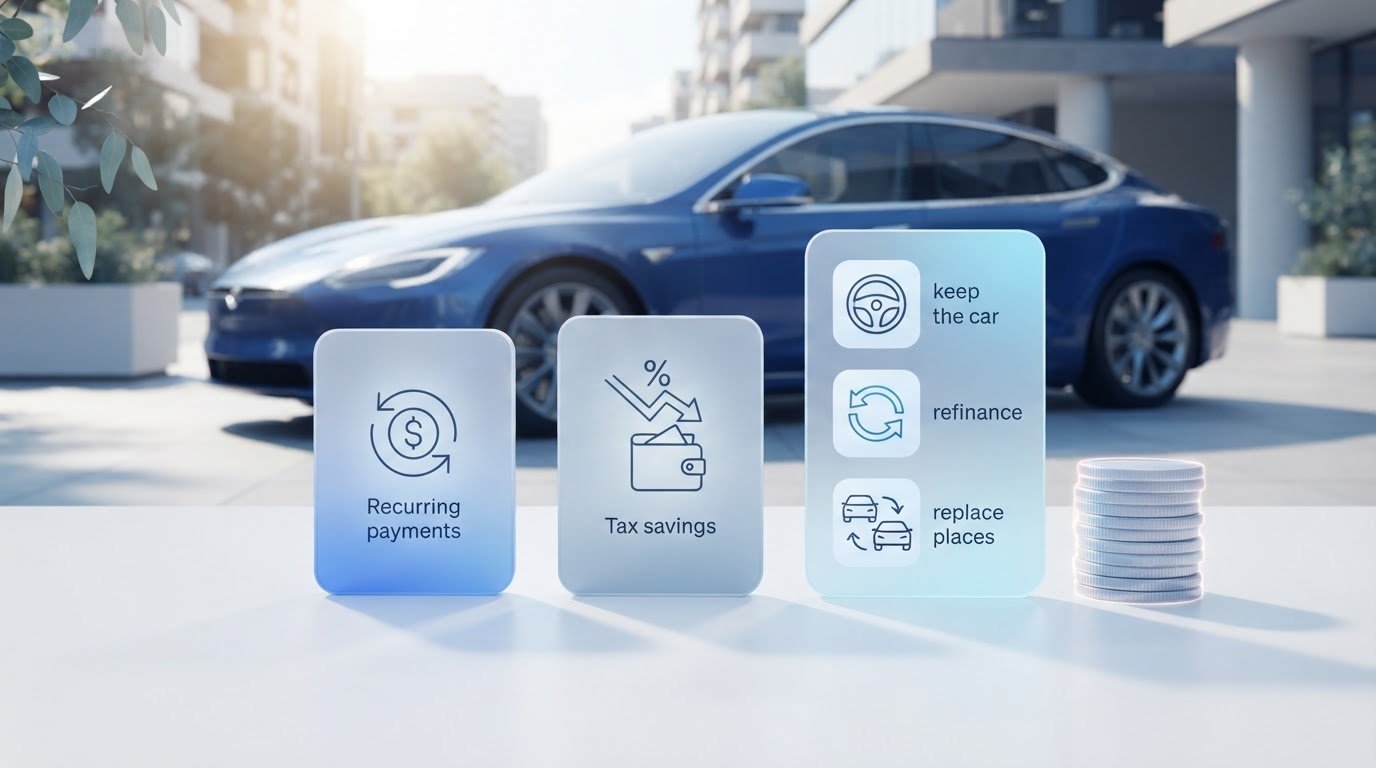
The lowest salary deduction isn’t automatically the best-value novated lease. A LeasePlan novated lease review should weigh fees, tax treatment, the residual and what happens if you change jobs, not just the amount taken from each pay. For a one-year car lease, the ATO minimum residual is 65.63% of the vehicle’s original value.
It’s sensible to want a clear estimate of your take-home pay and the car’s likely cost over the full lease term. The tax benefit depends on the package and your circumstances, and you’ll need to plan for the residual at the end. If you leave your employer, you remain responsible for the lease unless it can transfer to another participating employer.
This guide explains how to compare fees and salary deductions, understand tax treatment and residuals, and assess your options at lease end. It also covers how a job change can affect the arrangement, helping you judge whether the figures and terms fit your plans.
Key Takeaways
- Use the lease term and vehicle value to assess the residual: the ATO minimum for a car after a one-year lease is 65.63% of its original value.
- Plan for the lease-end choice early: you may pay the residual and keep the car, refinance subject to finance approval, or replace the vehicle.
- Understand how fringe benefits tax and post-tax contributions affect the package, especially if you’re considering an eligible electric vehicle.
- Compare salary deductions with your taxable income and running costs to see how pre-tax packaging could affect the overall cost.
- Include fees, residuals and what happens if you change jobs when weighing personalised lease estimates, not just the regular deduction.
Lease residuals and end-of-term options
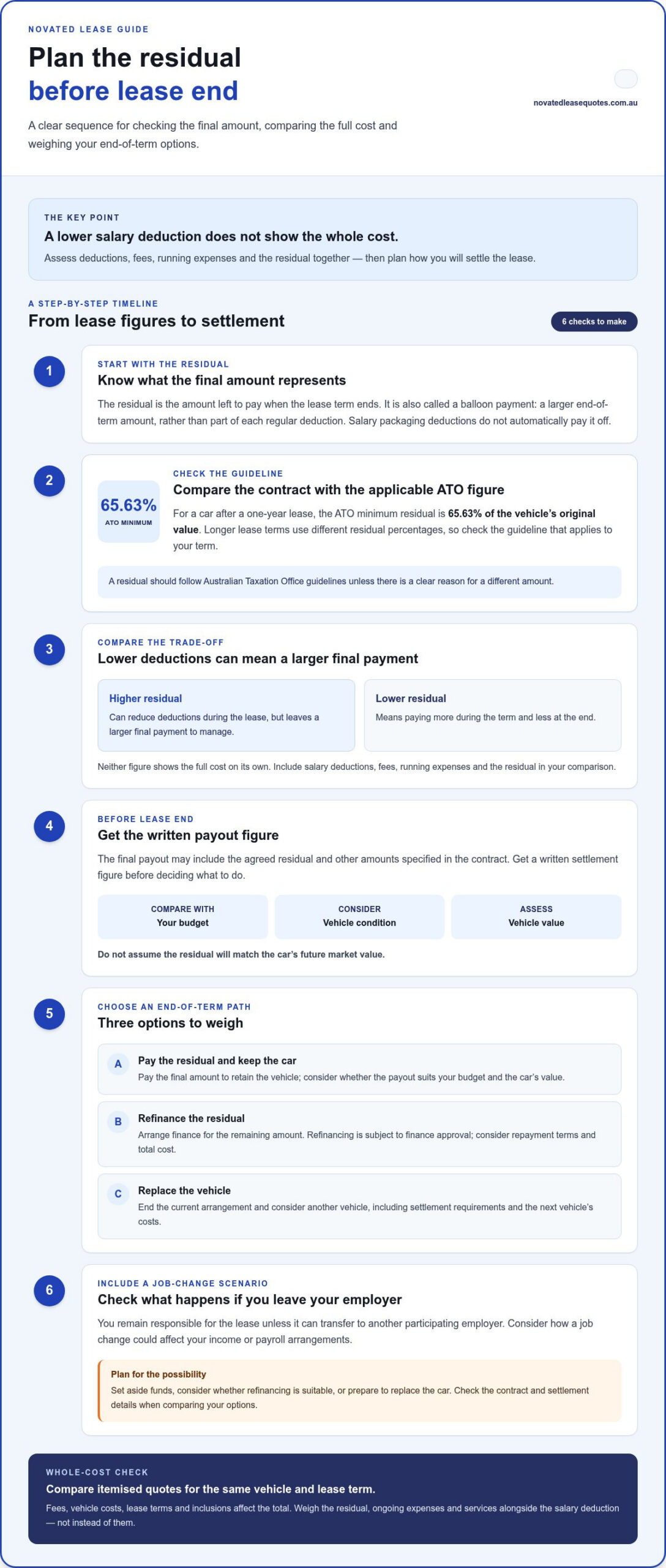
A residual is the amount left to pay when the lease term ends. It affects both the regular salary deductions and the decision you’ll face at the end. According to the ATO, the minimum residual value for a car after a one-year lease is 65.63% of its original value. Longer lease terms use different residual percentages, so compare the figure in your contract with the applicable ATO guideline.
A residual should follow Australian Taxation Office guidelines unless there is a clear reason for a different amount. A higher residual can reduce deductions during the lease, but leaves a larger final payment to manage. A lower residual means paying more during the term and less at the end. Neither figure shows the full cost on its own: compare deductions, fees, running expenses and the residual together.
The final payout is the amount you need to settle the lease at its end. It may include the agreed residual and other amounts specified in the contract. Get a written payout figure before deciding what to do. Compare it with your budget and the vehicle’s condition and value, rather than assuming the residual will match the car’s future market value.
A residual is also called a balloon payment because it is a larger amount due at the end, rather than part of each regular deduction. It isn’t automatically paid off through the salary packaging deductions. Plan for it from the start of the lease term: set aside funds, consider whether refinancing is suitable, or prepare to replace the car. Refinancing depends on finance approval.
At the end of an Australian novated lease, you may pay the residual and keep the car, refinance it subject to finance approval, or replace the vehicle. If you leave your employer during the term, responsibility usually returns to you unless the arrangement transfers to another participating employer. Include that possibility in your decision, especially if a job change could affect your income or payroll arrangements.
| End-of-term option | Payment approach | Key consideration |
|---|---|---|
| Pay residual and keep the car | Pay the final amount to retain the vehicle | Whether the payout suits your budget and the car’s value |
| Refinance the residual | Arrange finance for the remaining amount | Approval, repayment terms and total cost |
| Replace the vehicle | End the current arrangement and consider another vehicle | Settlement requirements and the next vehicle’s costs |
Choose by comparing the written settlement amount, your future transport needs and the funds available, not simply the size of the final payment.
Residuals also sit within the broader tax picture. Fringe benefits are taxed at 47% of their value, while the lease’s FBT treatment and any post-tax contributions affect the package calculations. Don’t treat the residual itself as a tax saving. Review the lease figures and FBT treatment together, so a lower deduction doesn’t distract from the final payout or overall expenses.
How does LeasePlan compare with other Australian novated lease providers on price and service? No single price comparison covers every arrangement, because fees, vehicle costs, lease terms and inclusions affect the total. Compare itemised quotes for the same vehicle and lease term, then weigh the residual, ongoing expenses and services alongside the salary deduction.
A LeasePlan novated lease review is most useful when it examines the full agreement, not just the headline deduction. Check the residual, final payout process and what happens if your employment changes. A clear comparison helps you assess whether the arrangement fits your budget throughout the lease and at settlement.
Fringe benefits tax and post-tax contributions
Fringe benefits tax (FBT) affects how a novated lease accounts for private vehicle use. In Australia, the employer is responsible for the FBT liability, though its cost is commonly accounted for in the employee’s salary package. The distinction matters: the employer has the liability, while package calculations can affect the employee’s take-home pay.
Fringe benefits are taxed at 47% of their value. This is not a flat charge on every lease payment. The FBT amount depends on the vehicle benefit and the method used to calculate the liability. A useful LeasePlan novated lease review therefore separates the vehicle’s FBT treatment from finance repayments, running expenses and any post-tax contribution. Look at how each component affects the package rather than treating the headline deduction as the full cost.
Post-tax contributions can be used to account for FBT within a package. They come from take-home pay, unlike pre-tax deductions, which are taken from salary before income tax is calculated. Compare the stated post-tax contribution with the pre-tax deduction and the package’s FBT calculation. This shows how each part affects your pay and whether the estimate reflects the vehicle’s tax treatment.
For eligible battery-electric and hydrogen fuel-cell vehicles, the current electric car discount may exempt the vehicle and associated car expenses from FBT. Eligibility matters, so identify the vehicle type and whether the package’s calculations apply the exemption. Plug-in hybrid electric vehicles ceased to be eligible for the FBT exemption after April 1, 2025. A plug-in hybrid considered under an older estimate may therefore need a different treatment in a current package.
Use these steps to assess the FBT component of a quote:
- Identify the vehicle type, including whether it is battery-electric, hydrogen fuel-cell or plug-in hybrid.
- Separate pre-tax deductions, post-tax contributions and other package expenses in the estimate.
- Review the method used to calculate any FBT liability, rather than relying only on the final deduction.
- Compare the same vehicle and package structure across estimates, so the tax treatment is not confused with different assumptions.
The FBT calculation matters because incorrect treatment can distort the apparent value of a package. Where FBT applies, examine how the liability is calculated and how any post-tax contribution is reflected. Where an exemption applies, check that the vehicle and associated expenses are treated accordingly. Don’t assume all electric vehicles receive the same treatment: eligibility depends on the vehicle and applicable rules.
Private use is relevant to the vehicle benefit being assessed, so make sure the package reflects the applicable details. Compare the same vehicle, expenses and salary assumptions. This makes differences in FBT treatment easier to identify and helps prevent mistaking a lower payroll deduction for a lower overall cost.
To compare how the tax treatment affects your package, use Novated Lease Quotes comparisons alongside the written FBT breakdown. A like-for-like comparison can clarify which figures come from tax treatment, which reflect post-tax contributions, and which relate to the vehicle’s other costs.
For eligible battery-electric and hydrogen fuel-cell vehicles, the FBT exemption can remove FBT on the vehicle and associated car expenses, reducing the FBT component of the package. Plug-in hybrids ceased to qualify after April 1, 2025. When evaluating these vehicle classes, ensure your financial calculations account for the specific GST credits and input tax credits applicable to your arrangement.
Pre-tax salary deductions and income tax savings
A novated lease can bundle vehicle finance repayments and running expenses into regular salary deductions. Eligible costs may be paid from pre-tax salary, reducing taxable income. Any tax benefit depends on the package structure, vehicle and employee’s circumstances. Compare the effect on take-home pay with the complete lease cost, rather than treating a lower taxable income as an automatic saving.
For an eligible battery electric vehicle below the luxury car tax threshold, lease payments may be drawn entirely from pre-tax salary. That treatment can make the difference between vehicle types important. An electric vehicle, petrol car and hybrid shouldn’t be compared using the deduction alone: each estimate needs to show its tax treatment, running expenses and residual across the same lease term.
An illustrative comparison uses an annual salary before tax of A$80,000 and an electric vehicle priced at A$50,000. This is a specific scenario, not a universal outcome. Its result depends on the assumptions behind the comparison, including salary, vehicle and lease structure.
Salary deductions also affect your regular pay. Pre-tax amounts reduce the salary used to calculate taxable income, while post-tax contributions come from take-home pay. FBT treatment can also affect the package. Separate these components in the estimate to see which deductions relate to the car, which cover running expenses, and which reflect tax treatment.
For a useful comparison, line up each estimate against the same details:
- Salary: Use the same annual salary before tax, such as A$80,000, in each illustration.
- Vehicle: Compare the same vehicle price and type, including whether an electric vehicle falls below the luxury car tax threshold.
- Deductions: Separate pre-tax deductions from post-tax contributions and identify packaged running expenses.
- Term and residual: Compare the full lease term and final residual, not just the regular payroll amount.
- Take-home pay: Review how the proposed deductions affect pay received after tax.
A petrol vehicle comparison can produce a different result from an electric vehicle example. The contrast shows why vehicle type and tax treatment matter, but it doesn’t establish which option suits every employee.
Use the figures to test your priorities. If predictable payroll deductions matter, examine the full package and its effect on take-home pay. If tax savings are your focus, identify which vehicle expenses are paid pre-tax and how FBT is accounted for. Then compare your total commitments over the lease term, including costs outside the package.
A practical final step is to compare the lease estimate with buying the vehicle outright. Keep the vehicle, salary, running expenses and timeframe consistent. This helps isolate the effect of pre-tax deductions and shows what happens to your overall budget, not just the tax calculation.
In Australia, a novated lease can reduce an employee’s taxable income when eligible vehicle expenses are paid from pre-tax salary. It can also provide tax savings and bundle vehicle expenses, though the value depends on the package and the employee’s circumstances. Weigh these benefits against the effect on take-home pay and the full lease cost, rather than relying on a deduction figure alone. Bundled maintenance may be convenient, but that does not by itself mean the lease costs less. Check which expenses are paid before tax and how the proposed package fits the vehicle and lease structure.
Fees and personalised estimates
A novated lease estimate is useful only if it shows the full package, not just the salary deduction. Compare the vehicle price, finance costs, fees, running expenses, tax treatment and residual together. Identify how each amount appears in the estimate and whether it is a recurring cost or a one-off charge. This breakdown helps show what drives the total.
Fee structures can differ, so compare what each charge covers rather than relying on its label. For example, check whether an administration fee is included in regular deductions or shown separately. Unless estimates use the same vehicle, lease term, running-cost assumptions and tax treatment, their headline deductions are not a fair basis for comparison.
Personalised estimates depend on factors such as your salary, chosen vehicle, lease term, expected driving and packaged expenses. Changing any of these inputs can alter the deductions and residual. Use the same details in each estimate, then compare the total commitment over the term. Check the assumptions so you can see how different circumstances might affect the figures.
This is a specific comparison, not a standard fee or a result that applies to every driver. It shows why the vehicle, finance assumptions and tax treatment matter when assessing value. A different car or package structure will change the comparison.
To make a useful comparison, organise each quote around the same checklist:
- Vehicle and term: Match the vehicle, purchase price and lease term across estimates.
- Fees: Record each fee and whether it is recurring, one-off or included elsewhere.
- Running expenses: Compare the included expense categories and their budget assumptions.
- Tax treatment: Separate pre-tax deductions, post-tax contributions and any FBT calculation.
- End of lease: Include the residual and settlement terms in the total-cost comparison.
Consider customer comments about support, billing and claims separately. Look for specific examples of how support queries were handled, whether billing was clear and how claims were managed. A general rating alone won’t explain how those service details affect your lease decision.
The cost of a novated lease depends on the vehicle, lease term, finance, fees, running expenses and tax treatment. Use a personalised estimate to see how those inputs combine, then compare the result with your budget and the cost of buying outright. Keep assumptions consistent, or differences may reflect changed inputs rather than better value.
For a like-for-like assessment, compare personalised lease estimates using the same vehicle and package assumptions. Review the itemised figures alongside the payroll deduction, residual and expenses. That gives you a clearer basis for deciding whether the overall arrangement suits your finances, rather than relying on one attractive headline figure.
Assess the result against the calculation’s assumptions, including how any purchase money not used to buy the car is treated. These are different scenarios, not guaranteed outcomes or standard fees, so make sure the assumptions match your circumstances before using either figure as a guide.
These comparisons are useful only alongside a quote built from your own inputs. Sean Callery has over 15 years of international experience covering consumer affairs, lending and personal finance.
Novated Lease Quotes: Novated lease quotes
Novated Lease Quotes helps Australian employees compare novated lease quotes against the details that shape their package. If you’re weighing fees, salary deductions, tax treatment or the lease-end residual, a personalised estimate can help you assess the figures together.
Use the Novated Lease Calculator to estimate potential tax savings and packaging costs, then use the Novated Lease Quote Comparison Service to compare options with consistent vehicle and lease assumptions. This is a practical next step when you’re ready to move beyond general examples and see how a novated lease could fit your circumstances.
Contact Novated Lease Quotes to compare novated lease options for your circumstances.
Make your next step a confident one
A novated lease should fit your plans, not just your current vehicle choice. Before deciding, consider how long you expect to keep the car, how stable your employment arrangements are, and how much flexibility you want in your budget. These priorities give the figures practical meaning.
Use a LeasePlan novated lease review to turn the comparison into a clear decision: proceed when the full arrangement suits your finances and future plans, rather than focusing on one appealing feature. If the options are difficult to weigh, a tailored comparison can help you assess them using the same assumptions.
Contact Novated Lease Quotes to take the next step with your novated lease decision. A well-informed choice starts with the details that matter most to you, and you’re now better placed to make it.