
A novated lease balloon, including the amount people search for as a standard residual payment, is due at the end of the lease. It’s paid with post-tax dollars, includes GST and can’t be paid from funds in the novated lease account. As an example, a $30,000 car on a five-year novated lease has an example residual of A$8,439.
The final amount can catch you off guard if you’ve focussed mainly on regular salary deductions. The residual is a separate payment due at the end of the lease, so plan for it alongside your ongoing lease costs.
This guide explains how the balloon payment works, why it’s paid after tax and what you need to do when the lease ends. It also explains how the minimum residual varies with the lease term, so you can understand the figures and plan your next step.
Key Takeaways
- Understand how the lease term and vehicle cost shape the residual, then compare the amount with your plans for the car at lease end.
- Build a savings plan around your pay cycle so the final payment doesn’t come as a surprise.
- Compare the main end-of-lease options: pay the residual and keep the car, sell or trade it in, or arrange new finance.
- Consider how a sale or trade-in could affect your position: proceeds above the residual may leave a surplus, while a shortfall needs to be covered or financed.
- See how post-tax payment and GST affect the residual, and what to consider before arranging finance for the amount owing.
How does the balloon payment work?
A balloon payment is the residual amount left to pay when a novated lease ends. Regular lease deductions cover the financed vehicle and agreed costs over the lease term, but the residual remains payable at the end. For a five-year lease on a A$30,000 car, the example residual is A$8,439. Planning for a Maxxia residual payment means treating this final balance as a separate expense, not assuming it will be covered by your usual salary deductions.
Start planning early by dividing the expected residual into amounts that fit your pay cycle. Setting aside money regularly can help build a fund for the residual payment. This is a savings illustration, not an extra lease deduction. Keeping the money separate from everyday spending can make it easier to track your progress and avoid using funds already allocated to other costs.
Use these steps to make your end-of-lease decision more manageable:
- Find the residual amount in your lease documents and note when it falls due.
- Choose a savings amount that suits your pay frequency and set it aside consistently.
- As the lease end approaches, compare the residual with the car’s likely sale or trade-in value.
- Decide whether you want to keep the car, sell it, trade it in or arrange finance for the remaining balance.
At lease end, you can pay the residual from savings and keep the vehicle. You can also sell or trade in the car and use the proceeds towards the amount owing. If the sale or trade-in proceeds exceed the residual, the difference may be paid to you. If they fall short, you’ll need to cover the shortfall or arrange finance for it. A trade-in can also be used towards a new lease, but the residual still needs to be settled as part of the changeover.
What fees or charges can apply when paying out a Maxxia lease residual? The residual is the amount owing for the vehicle. Any separate payout or administration charge depends on the lease agreement. Keep additional charges distinct from the residual when calculating the total amount needed to settle the lease.
Before the lease ends, review the due date, payment instructions and your plans for the vehicle. This gives you time to organise savings or a sale instead of deciding only when the payment is due. If you’re weighing keeping or selling your current car against getting another vehicle, compare the full costs and likely sale proceeds, not just the residual.
Residual payments and post-tax dollars
In Australia, a novated lease residual is due at the end of the lease and is paid with post-tax dollars. The residual includes GST, so it’s a separate end-of-term payment, not another pre-tax salary deduction. This distinction matters when you plan your take-home pay: regular lease packaging and the final residual are treated differently. Budget to pay the residual from personal funds rather than expecting your lease account balance to cover it.
Funds held in a novated lease account can’t be used to pay the residual. The account balance and amount due are separate figures, even though both relate to the same car. For budgeting, note the residual shown in your lease documents and treat it as an after-tax payment. Don’t count packaged funds towards it.
The post-tax treatment matters when you compare costs. Regular salary deductions may be packaged through your lease, while the residual must be paid from money left after tax. Don’t combine the two as if they were one deduction. That figure illustrates the size of a separate final payment, not a monthly or fortnightly deduction.
Use this simple planning sequence to keep the tax treatment clear:
- Find the residual and its due point in your lease documents.
- Record it separately from salary-packaged lease payments and running costs.
- Build a personal savings plan using funds available after tax.
- As the lease end approaches, decide whether to pay the residual, sell or trade the vehicle, or arrange finance.
The residual amount already includes GST. Keep it separate from other lease costs in your budget rather than adding GST again. This helps you compare the final payment with your savings and any sale or trade-in proceeds. Those proceeds may contribute towards the amount owing, but they don’t change the residual’s post-tax treatment.
If you plan to keep the car, work out whether your post-tax savings will cover the full residual by the due date. If you plan to sell it or trade it in, compare the expected proceeds with the amount owing. You’ll need to cover any shortfall; any surplus may remain after the residual is paid. Keeping these calculations separate from pre-tax deductions gives you a clearer end-of-lease budget.
If you’re comparing lease structures and their effect on salary packaging, a novated lease quote comparison can help you review the quoted costs together.
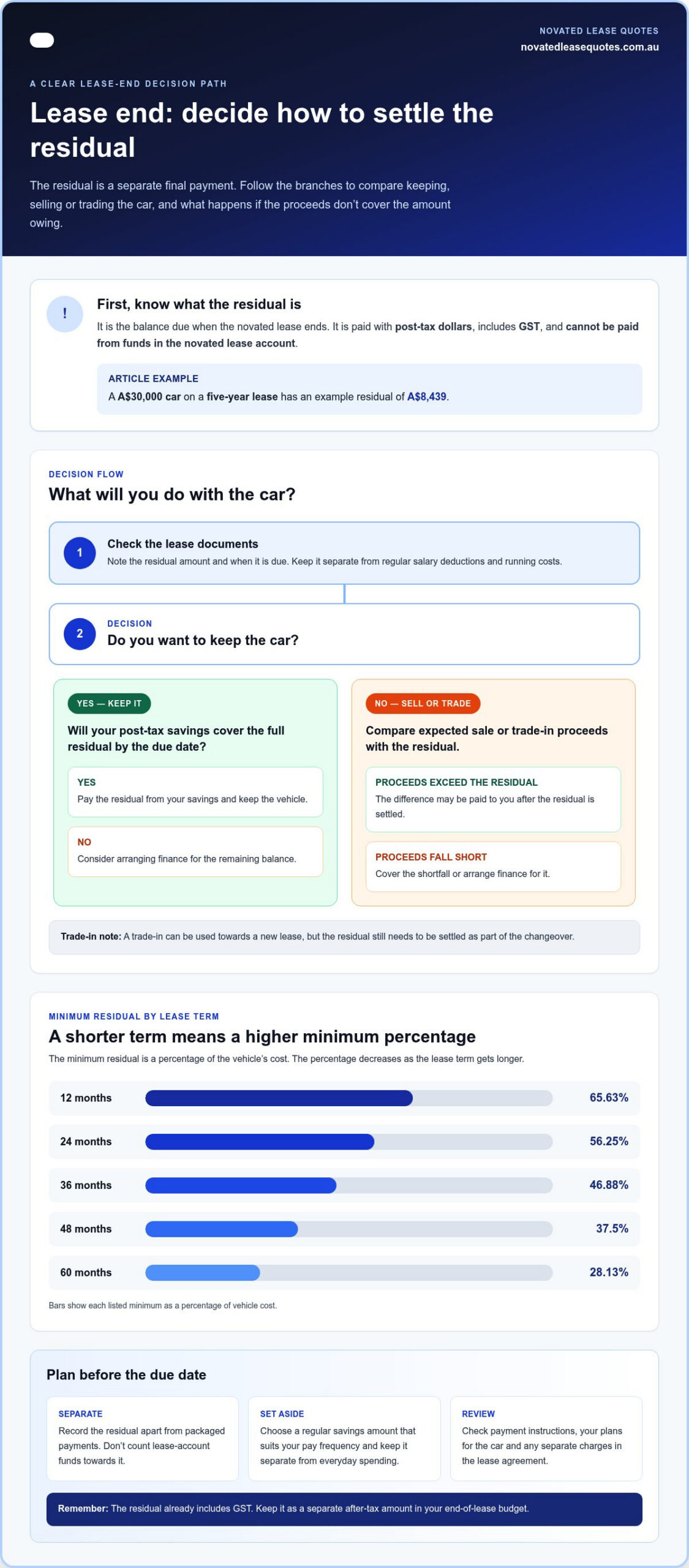
What are the ATO minimum residual value percentages by lease term?
The minimum residual is set as a percentage of the vehicle’s cost, with the applicable percentage determined by the lease term. The Australian Taxation Office stipulates residual percentages according to the term of an Australian novated lease. The minimum percentage decreases as the lease term gets longer, leaving a larger proportion of the vehicle’s cost to pay after a shorter lease.
These are the minimum residual percentages for the listed Australian novated lease terms:
- 12 months: 65.63% of the vehicle cost.
- 24 months: 56.25% of the vehicle cost.
- 36 months: 46.88% of the vehicle cost.
- 48 months: 37.5% of the vehicle cost.
- 60 months: 28.13% of the vehicle cost.
The pattern is straightforward: a shorter term has a higher minimum residual percentage, while a longer term has a lower one. For example, the minimum for a 12-month lease is 65.63%, compared with 28.13% for a 60-month lease. The percentages let you compare how the lease term affects the balance due at its end. They don’t mean the vehicle’s actual market value will match the residual.
This illustrates the relationship between the lease term, vehicle cost and residual amount. When weighing your end-of-lease options, compare the residual in your lease documents with the vehicle’s expected value.
Use the percentage table as a planning reference and compare it with the figures in your lease documents. Check that you’re using the same vehicle cost basis and lease term. A percentage alone doesn’t tell you the cash amount due, which also depends on the vehicle cost. The final balance matters whether you plan to keep the car, sell or trade it, or arrange new finance for the residual.
When comparing lease terms, consider the residual alongside regular lease costs and your plans for the vehicle. A shorter term can mean a higher minimum residual percentage, while a longer term reduces that percentage. Include the residual in the overall cost rather than judging it in isolation. Use the term-specific percentage to understand the minimum, then compare the stated residual with your budget and end-of-term plans.
The residual is expressed against the vehicle’s cost, so the percentage and the dollar amount are different ways of understanding the same end-of-lease obligation. As the lease term gets longer, the residual percentage decreases; the amount also depends on the car’s value at the end of the lease.
In Australia, residual values are minimum amounts based on the lease term and the vehicle’s expected market value at lease end. Consider both when deciding whether the stated residual fits your plans.
Can I refinance or pay the Maxxia residual in instalments?
You can arrange new finance to pay the residual and keep the car at the end of an Australian novated lease. This is a new finance arrangement, not an automatic extension of the existing lease. The residual remains the amount to settle under the original arrangement. If the new finance has scheduled repayments, they spread the financed amount over the agreed term.
Paying the residual in instalments and refinancing it are different approaches. With refinancing, a new arrangement funds the amount owing, which you then repay according to its schedule. This is not the same as splitting the residual into instalments under the original lease.
Before choosing new finance, work through the decision in this order:
- Confirm the residual amount and the date it must be settled.
- Decide whether you want to keep the current vehicle.
- Compare the new finance repayments and total payable with paying the residual from savings.
- Include the car’s condition, expected use and likely ownership period in your decision.
- Allow time to organise the new arrangement before the original lease ends.
If keeping the car is your priority, compare the residual with the repayments and total cost under new finance. The example shows the residual amount, not the cost of refinancing. The new arrangement’s repayment schedule and total cost will help you decide whether spreading the payment suits your budget.
Instalments can spread a large balance across pay periods, but financing changes when you pay, not the need to settle the original residual. Compare repayments with your take-home pay and other regular commitments. Consider how long you plan to keep the vehicle, too. Financing a car you intend to replace soon may not suit your plans.
If you don’t want to keep the car, refinancing may not suit your plans. You can sell or trade it in and put the proceeds towards the residual. If the proceeds are lower than the amount owing, you’ll need to cover the difference or arrange new finance for the shortfall. If they exceed the residual, you may receive the difference after the sale.
Use the lease end date as your planning point. Compare your savings, likely sale proceeds and any new finance against the same residual figure. This clarifies your options: pay the balance and own the car, arrange new finance to keep it, or sell or trade it and account for any remaining difference.
Is GST payable on a Maxxia lease residual payment
Yes. An Australian novated lease residual includes GST and is paid with post-tax dollars at the end of the lease. Treat the residual in your lease documents as the amount owing, rather than adding GST to it again. GST is part of the residual payment, not a separate pre-tax salary deduction. This distinction matters when estimating how much personal money you’ll need to settle the lease.
Because the residual is paid after tax, you can’t use funds in the novated lease account to pay it. Keep the residual separate from packaged lease payments when budgeting. For example, if your lease documents state a residual, plan to pay the full amount with personal funds. Don’t count the account balance towards the final payment.
As the lease end approaches, use these steps to prepare:
- Locate the residual amount and payment due point in your lease documents.
- Use the stated residual as the GST-inclusive figure for your budget.
- Keep personal savings separate from funds held in the novated lease account.
- Compare the residual with any expected sale or trade-in proceeds.
- Allow for a shortfall if the vehicle’s sale proceeds are lower than the residual.
That example illustrates the size of a final balance, not a separate GST charge to add on top. If you plan to keep the car, budget for the residual from post-tax savings. If you sell or trade it, the proceeds can go towards settling the amount owing, but the residual remains the figure to compare against them.
Keep three figures separate: the residual, the money in your lease account and your personal savings. Under the arrangements described, only personal funds or vehicle sale proceeds can go towards the residual. Separating the figures can prevent you from budgeting twice for GST or relying on funds that aren’t available for this payment. It also makes it easier to see whether sale proceeds cover the balance or leave a shortfall.
Before deciding whether to keep, sell or trade the car, write down the residual and the funds available to pay it. If a trade-in brings in more than the residual, you may receive the difference. If the proceeds are lower, you’ll need to cover the gap or arrange new finance for the shortfall. Either way, the residual includes GST and is paid after tax.
To compare lease costs and packaging options for a future vehicle, request novated lease quotes and assess the figures alongside your end-of-lease plans.
Novated Lease Quotes: Novated lease quotes
Novated Lease Quotes can help you compare novated lease quotes when weighing vehicle options, ongoing costs and the residual due at lease end. The Novated Lease Calculator helps estimate potential tax savings and salary-packaging costs, while the Quote Comparison Service brings together quotes from multiple providers for review.
Use these tools to compare lease options or see how the term and residual fit your budget. Consider the full picture, including regular deductions and the post-tax amount due at lease end, rather than focusing on one figure alone.
To explore your options, contact Novated Lease Quotes.
Plan your next vehicle decision with clarity
Your next step is to consider how you’ll use a vehicle after the current agreement ends. Think about whether keeping your car still suits your work, household needs and expected driving. If your circumstances have changed, replacing the vehicle may be more practical, even if keeping it seems simpler today.
Use the Maxxia residual payment as a planning milestone. Set out the likely costs and practical steps for keeping, selling or changing vehicles, then compare those options with your broader budget. This shifts the focus from one final figure to the decision that follows: which option best fits your needs and finances?
If you’re considering another novated lease, compare its overall costs with keeping your current car. Novated Lease Quotes can help you assess lease options as part of that decision. Take the next step when you’re ready, with a clear view of what you want from your next vehicle.
Explore your novated lease options and move forward with confidence.
Frequently Asked Questions
What happens at the end of your novated lease?
At the end of a novated lease, you need to pay the residual to own the car or settle it through another option. You can pay the balance and own the car, sell or trade it and put the proceeds towards the amount owing, or arrange new finance to keep the vehicle. Decide based on whether you still need the car and how your available funds compare with the residual.
Can I sell or trade in the car to cover a Maxxia residual?
Yes, you can sell or trade in the car and use the proceeds towards a Maxxia residual payment. Compare the offer with the amount owing before finalising the sale. If proceeds exceed the residual, you may receive the difference; if they fall short, you’ll need to cover the gap or arrange new finance. This comparison helps you plan the changeover without assuming the car’s value will match the balance.