
The “free” company car provided by your employer might actually be the most expensive way to get behind the wheel in 2026. While the idea of a vehicle with no out-of-pocket costs sounds ideal, the reality of reportable fringe benefits and limited vehicle choice often leaves professionals feeling restricted. When weighing up a novated lease vs company car, the right choice depends entirely on how you value your take-home pay and your long-term career mobility.
It’s understandable to feel overwhelmed by shifting tax regulations, especially with the phasing out of certain EV exemptions and the recent introduction of “Payday Super” legislation. You shouldn’t have to worry about your pay packet shrinking due to Fringe Benefits Tax (FBT) or fear losing your transport if you decide to change jobs. This guide will clarify the financial impact on your disposable income and show you how to maintain control over your vehicle choice. We’ll break down the 2026 tax thresholds and provide a clear comparison to help you decide which path offers the best tax advantages and lifestyle flexibility for your specific career situation.
Key Takeaways
- Understand the structural differences between a company-owned tool-of-trade vehicle and the flexible three-way agreement of a novated lease.
- Learn how to immediately reduce your vehicle purchase price by 10% through GST credits while lowering your annual taxable income.
- Compare the long-term financial impact of a novated lease vs company car to determine which model maximises your take-home pay under 2026 tax rules.
- Discover why current FBT exemptions for electric vehicles are significantly widening the savings gap for employees opting for a lease over a traditional company car.
- Identify which vehicle arrangement aligns with your specific career profile, from high-mileage business requirements to professional roles seeking lifestyle flexibility.
Novated Lease vs Company Car: Defining the Two Models
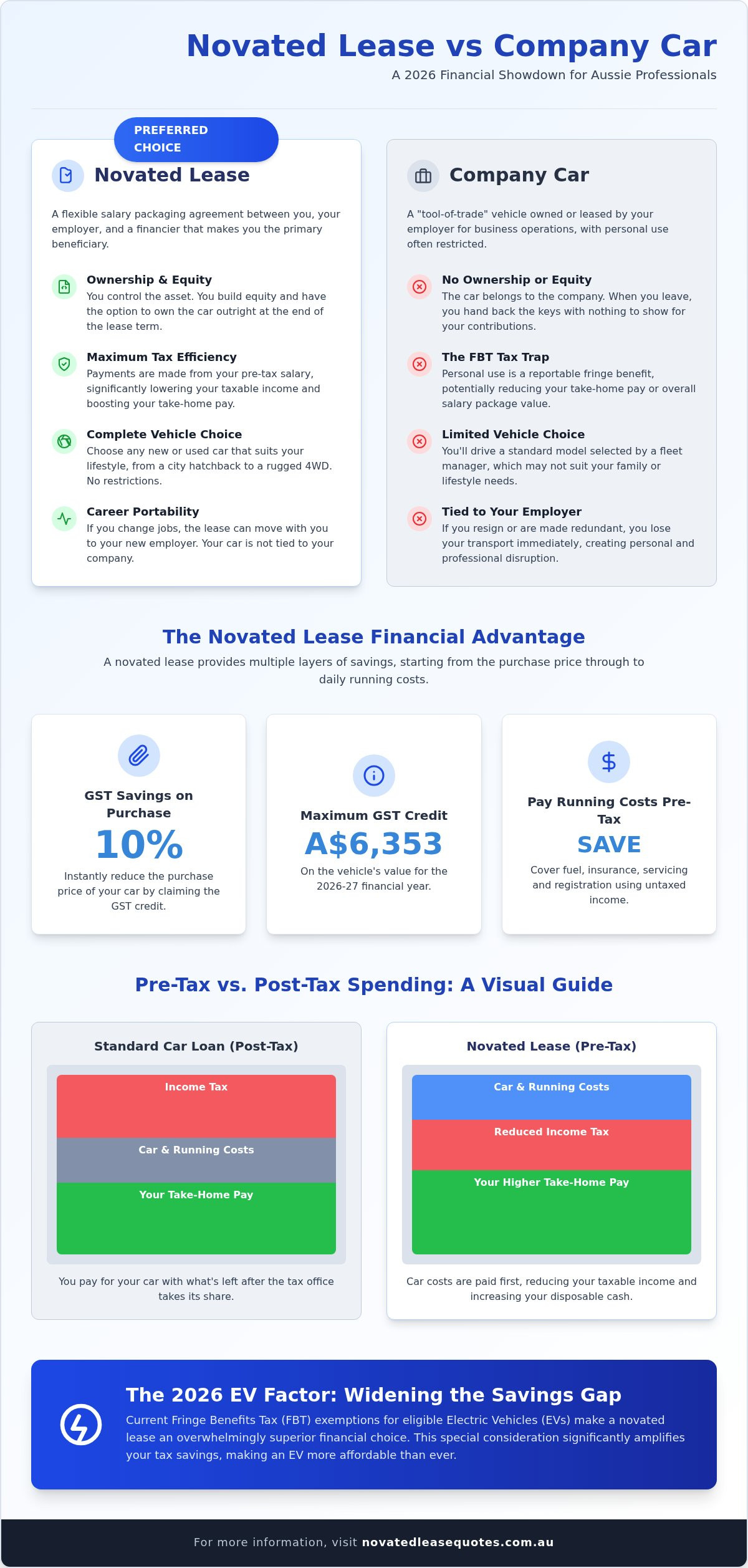
Choosing between a novated lease vs company car essentially comes down to who controls the asset and how the tax benefits are distributed. A company car is a “tool-of-trade” vehicle. The business owns or leases it specifically for business operations. You use it, but you don’t own it. In contrast, a novated lease is a three-way agreement between you, your employer, and a financier.
A novated lease is a salary packaging arrangement that turns your car into a pre-tax benefit. If you’re looking for a foundational overview, you might ask, What is a novated lease? at its core. It’s a method where the lease obligations are transferred from you to your employer for the duration of your employment, allowing for significant financial optimisation.
The “Tool of Trade” Concept
Traditionally, company cars serve a specific purpose. They’re often reserved for roles requiring high mileage, such as sales representatives or technical field staff. Because the employer provides the vehicle, they usually dictate the make, model, and colour. When comparing a novated lease vs company car, the ownership structure is the most critical factor to consider.
- Limited Personal Use: Many company fleet policies restrict personal use or require logbooks to track business vs. private kilometres.
- No Equity: You’re essentially borrowing the car. When you leave the company or the car reaches the end of its life, you hand back the keys with nothing to show for it.
- Standardised Choice: You’ll likely be driving whatever the company fleet manager has negotiated in bulk, which might not align with your lifestyle needs.
The Flexibility of Salary Packaging
The biggest shift when moving to a novated lease is the element of choice. You aren’t restricted to a specific brand or body style. Whether you need a rugged 4WD for weekend trips or a compact hatch for city commuting, the choice remains yours. This model relies on “salary sacrifice.” Your employer pays the lease and running costs directly from your gross salary. This reduces your taxable income, meaning you pay less tax overall.
Unlike a company car, a novated lease offers portability. If you change jobs, the lease can move with you to your new employer, provided they offer salary packaging. You maintain the equity in the vehicle and have the option to purchase it at the end of the term. This converts a standard business perk into a genuine wealth-building tool that stays with you regardless of your employer.
Tax Efficiency and the Bottom Line: The Financial Mechanics
Understanding the financial mechanics is vital when comparing a novated lease vs company car. The primary driver of savings in a lease is the immediate GST advantage. Because the financier purchases the vehicle, they claim the GST back, which effectively reduces the purchase price by up to 10%. For the 2026-27 financial year, the maximum GST credit you can benefit from is A$6,353, providing a significant head start compared to buying a car privately.
Beyond the initial purchase, the savings continue through everyday operation. A novated lease allows an employee to claim back the GST on running costs, which is not possible with a private car loan. Paying for fuel, registration, servicing, and insurance from your gross salary lowers your annual taxable income. According to ATO car expense rules, these deductions are structured to provide a clear financial benefit over spending your hard-earned post-tax dollars.
Pre-Tax vs Post-Tax Spending
When you pay for car expenses after tax, you’ve already lost a significant portion of your income to the tax office. Salary packaging flips this logic. If you’re in the 37% or 45% tax brackets, every dollar spent pre-tax represents a much larger saving than for those on lower incomes. All novated lease running costs are bundled into a single, predictable payment. You can use a novated lease calculator to see exactly how this shift in spending impacts your fortnightly take-home pay.
The Company Car Tax Trap
A company car is often viewed as a free perk, but it’s rarely that simple. Employers are liable for Fringe Benefits Tax (FBT) on vehicles provided for private use. To manage this, many businesses either reduce your base salary or require you to track every kilometre with a logbook. The real trap lies in Reportable Fringe Benefits. Even if you don’t pay FBT directly, the taxable value of the car appears on your income statement, which can increase your HECS or HELP repayment obligations and affect your eligibility for government offsets.
In the debate of novated lease vs company car, the lease often provides a more transparent outcome. By using the Employee Contribution Method (ECM), you can use a mix of pre-tax and post-tax funds to offset FBT entirely. This ensures the car doesn’t become a hidden liability when tax time rolls around, keeping your financial strategy on track.
The 2026 EV Factor: Why the Gap is Widening
The financial distance between a novated lease vs company car has never been greater than it is in 2026. This is largely due to the Federal Government’s Electric Vehicle (EV) FBT exemption. While company fleets often struggle with the infrastructure and policy changes required to go green, individual employees can pivot instantly. This agility allows you to capitalise on tax breaks that many corporate car policies haven’t yet integrated into their standard offerings.
An EV novated lease Australia is currently the most tax-effective way to put a new car in your driveway. Because eligible EVs are exempt from the 47% Fringe Benefits Tax, the effective cost of ownership drops dramatically. In many cases, a A$70,000 electric vehicle will actually have a lower weekly impact on your take-home pay than a A$40,000 petrol-equivalent car. This counterintuitive reality is the primary reason why EVs now account for over 21% of new car sales.
FBT-Free Salary Packaging Explained
To qualify for the exemption in the 2026-27 financial year, the vehicle must be a battery electric or hydrogen fuel cell model with a retail price below the Luxury Car Tax (LCT) threshold for fuel-efficient vehicles, which sits at A$91,661. It’s a significant advantage over the standard novated lease vs company car comparison because it removes the need for the Employee Contribution Method (ECM). You can pay for 100% of the lease and running costs from your pre-tax salary without triggering a tax liability, a benefit that traditional company car programs rarely pass on to the employee in full.
Charging and Maintenance in 2026
Modern leasing goes beyond just the vehicle. You can now include the cost of a home charging station and its installation within your pre-tax packaging. This further reduces your out-of-pocket expenses while adding value to your property. Since EVs have fewer moving parts, maintenance costs are typically lower, allowing you to allocate more of your budget toward the vehicle itself rather than repairs.
When planning your lease term, remember the 31 March 2027 deadline. Leases entered into before this date generally lock in the full FBT exemption for the duration of the term. With ATO residual values for a three-year lease set at 46.88%, the end-of-lease strategy for an EV requires careful consideration of battery health and market demand, making expert guidance more valuable than ever.
Selection Guide: Which Option Fits Your Profile?
Deciding between a novated lease vs company car often depends on your current career stage and long-term financial goals. A company car remains a practical choice for entry-level roles or positions requiring high business mileage where you don’t want the responsibility of vehicle management. If you view a car simply as a tool to get from A to B and have zero interest in vehicle choice, the company-provided model offers simplicity. However, for established professionals, the lack of ownership and tax optimisation often outweighs that convenience.
Career Flexibility and Ownership
The “portability” factor is perhaps the most significant differentiator. If you resign or your role is made redundant, you must return a company car immediately. This leaves you without transport during a career transition. A novated lease is different. It stays with you. You can transfer the arrangement to a new employer or continue making payments personally. This flexibility ensures you maintain equity in the asset. You aren’t just paying for the use of a vehicle; you’re working toward owning it at the end of the term.
Administrative Burden vs Financial Gain
Many employees stick with a company car to avoid paperwork. While the “zero admin” appeal is real, it often comes at a high financial cost in lost tax savings. Modern leasing providers have solved this. By using a novated lease comparison service, you can find providers that offer streamlined apps for tracking expenses and managing fuel cards. The administrative effort is now minimal, making the financial gains of a lease far more accessible for busy professionals.
To truly understand the impact on your wallet, you should use a novated lease calculator to run the numbers. Follow these steps to get an accurate comparison:
- Step 1: Input your current gross salary to establish your 2026-27 tax bracket.
- Step 2: Enter the purchase price of your desired vehicle, ensuring you account for the GST discount.
- Step 3: Estimate your annual kilometres to calculate bundled costs like fuel and servicing.
- Step 4: Compare the resulting take-home pay against your current pay packet to see the real-world difference.
When weighing up a novated lease vs company car, the data usually points toward leasing for those seeking to maximise their wealth. Before making a final commitment, it is highly recommended that you compare novated lease quotes from multiple Australian specialists to ensure you’re securing the lowest management fees and most competitive terms available in the current market.
Securing the Best Outcome for 2026
Generic estimates are a helpful baseline, but the 2026-27 tax environment requires precision. To truly decide between a novated lease vs company car, you need tailored figures based on your exact salary and chosen vehicle. Before you start shopping, confirm your organisation’s salary packaging policy. Some employers have preferred providers, while others allow you to bring your own specialist to ensure you get the most competitive deal.
Moving from a Company Car to a Lease
If you currently drive a company-provided vehicle, transitioning to a lease requires a structured conversation with HR or your manager. You can often negotiate a salary increase in lieu of the “tool-of-trade” vehicle. This is particularly effective when you present the “payroll tax saving” argument. Because a lease is paid from your gross salary, the business reduces its total payroll. This can lower their payroll tax obligations and workers’ compensation premiums. It’s a pragmatic solution that benefits both the employee’s take-home pay and the company’s bottom line.
The timeline for this transition usually takes between four to eight weeks. This allows for vehicle procurement, credit approval, and the activation of the three-way novation agreement. Starting this process early ensures you aren’t left without a vehicle once you hand back the keys to the company fleet car.
The Power of Multiple Quotes
Don’t make the mistake of accepting the first quote you receive. Interest rates and “doc fees” vary significantly between Australian specialists. One provider might offer a lower interest rate but hide high monthly management fees in the fine print, which can erode your tax savings over a five-year term. Novated Lease Quotes streamlines this search by connecting you with top-tier specialists for an independent comparison of the current market.
Before committing to a contract, it’s essential to prepare the right questions to ask a novated lease provider. Focus on transparency regarding the residual value, the flexibility of the insurance options, and whether you can choose your own repairer. A well-structured lease should feel like a tool for financial growth, not an administrative burden.
The math for 2026 is clear. While a company car offers simplicity, a structured lease offers superior wealth-building potential and lifestyle choice. Don’t settle for the company car until you’ve seen the real-world lease numbers. Compare multiple tailored quotes today to see exactly how much your take-home pay could increase by making the switch.
Take Control of Your Financial Mobility in 2026
The landscape of Australian salary packaging has shifted significantly. While a company car once represented the pinnacle of professional perks, the 2026 tax environment favours the flexibility and ownership offered by a structured lease. By leveraging the current FBT exemptions for electric vehicles and the immediate 10% GST saving on the purchase price, you can transform a standard commute into a powerful financial strategy.
Choosing between a novated lease vs company car shouldn’t be based on guesswork. You need to see the real impact on your take-home pay through tailored, independent data. Our service simplifies this process by providing specialist advice on the 2026 EV tax landscape and connecting you with top-tier providers across Australia.
Ready to maximise your disposable income? Get your competitive novated lease quotes today through our 100% independent and transparent service. We help you compare multiple Australian providers in one place so you can secure the best interest rates and lowest management fees. It’s time to drive a vehicle that works as hard for your future as you do.
Frequently Asked Questions
Is a company car “free” for the employee?
A company car is rarely free in the truest sense. While you avoid purchase costs, the taxable value of the benefit appears on your income statement as a Reportable Fringe Benefit. This can increase your Medicare Levy Surcharge or HECS repayments. Additionally, many employers offer a lower base salary if a vehicle is included. Comparing a novated lease vs company car reveals that the lease often provides better transparency regarding your actual disposable income.
Can I choose any car I want with a novated lease?
Yes, one of the primary benefits of a novated lease is the freedom of choice. Unlike company-owned fleets where the boss usually decides the make and model, a lease allows you to select any new or used vehicle that meets financier criteria. Whether you need a family SUV or a commuter hatch, you aren’t restricted to a standardised list. This flexibility ensures the vehicle actually fits your lifestyle rather than just your job description.
Does a novated lease affect my borrowing capacity for a mortgage?
Yes, banks and lenders consider the monthly lease payment as a fixed financial commitment when assessing your debt-to-income ratio. While salary packaging reduces your taxable income, which might look like a lower salary on paper, most lenders are now accustomed to these arrangements. They’ll often add back the tax savings when calculating your actual serviceability. It’s best to speak with a mortgage broker who understands how salary packaging works for Australian professionals.
What happens to my novated lease if I lose my job?
If you leave your current role, the lease is “de-novated” and the responsibility for payments transfers entirely to you. You can continue to pay the lease from your post-tax bank account or, more commonly, transfer the arrangement to your new employer. This portability is a major advantage in the novated lease vs company car comparison, as you don’t lose your transport simply because you’ve decided to move to a new organisation.
Is the EV FBT exemption still available in 2026?
Yes, the full FBT exemption remains available for eligible battery electric and hydrogen fuel cell vehicles in 2026. To qualify, the vehicle’s value must remain below the Luxury Car Tax threshold for fuel-efficient vehicles, which is A$91,661 for the 2026-27 financial year. Leases started before 31 March 2027 typically lock in this benefit for the full term. This exemption makes EVs significantly more affordable than traditional internal combustion engine vehicles provided by an employer.
Who pays for the insurance and petrol in a novated lease?
All running costs, including insurance, fuel or charging, registration, and servicing, are bundled into your lease payments. These are paid by your employer using a combination of your pre-tax and post-tax salary. This structure allows you to pay for these expenses without the 10% GST, effectively stretching your budget further. You won’t need to find extra cash for a large insurance premium or an unexpected service, as the funds are already set aside.
Can I switch from a company car to a novated lease mid-contract?
Switching is possible but requires coordination with your employer. You’ll need to return the company-owned vehicle and negotiate a salary adjustment to reflect the shift from a provided perk to a salary-sacrificed arrangement. Most businesses are open to this because it can reduce their payroll tax and workers’ compensation costs. Once your employer agrees, you can use a comparison service to find a lease that offers better long-term value than the fleet car.


