
Is the traditional car loan actually the most expensive way to get behind the wheel in 2026? With interest rates for prime borrowers currently averaging 7.67% p.a., the conventional path of a standard loan or the perceived safety of a novated lease vs buying a car outright is no longer a simple choice. The “obvious” route of using your own savings often results in paying significantly more over the life of the vehicle once tax is factored into the equation.
You likely feel the pressure of rising petrol prices and the annual headache of rego and insurance renewals, all while trying to decipher complex ATO rules. It’s frustrating to watch your take-home pay vanish into vehicle overheads that seem to increase every quarter. We know you want a clear, pragmatic path to lower your total cost of ownership while removing the administrative burden of running a modern car.
This guide breaks down the real cost differences between salary packaging and traditional finance to find the smartest way to fund your next vehicle. We will explore the 2026 FBT exemptions for electric vehicles and show you how to use a specialised calculator to model your potential savings and maximise your disposable income.
Key Takeaways
- Learn how salary packaging allows you to use pre-tax income to cover vehicle costs, effectively reducing your taxable income and saving 10% on the initial purchase price via GST credits.
- Evaluate the true financial impact of a novated lease vs buying a car outright by comparing the total cost of ownership, including fuel, maintenance, and insurance.
- Identify why battery electric vehicles (BEVs) are the most tax-efficient option in 2026 thanks to the continued FBT exemption for eligible models.
- Use a specialised Novated Lease Calculator to model personalised savings and see exactly how much you can increase your fortnightly take-home pay.
- Secure the most competitive finance rates by obtaining and comparing multiple quotes rather than settling for an employer’s default provider.
The Great Australian Debate: Novated Lease vs Car Loan
In 2026, Australians are facing a vehicle market shaped by high interest rates and evolving tax incentives. Choosing between a Novated Lease and a traditional car loan is no longer just about the monthly payment. It’s about how you interact with the Australian Taxation Office (ATO) to keep more of your salary. While a car loan is a straightforward liability, a novated lease functions as a strategic employee benefit designed to lower your taxable income.
The debate often centres on the psychological weight of ownership. For some, owning a debt feels familiar. For others, managing a benefit that automates every cost is the ultimate goal. Recent updates to tax laws, particularly around electric vehicles, have added layers of complexity to this decision. You can’t simply compare interest rates anymore. The interest rate on a loan is just one number; the tax savings on a lease represent an entirely different, and often larger, financial lever.
What is a Traditional Car Loan?
Traditional car loans remain a common path for many. These are typically secured loans where the vehicle acts as collateral, or unsecured personal loans with higher rates. In September 2026, average rates for prime borrowers sit around 7.67% p.a. for standard vehicles.
The defining characteristic of a car loan is that you make repayments using your after-tax income. This means every dollar you send to the bank has already been taxed at your marginal rate. While you enjoy full ownership and the flexibility to sell the car whenever you like, you’re also responsible for paying every bill, from rego to tyres, out of your own pocket. When comparing a novated lease vs buying a car outright, the lack of tax relief on these running costs is often the biggest hidden expense of a loan.
What is a Novated Lease?
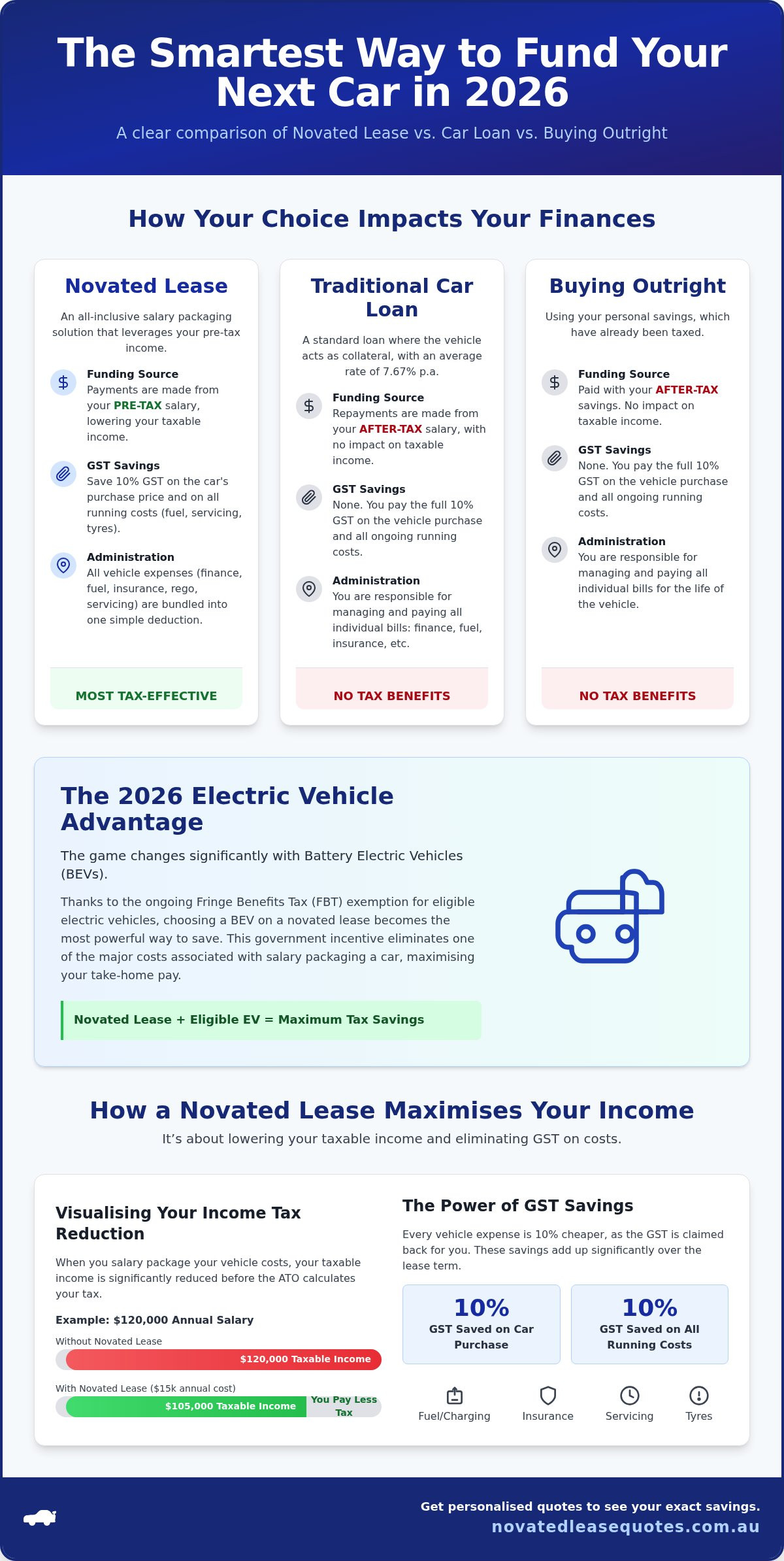
A novated lease is a three-way agreement between you, your employer, and a leasing company. It integrates your vehicle expenses directly into your pay cycle through salary packaging. Instead of paying for your car after you’ve been taxed, your employer deducts a portion of the costs from your pre-tax salary. This reduces your taxable income, which means you pay less income tax overall.
This setup is all-inclusive. Your lease covers the finance, insurance, registration, servicing, and even fuel or charging costs. By bundling these into one payment, you simplify your vehicle admin while benefiting from GST savings on both the purchase price and the running costs. It transforms a car from a post-tax drain into a tool for financial optimisation.
Comparing the Financial Mechanics: Pre-Tax vs After-Tax
The fundamental difference between a novated lease vs buying a car outright lies in the timing of your tax obligations. When you buy a car with a standard loan or cash, you use money that has already been taxed at your highest marginal rate. In contrast, a novated lease allows you to pay for your vehicle before the ATO takes its cut. This simple shift in timing turns the tax office from a collector into a contributor, effectively subsidising your car ownership through reduced income tax and GST exemptions.
The GST Advantage on Purchase and Running Costs
Most car buyers overlook the immediate 10% saving available through a lease. When you purchase a vehicle via a novated lease, you don’t pay GST on the purchase price up to the maximum claimable credit of A$6,353 for the 2026-2027 financial year. This is a benefit that traditional car loans simply cannot match. However, the savings don’t stop at the showroom floor.
You also save 10% on every litre of fuel, every new set of tyres, and every scheduled service. Because these expenses are packaged into your lease, the GST is removed from the equation. While a standard car owner pays the full-freight retail price including GST, a lease holder pays the net amount. Over a typical three to five year term, these small percentages accumulate into thousands of dollars in saved cash flow. To see how these percentages apply to your specific salary, you can use a novated lease calculator to model the exact impact.
Impact on Taxable Income
Salary packaging your car reduces your gross salary, which in turn lowers your overall income tax bill. If your annual salary is A$120,000 and your lease costs A$15,000 per year, your taxable income drops to A$105,000. This doesn’t just mean you pay less tax on those 15,000 dollars; it could potentially move you into a lower tax bracket for your remaining income.
For high earners, this effect is even more dramatic. The higher your marginal tax rate, the more the ATO contributes to your car. To manage Fringe Benefits Tax (FBT), most non-EV leases use the Employee Contribution Method (ECM). This involves paying a portion of the running costs from your after-tax salary to offset the FBT liability to zero. Even with this after-tax component, the combined savings from pre-tax finance and GST credits generally outperform any standard car loan or cash purchase scenario.
The 2026 EV Factor: Why Electric Vehicles Change the Math
The landscape of novated lease vs buying a car outright has been fundamentally rewritten by the Electric Car Discount. For the 2026-2027 FBT year, eligible battery electric vehicles (BEVs) remain exempt from the 47% Fringe Benefits Tax, provided their value stays below the fuel-efficient luxury car tax threshold of A$91,661. This exemption is the single most powerful financial incentive in the Australian car market today. It effectively turns a depreciating asset into a high-yield tax strategy.
While green car loans offer slightly lower interest rates, typically starting around 5.49% p.a., they still require you to pay for the vehicle using after-tax income. An EV novated lease allows you to fund the entire vehicle and its running costs using 100% pre-tax dollars. It’s vital to remember that the exemption for plug-in hybrids (PHEVs) is currently phasing out. This makes pure electric models from brands like Tesla or BYD the most logical choice for those seeking maximum tax efficiency before the BEV exemption window begins its scheduled transition after 31 March 2027.
Zero FBT: The Holy Grail of Salary Packaging
In a standard lease for a petrol car, you must use the Employee Contribution Method to offset FBT, which requires spending a portion of your take-home pay. With an eligible EV, this requirement disappears. You gain the full benefit of salary packaging without the need for post-tax contributions. This results in thousands of dollars saved annually compared to a standard bank loan. For a detailed breakdown of these savings, see our EV Novated Lease Australia: The 2026 Guide to FBT-Free Salary Packaging.
Charging vs Petrol: Running Cost Comparisons
The financial advantage extends to how you “fuel” your vehicle. Within a lease, home charging costs and public network subscriptions are bundled into your novated lease running costs budget. This means you aren’t just saving on the electricity itself; you’re paying for that electricity with pre-tax income and zero GST.
Managing these costs is seamless. Most leasing providers offer integrated charging cards for public networks, which automatically deduct expenses from your pre-tax pool. For busy professionals, this removes the administrative burden of tracking receipts or calculating home power usage for tax purposes. When you combine zero FBT with these reduced energy costs, the math overwhelmingly favours the lease model for modern electric vehicles.
Decision Framework: Which Option Suits Your Lifestyle?
Determining whether a novated lease vs buying a car outright is the right move depends heavily on your professional and personal circumstances. Your annual mileage is a primary variable. While novated leases were once considered better for high-kilometre drivers, current tax structures make them highly effective for average Australian commuters. You also need to verify your employer’s policy. Most mid-to-large organisations and government departments provide salary packaging, and many smaller businesses now offer it as a standard recruitment tool to remain competitive in the 2026 talent market.
The structure of the debt also differs. A car loan eventually ends with a zero balance and clear ownership. A novated lease includes a residual value, or balloon payment, at the end of the term. This keeps your monthly payments lower but requires a plan for the final lump sum. For many, the all-in-one payment is the deciding factor. Managing registration, insurance, and servicing manually is a significant administrative burden that a managed lease effectively removes from your plate.
When the Car Loan Wins
A car loan might be the better tactical choice if you are targeting the second-hand market. Most leasing companies have strict requirements regarding the age of the vehicle, often capping it at 12 years at the end of the lease term. If you are buying an older vehicle from a private seller, a traditional loan provides the necessary flexibility. It also suits those who want to perform extensive vehicle customisation, such as adding aftermarket off-road equipment, which can occasionally complicate the valuation at the end of a lease.
When the Novated Lease Wins
The financial sweet spot for leasing is anyone in a middle-to-high income tax bracket looking at a new or near-new vehicle. If you earn over A$45,000, the tax savings often begin to outweigh the total costs of a loan. These benefits peak for those in the higher tax brackets, where the ATO effectively covers a larger portion of your vehicle’s depreciation and running costs. Job mobility is also less of a hurdle than many believe. Most leases are portable, meaning you can take the arrangement with you if you move to a new employer that offers salary packaging.
To find your specific break-even point, you should use a novated lease calculator to model your potential savings. It is the most efficient way to see how much of your gross salary you can preserve each fortnight. If you value your time as much as your money, the outsourced administration of a managed lease is a clear advantage. You can get a novated lease quote comparison today to see exactly how these figures compare to a standard car loan.
Securing the Best Deal: How to Compare Quotes
Securing a competitive deal requires more than just looking at the monthly repayment figure. Many Australian employees mistakenly believe they are restricted to their employer’s preferred leasing provider. While these providers offer a streamlined setup, they don’t always provide the most competitive finance rates or the lowest management fees. You have the right to seek independent quotes to ensure your salary packaging arrangement is actually working in your favour. Comparing multiple offers is the only way to verify that the tax savings aren’t being eroded by high margins.
When you evaluate a novated lease vs buying a car outright, the comparison must be based on the total cost of ownership. A car loan quote usually only details the principal and interest. In contrast, a lease quote bundles finance with running costs. To compare these fairly, you must add your estimated costs for fuel or charging, insurance, registration, and servicing to any car loan offer you receive. Only then can you see the true impact on your fortnightly disposable income.
What to Look for in a Lease Quote
Transparency is essential when reviewing your offer. You should scrutinise the management fees and check if the interest rate is clearly disclosed rather than hidden within the total repayment. It’s also vital to ensure the running cost budgets are realistic for your driving habits. If a provider underestimates your fuel or tyre usage to make the monthly payment look lower, you’ll simply face a shortfall later. For a comprehensive breakdown of what to verify, refer to our Novated Lease Comparison 2026: The Australian Guide to Finding the Best Deal for a full checklist.
Your Next Steps: From Calculator to Quote
The path to optimising your vehicle finance is logical and data-driven. Start by using an online tool to model your potential savings based on your specific salary and vehicle choice. This gives you a baseline for what a good deal looks like in the current 2026 market. Once you have a clear idea of the potential tax benefits, gather your most recent pay slip and confirm the exact model and trim of the car you want. This level of detail ensures the quotes you receive are accurate and comparable.
The final step is to secure multiple novated lease quotes from different specialists. By presenting these options to your employer’s salary packaging department, you can often negotiate better terms or simply choose the provider that offers the best value. Taking this proactive approach ensures that you aren’t just getting a new car, but you’re doing so in the most tax-efficient way possible.
Optimise Your Next Vehicle Purchase
Choosing between a novated lease vs buying a car outright is a decision that impacts your disposable income for years. As we have established, the 2026 landscape heavily rewards those who utilise salary packaging, particularly through GST savings on running costs and the continued FBT exemption for electric vehicles. While a standard car loan offers simplicity, it lacks the structural tax advantages that effectively lower your total cost of ownership. By using pre-tax dollars, you aren’t just funding a car; you’re reducing your taxable income and increasing your fortnightly take-home pay.
The smartest path forward involves moving from general research to personalised data. You should model your specific situation to see how the numbers stack up against a traditional finance offer. Whether you are considering a petrol SUV or a new EV, the right choice depends on your salary bracket and driving habits. Take control of your vehicle expenses by using our free-to-use Novated Lease Calculator or speaking with our specialists for tailored advice. You can Compare Novated Lease Quotes and Save Today to access multiple offers from leading Australian providers. Finding the most efficient way to fund your next car is a straightforward step toward better financial health.
Frequently Asked Questions
Does a novated lease affect my ability to get a home loan?
Lenders will factor a novated lease into your borrowing capacity as it is a fixed financial commitment. While the lease reduces your taxable income, which might slightly lower your perceived gross serviceability, the reduction in your total living expenses often balances the equation for credit assessors. You should provide your lease statements to your mortgage broker early to ensure your debt-to-income ratio remains within the specific lender thresholds for 2026.
What happens to my novated lease if I lose my job or change employers?
Your novated lease is portable, meaning you can typically transfer the arrangement to a new workplace if they offer salary packaging. If you lose your job or your new employer doesn’t support leasing, the novation agreement ends. You then become responsible for making the full repayments from your after-tax income, similar to a standard car loan, until you secure new employment or pay out the remaining balance of the finance.
Can I get a novated lease on a used car, or must it be brand new?
You can package a used car under a novated lease provided the vehicle meets the age and condition requirements set by the leasing company. Most providers require the car to be no older than 10 to 12 years at the end of the lease term. When comparing a novated lease vs buying a car outright for a used vehicle, ensure you account for the GST savings on running costs, which apply regardless of the car’s age.
Is the residual payment (balloon) at the end of a lease negotiable?
The residual payment is not negotiable because it is strictly governed by ATO minimum residual value guidelines. These percentages are based on the length of the lease term to ensure the arrangement remains a legitimate tax-effective tool. At the end of the term, you have the choice to pay the residual to own the car, trade it in for a new model, or refinance the remaining balance into a new lease agreement.
Is it better to pay for a car in cash or use a novated lease?
Paying in cash avoids interest charges but means you miss out on significant tax benefits and GST credits. When you use a novated lease, you preserve your capital for other investments while paying for the car and running costs with pre-tax income. For many professionals, the combination of income tax savings and the 10% GST discount on the purchase price and maintenance often outweighs the cost of the interest incurred.
Does a novated lease include insurance and what happens if I crash the car?
Comprehensive car insurance is a standard inclusion in your managed running cost budget. If you are involved in an accident, you follow the standard claims process with the insurer. Your leasing provider manages the payment of the excess and any premium adjustments through your salary packaging account. This ensures your out-of-pocket expenses remain predictable and are funded using the tax-effective pre-tax dollars already set aside in your monthly vehicle budget.
How does the EV FBT exemption change the novated lease vs car loan calculation?
The EV FBT exemption fundamentally shifts the novated lease vs buying a car outright calculation by removing the need for after-tax employee contributions. For eligible battery electric vehicles under the luxury car tax threshold of A$91,661, the entire cost of the car and its running expenses can be paid using pre-tax salary. This creates a much larger gap in savings compared to a car loan, where all repayments are made using after-tax income.
Can I exit a novated lease early if my circumstances change?
You can exit a novated lease early by requesting a payout figure from the leasing company. This figure includes the remaining principal on the vehicle plus the residual value and any applicable early termination fees. While exiting early is possible, it is generally most cost-effective to see out the term or transfer the lease to a new employer. You can also choose to sell the vehicle privately to cover the payout amount.


