
What if the Fringe Benefits Tax wasn’t a cost to fear, but a variable you could master to unlock thousands in extra take-home pay? For many Australian professionals, the mere mention of FBT triggers a sense of dread. It’s easy to feel overwhelmed by the choice between the Statutory Formula and the Operating Cost method, especially when a wrong move could result in an unexpected tax bill at the end of the financial year. You aren’t alone in this confusion; the system is designed with complexity in mind.
The good news is that you don’t need to be a tax accountant to secure the best deal. By using a specialised novated lease fbt calculator, you can gain immediate clarity on your 2026 salary packaging potential. This guide will show you how to use these tools to compare different models and ensure you’re choosing the most tax-effective path. We will explore the shifting landscape of EV FBT exemptions for 2026, explain how the Employee Contribution Method can eliminate your liability entirely, and provide a clear roadmap to maximising your monthly income through smart vehicle financing.
Key Takeaways
- Learn the critical differences between the Statutory Formula and Operating Cost methods to ensure you aren’t paying more tax than necessary.
- Discover how the 2026 EV FBT exemption can reduce your tax liability to zero, making electric vehicles the most cost-effective choice for salary packaging.
- Master our step-by-step guide on using a novated lease fbt calculator to accurately model your monthly take-home pay and avoid end-of-year tax surprises.
- Understand how to apply the Employee Contribution Method to offset fringe benefits tax and maximise your total salary savings.
- Find out why comparing quotes from multiple providers is essential for identifying the most competitive FBT management fees and interest rates.
Understanding FBT on Your Novated Lease: Why it Matters in 2026
Fringe Benefits Tax (FBT) often feels like a barrier to salary packaging, but it’s simply the mechanism the ATO uses to tax non-cash benefits. When your employer provides a vehicle through a novated lease, it’s viewed as a private benefit rather than a cash salary. Because you’re receiving a perk instead of money, the tax system applies FBT to ensure fairness across all types of remuneration. While FBT might seem like an unnecessary expense, using a novated lease fbt calculator helps you understand how this tax is balanced against the significant income tax savings you’ll achieve.
The ATO treats a car provided by an employer as a non-cash benefit because you have the right to use the vehicle for private travel. This includes everything from your daily commute to weekend trips. Understanding how these figures interact with your gross salary is key; using a novated lease fbt calculator allows you to see the real-world impact on your bank account before you commit to a specific vehicle or lease term.
The 2026 FBT Landscape for Australian Employees
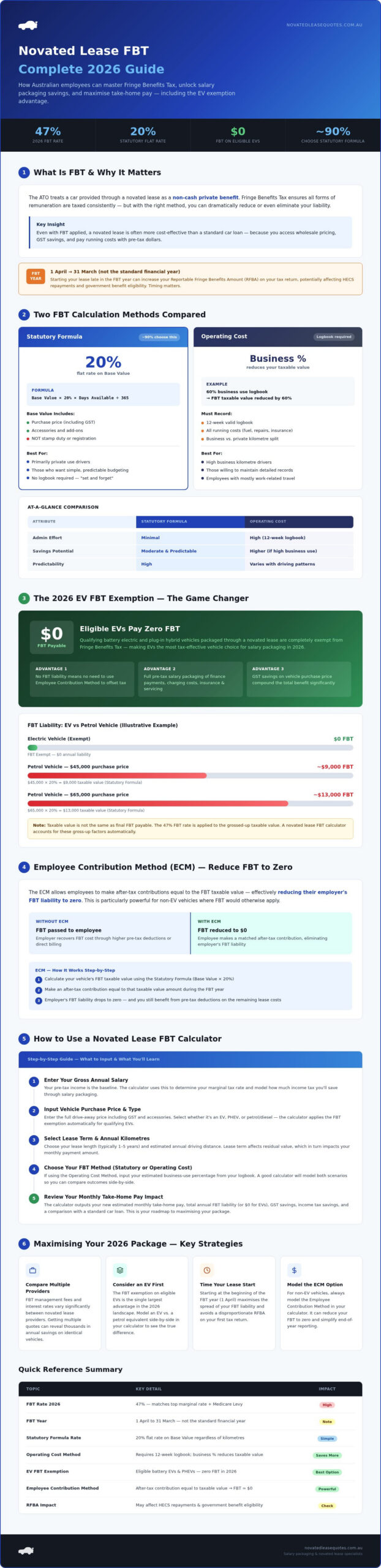
The 2026 FBT period follows a specific cycle, running from 1 April to 31 March, which is distinct from the standard Australian financial year. For this period, the FBT rate is set at 47 per cent, which matches the top marginal tax rate plus the Medicare Levy. This high rate is why the gross-up factor exists; it’s designed to reflect the pre-tax income required to pay for the benefit after tax. Timing your lease is vital because starting late in the FBT year can result in a higher Reportable Fringe Benefits Amount (RFBA) on your annual tax return, which may impact your HECS repayments or other government benefits.
FBT vs. Income Tax Savings: The Balancing Act
Packaging a car reduces your taxable income because you’re paying for vehicle expenses using pre-tax dollars. Even with the added FBT, a novated lease is often more cost-effective than a standard car loan because you’re accessing wholesale pricing and reduced income tax. This structure allows you to pay for fuel, insurance, and servicing with money that hasn’t been taxed yet, effectively increasing your purchasing power.
Your FBT liability is effectively offset by the substantial GST savings gained on the initial vehicle purchase price.
Calculation Methods: Statutory Formula vs. Operating Cost
The ATO provides two distinct pathways for determining FBT: the Statutory Formula Method and the Operating Cost Method. Most Australian employees, approximately 90 per cent, opt for the Statutory Formula. It is widely preferred for its simplicity and “set and forget” nature. Rather than tracking every trip, this method applies a flat 20 per cent rate to the “Base Value” of the car. This consistency makes it much easier to manage your budget throughout the year.
Defining the Base Value is the first step in any novated lease fbt calculator. This figure represents the original purchase price of the vehicle, including GST and any accessories, but excluding government charges like stamp duty and registration. Accuracy here is vital. It forms the foundation of your FBT liability for the life of the lease. If you choose a car with a high purchase price, your FBT will be higher under this method, regardless of how much you drive.
When to Use the Statutory Formula Method
This method is ideal if you primarily use your vehicle for private travel or if you simply want to avoid the administrative burden of keeping a logbook. The 20 per cent flat rate applies regardless of how many kilometres you drive annually. To find the taxable value, you multiply the Base Value by 20 per cent, then adjust for the number of days the car was available for use during the FBT year. If you’re looking for a streamlined approach, you can request a quote comparison to see how this method impacts your specific salary package.
When to Choose the Operating Cost Method
The Operating Cost Method is generally more beneficial for employees who use their car heavily for work related purposes. It requires you to maintain a valid 12-week logbook to establish a “business-use percentage.” If your logbook proves that 60 per cent of your travel is business related, your FBT taxable value is reduced by that same 60 per cent. While this can lead to significant savings, it does require meticulous record keeping of all running costs, including fuel, repairs, and insurance. A novated lease fbt calculator can help you model both scenarios, allowing you to decide if the extra effort of a logbook is financially justified based on your driving habits.
The 2026 EV FBT Exemption: Calculating Savings on Electric Cars
The Electric Vehicle (EV) FBT exemption has transformed salary packaging from a niche benefit into a mainstream financial strategy. When you use a novated lease fbt calculator for a qualifying electric car, the results often show a zero-dollar FBT liability. This exemption applies to battery electric vehicles (BEVs) and hydrogen fuel cell electric vehicles that sit below the Luxury Car Tax (LCT) threshold for fuel-efficient vehicles. For the 2026 period, choosing an EV novated lease in Australia remains the most tax-effective method of vehicle procurement. It allows you to pay for the car and all its running costs entirely from your pre-tax salary without the usual FBT penalty. This effectively brings the cost of a premium electric vehicle down to a level comparable with much cheaper internal combustion engine cars.
To qualify for this 0 per cent rate in 2026, the vehicle must be a “car” for FBT purposes and must have been first held and used on or after 1 July 2022. The most critical factor for your calculation is ensuring the retail price stays under the LCT threshold for green vehicles. If the car exceeds this limit, even by a small amount, the entire FBT exemption is lost, and the vehicle is taxed at the standard 20 per cent statutory rate. This makes the choice of model and optional accessories a vital part of your financial planning.
The PHEV Sunset Clause: What You Need to Know
The landscape for Plug-in Hybrid Electric Vehicles (PHEVs) changes significantly in 2026. The FBT exemption for PHEVs is scheduled to sunset on 1 April 2025. If you initiate a new lease after this date, the vehicle will likely be subject to standard FBT calculations. When using your novated lease fbt calculator, it’s essential to distinguish between a BEV and a PHEV. While existing PHEV contracts entered into before the deadline may be grandfathered, new 2026 entrants should focus on battery electric models to guarantee the 0 per cent FBT rate. BEVs remain the gold standard for those seeking maximum tax optimisation, as they aren’t subject to this sunset clause.
Calculating the RFBA for Exempt Vehicles
A common misconception is that an FBT-exempt vehicle vanishes from your tax return. Even when your actual FBT liability is zero, your employer must still calculate a Reportable Fringe Benefits Amount (RFBA). This figure is included on your annual payment summary. While you don’t pay income tax on this amount, it’s used by the ATO to assess your eligibility for various government obligations. A high RFBA can increase your HECS or HELP debt repayments and may trigger the Medicare Levy Surcharge if your combined income exceeds the relevant thresholds. It can also affect your eligibility for certain family assistance payments.
Using a calculator to model these “net” benefits is crucial for a complete financial picture. It ensures you understand how the packaging arrangement interacts with your broader financial situation. By accounting for these variables early, you avoid the frustration of a reduced tax refund or an unexpected debt from the ATO during tax time. This transparency allows you to enjoy the savings of an electric vehicle with total confidence in your 2026 financial plan.
How to Use a Novated Lease FBT Calculator: A Step-by-Step Guide
To get the most out of a novated lease fbt calculator, you must first gather three critical pieces of information: the vehicle’s purchase price, your annual gross salary, and an estimate of your yearly driving distance. These inputs form the baseline for your potential savings. Once you’ve entered these, you’ll select your preferred FBT method. While we’ve discussed the Statutory Formula and Operating Cost methods earlier, most users start with the Statutory Formula to see a baseline figure.
Next, you’ll input anticipated running costs. This includes fuel or charging expenses, comprehensive insurance, registration, and scheduled servicing. Don’t guess these numbers; use historical data from your current vehicle or manufacturer estimates to ensure the calculation is grounded in reality. The calculator then processes these variables to provide a clear “Take-Home Pay” result, showing exactly how much extra cash stays in your pocket each fortnight compared to a traditional car loan.
The Employee Contribution Method (ECM) Input
The ECM, or Post-Tax Contribution, is a powerful tool for those not choosing an exempt electric vehicle. By paying for a portion of your car’s running costs from your after-tax salary, you can reduce the taxable value of the fringe benefit to zero. This effectively wipes out the FBT liability that would otherwise be paid by your employer and passed on to you. Finding the exact sweet spot where your FBT liability hits zero without over-contributing from your net pay is tricky. This is why using a specialised novated lease calculator is essential to model different contribution levels and maximise your 2026 savings.
Interpreting Your Savings Report
When you receive your results, focus on the “With Lease” versus “Without Lease” columns. This comparison highlights the true impact on your disposable income. You’ll likely notice a significant reduction in the GST you pay, as a novated lease allows you to claim back the GST on both the vehicle purchase and its ongoing running costs. These savings are often hidden in standard financing but are clearly itemised in a professional calculation. While a novated lease fbt calculator provides a highly accurate estimate, a specialist quote provides the contract-ready figures you’ll need for final approval. To see how these numbers look for your specific situation, get a tailored quote comparison and start optimising your 2026 package.
Maximising Your 2026 Package: Compare Quotes and Save
One provider’s quote might look cheaper than another’s on the surface, but the underlying FBT modelling often tells a different story. When you receive multiple offers, you’ll notice that the estimated savings can vary even for the same vehicle. This usually happens because providers use different assumptions for running costs, interest rates, or FBT management fees. Using your results from a novated lease fbt calculator allows you to identify these variations and ask the right questions before signing a contract.
It’s vital to compare the total cost of the lease, not just the interest rate. Some providers offer a low headline rate but compensate with higher monthly administration fees or inflated insurance premiums. These hidden costs can erode the tax benefits you’ve worked hard to calculate. By having a clear understanding of your expected FBT liability, you’re in a much stronger position to negotiate. You can challenge a provider if their FBT estimates seem unusually high or if their running cost budget doesn’t align with your driving habits.
Novated Lease Quotes streamlines this entire process by connecting you with specialists who understand the 2026 regulatory environment. Instead of manually contacting every leasing company, you can access a range of competitive models in one place. This transparency ensures you aren’t just getting a car; you’re getting the most tax-efficient financial structure available for your specific income level.
Questions to Ask Your Specialist About FBT
Before committing, refer to our guide on questions to ask a novated lease provider to ensure no detail is overlooked. You should specifically ask for a side-by-side comparison of the Employee Contribution Method (ECM) versus full pre-tax packaging. While ECM is common for petrol cars, the numbers shift significantly for EVs. Additionally, verify the residual value calculation. A lower residual value might seem attractive, but it can increase your FBT liability over the term of the lease because the “Base Value” remains fixed for the first few years.
Getting Your Custom 2026 Calculation
A generic novated lease fbt calculator is a brilliant starting point, but it’s only the first step in your journey. Your actual savings depend on your exact tax bracket, the specific car price negotiated with the dealer, and any state-based incentives that might apply in 2026. A tailored quote provides the precision you need to make an informed decision. Don’t leave your salary packaging to chance. Get your competitive novated lease quotes today and ensure your 2026 vehicle is as cost-effective as possible.
Take Control of Your 2026 Salary Packaging
Securing your financial future through smart salary packaging starts with accurate data. We’ve explored how the 2026 FBT landscape offers unique opportunities, particularly for those transitioning to battery electric vehicles. By using a novated lease fbt calculator, you’ve taken the first step toward understanding your potential take-home pay. The next phase is ensuring you aren’t overpaying for management fees or interest rates that erode your tax benefits.
Novated Lease Quotes offers a 100% independent comparison service that simplifies this final step. You can access multiple Australian providers in one place, with specialised 2026 FBT modelling included to provide total transparency. This objective approach ensures you choose a lease based on value rather than guesswork. It’s about making the system work for you, not the other way around.
Compare Novated Lease Quotes and Save Today
You’re now equipped with the knowledge to make an informed decision. Take the lead on your 2026 financial goals and start your comparison now to see how much you can save.
Frequently Asked Questions
How is FBT calculated on a novated lease in 2026?
FBT is calculated using either the Statutory Formula Method or the Operating Cost Method. The Statutory Formula applies a flat 20 per cent rate to the vehicle’s base value, whereas the Operating Cost Method uses your actual running costs and business use percentage. For the 2026 period, the FBT rate remains at 47 per cent. Using a novated lease fbt calculator helps you compare these two pathways to determine which one offers the lowest taxable value for your specific car.
Can I use a novated lease FBT calculator for a used car?
You can certainly use a novated lease fbt calculator for a used vehicle. The FBT calculation for a used car is still based on its original purchase price when first provided as a fringe benefit, though the base value may be reduced by one third after it’s been held for four full FBT years. Salary packaging a used car often results in a lower lease payment while still providing significant income tax and GST savings on running costs.
What is the Employee Contribution Method (ECM) and how does it save me money?
The Employee Contribution Method allows you to reduce your FBT liability by paying for a portion of the vehicle’s operating costs using your after tax salary. Every dollar you contribute from your net pay reduces the taxable value of the fringe benefit by one dollar. This strategy is highly effective for petrol and diesel vehicles, as it can reduce your FBT liability to zero while still allowing you to pay for most expenses with pre tax funds.
Is an electric car still FBT-exempt in 2026?
Battery electric vehicles remain FBT exempt in 2026 provided they stay below the Luxury Car Tax threshold for fuel efficient cars. This exemption allows you to package the entire lease from your pre tax salary with zero FBT. However, plug in hybrids are no longer exempt for new contracts entered into after 1 April 2025. It’s vital to check the current eligibility of your chosen model to ensure you still qualify for the zero per cent rate.
Does a novated lease affect my HECS/HELP debt?
A novated lease can increase your HECS or HELP repayments because the benefit is reported as a Reportable Fringe Benefits Amount on your payment summary. While you don’t pay income tax on this amount, the ATO includes it when calculating your repayment income. This may push you into a higher repayment bracket. It’s essential to factor this into your budget to ensure your fortnightly take home pay remains sufficient for your needs.
What happens to the FBT calculation if I change jobs mid-year?
If you change employers, your novated lease must be transferred to your new company through a new deed of novation. The FBT calculation is based on the number of days the vehicle was available to you during the FBT year. If there’s a gap between jobs where the car isn’t held by an employer, your FBT liability for that period may be zero. Your new employer will then restart the packaging arrangement based on your new salary.
Why do I need a logbook for the Operating Cost method?
A logbook is mandatory for the Operating Cost Method because it provides the evidence needed to establish your business use percentage. You must maintain a continuous 12 week record of all journeys to distinguish between private and work related travel. If you can prove a high business use percentage, you can significantly reduce the taxable value of the car. Without a valid logbook, the ATO requires the use of the Statutory Formula Method instead.
How does the FBT year differ from the financial year?
The FBT year runs from 1 April to 31 March, which is different from the standard Australian financial year ending on 30 June. This distinction is important for reporting and calculating your tax liability. Any vehicle benefits provided during this specific window are reported on the following year’s income tax return. Understanding this timing helps you plan your lease start date and manage any potential impacts on your annual tax obligations or government benefits.


