
If you could lock in a tax-free vehicle for the next five years, would you wait until 2027 to sign the paperwork? With the full EV FBT exemption beginning its phase-out on 31 March 2027, the window to maximise your savings is narrowing. Most Australian professionals recognise that salary packaging is a smart move, yet the confusion between pre-tax and post-tax deductions often leads to expensive hesitation. It’s difficult to feel confident when you’re unsure how the 2026-2027 tax brackets or the Luxury Car Tax thresholds will impact your bottom line.
Using a specialised salary sacrifice car calculator removes this guesswork by providing a clear dollar-for-dollar comparison of your take-home pay. You’ll learn how to accurately model your financial projections, including the real impact of the current EV incentives and the truth about residual value payments. This guide explains how to use those figures to force competition between providers, ensuring you secure the most cost-effective deal before the regulatory landscape shifts.
Key Takeaways
- Understand why 2026 is a critical window for vehicle salary packaging and how to navigate the upcoming shifts in FBT regulations.
- Learn how to use a salary sacrifice car calculator to accurately model pre-tax and post-tax deductions for a clear view of your take-home pay.
- Discover why electric vehicles continue to offer significant tax advantages and how to compare their total cost of ownership against petrol alternatives.
- Identify the five essential inputs, including annual kilometres and residual values, required to ensure your financial projections remain reliable.
- Find out how to transition from a basic estimate to a binding deal by using your calculation results to secure competitive novated lease quotes.
Why a salary sacrifice car calculator is your essential 2026 planning tool
A salary sacrifice car calculator is a precision financial tool designed to model how a novated lease affects your Australian taxable income. It isn’t a simple loan estimator. It’s a comprehensive simulator that accounts for tax brackets, GST credits, and running costs to show the real-world impact on your wallet. By inputting your specific salary and vehicle choice, you can see exactly how much your disposable income changes before you ever step foot on a dealership floor.
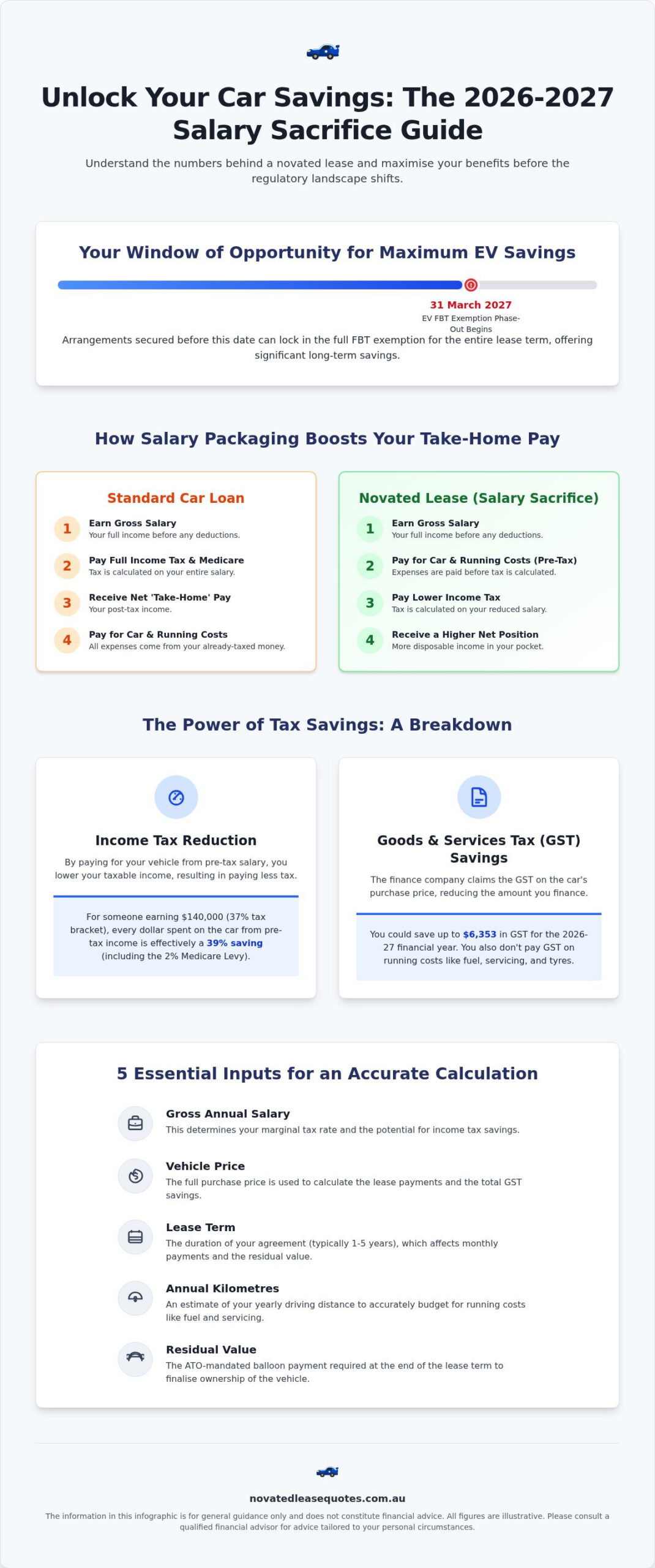
2026 is a critical year for this financial modelling. With the full Electric Vehicle (EV) Fringe Benefits Tax (FBT) exemption entering its final phase-out period on 31 March 2027, timing is everything. Securing an arrangement now allows you to retain the full exemption for the life of the lease, even as rules tighten for new entrants in later years. Without a specialised salary sacrifice car calculator, you risk missing the window for these significant savings or miscalculating how the current 30% tax bracket for incomes between $45,001 and $135,000 affects your packaging potential.
The financial logic of salary packaging
Salary packaging works by shifting vehicle costs from your after-tax salary to your pre-tax income. What is a novated lease? It is a three-way agreement between you, your employer, and a finance provider. Your employer makes the lease payments on your behalf, which reduces your total taxable earnings. Assessable income is the total amount of gross earnings you receive before any tax is withheld or deductions are applied, serving as the starting figure from which your Australian tax obligations are calculated. By lowering this figure, you effectively pay less income tax while funding your vehicle’s running costs, including fuel, insurance, and servicing.
The “Take-Home Pay” test
Many professionals fear that a lease deduction will leave them short on monthly cash. However, the “take-home pay” test often proves the opposite. Because you aren’t paying GST on the purchase price (saving up to $6,353 in the 2026-27 year) and you’re paying for running costs with pre-tax dollars, your net position is often stronger than if you took out a standard car loan. A salary sacrifice car calculator allows you to compare the opportunity cost of an upfront cash purchase against a lease, showing you how much capital you can keep in your offset account or investments instead of tying it up in a depreciating asset.
Using these tools early in the process prevents “sticker shock” when you visit a showroom. Instead of looking at a $60,000 price tag and wondering if you can afford the monthly repayments, you’ll know exactly how many dollars will be deducted from your pay packet each fortnight. This clarity gives you the leverage to negotiate with confidence, knowing your exact budget and the tax-optimised reality of your purchase.
Decoding the math: How the calculator processes your income
The true value of a novated lease isn’t found in the car itself, but in the underlying tax architecture. A salary sacrifice car calculator doesn’t just subtract a payment from your pay packet. It performs a multi-layered simulation of your taxable income. It evaluates how your gross salary interacts with the 2026-2027 tax brackets, where the 30% rate now applies to income up to $135,000. By diverting a portion of your gross salary toward vehicle expenses, you effectively lower the amount of income the ATO can tax. This keeps more money in your pocket every fortnight.
Accuracy is paramount here. The calculator must account for the 2% Medicare Levy and the specific impact of your total earnings. For instance, an individual earning $140,000 sits in the 37% tax bracket. Every dollar sacrificed from their pre-tax income for car running costs represents a 39% total saving when including the levy. These aren’t just theoretical numbers. They’re tangible increases to your disposable income that a standard car loan simply cannot replicate.
GST and the 10% advantage
One of the most immediate benefits processed by the calculator is the GST credit. When you purchase a vehicle privately, you pay the full retail price including 10% GST. Under a novated lease, the financier claims the GST back as an input tax credit, which reduces the total amount you need to finance. For the 2026-2027 financial year, the maximum GST credit for cars is $6,353. This “leased price” is significantly lower than the “retail price” found in showrooms. The savings also extend to your daily drive. You don’t pay GST on fuel, tyres, or servicing, as these costs are also processed as tax-free expenses within the lease structure.
The Employee Contribution Method (ECM) explained
Fringe Benefits Tax (FBT) is a 47% tax applied to benefits provided by employers. To avoid this high rate, the calculator uses the Employee Contribution Method. This involves paying a portion of your lease costs from your post-tax salary. By doing this, you reduce the taxable value of the car benefit to zero, effectively “killing” the FBT liability. A precise Novated Lease Calculator: Maximise Your 2026 Salary Packaging Savings will determine the exact dollar-for-dollar split required to eliminate FBT while maximising your income tax savings. If you’re ready to see how these numbers apply to your own pay slip, you can request a tailored comparison to find the most efficient structure for your needs.
EVs vs Petrol: Modelling the 2026 FBT exemption impact
While purchase prices for different engine types are converging, the financial gap between internal combustion engine (ICE) vehicles and electric vehicles (EVs) has never been wider. A salary sacrifice car calculator reveals that a petrol car and an electric car with identical $60,000 price tags have vastly different impacts on your take-home pay. This is primarily due to the Electric Vehicle FBT exemption. It effectively acts as a “cheat code” for Australian taxpayers, allowing you to fund the entire cost of a vehicle using pre-tax dollars without the usual tax penalties.
For a petrol vehicle, you must use the Employee Contribution Method to offset the 47% Fringe Benefits Tax. This requires a significant portion of your lease payment to come from post-tax dollars. In contrast, an eligible EV under the fuel-efficient Luxury Car Tax threshold incurs zero FBT. This means every cent of the lease and its running costs is paid before your income is taxed, significantly increasing your take-home pay compared to any other finance method.
The FBT-Free advantage for Australian employees
Australian employees can save thousands of dollars annually by removing FBT from the equation. Under current regulations, any arrangement entered into before 31 March 2027 retains this full exemption for the life of the lease. This creates a clear deadline for those looking to maximise their savings. Certain Plug-in Hybrids (PHEVs) also remain eligible for these benefits provided they meet specific emission standards and fall under the relevant price caps. You can find more details in our EV Novated Lease Australia: The 2026 Guide to FBT-Free Salary Packaging.
Modelling charging vs. fuel costs
Running costs are the second half of the savings story. A salary sacrifice car calculator allows you to input estimated energy costs to see the long-term benefit of switching to electric. For the 2026-2027 financial year, the ATO allows a home charging rate of 5.47 cents per kilometre to simplify electricity cost calculations for FBT purposes. The Luxury Car Tax threshold for fuel-efficient vehicles is $91,661 for the 2026-2027 financial year. By modelling home charging against the rising price of petrol, the calculator shows a clear reduction in your total cost of ownership. These lower energy costs are also paid for using pre-tax income, compounding the savings over the term of your lease.
Accuracy check: 5 inputs you must get right for a reliable quote
A salary sacrifice car calculator is a powerful diagnostic tool, but its utility is directly tied to the precision of your data. Many Australians treat these calculators as a rough guide, yet small errors in your inputs can lead to significant financial discrepancies over a four or five-year lease. To ensure your projections match your actual bank balance, you must look beyond the car’s sticker price and focus on the technical variables that dictate your tax savings. Precise modelling now prevents frustrating adjustments to your take-home pay later.
Your annual salary is the first critical pillar. You must include any regular bonuses or commissions, as these can push you into a higher tax bracket. In the 2026-2027 financial year, the jump from the 30% bracket to the 37% bracket occurs at $135,001. If your base salary is $130,000 but you earn a $10,000 bonus, your savings potential per dollar sacrificed increases. Failing to account for this means the calculator will underestimate your total tax benefit. Similarly, your annual kilometres must be a realistic reflection of your driving habits. Underestimating your mileage results in insufficient funds being set aside for fuel or electricity, which can lead to a debt at the end of the lease term.
The Residual Value trap
The residual value, often called a balloon payment, is the amount owing to the financier at the end of the lease. The ATO mandates minimum residual percentages based on the lease term. For a five-year lease, the minimum is 28.13% of the purchase price. While a higher residual value lowers your fortnightly deductions, it increases the amount you must pay out or refinance when the lease ends. A reliable salary sacrifice car calculator should clearly display this figure so you can plan for the eventual handover or upgrade without any surprises.
Estimating running costs realistically
Running costs are where many generic calculators fail. Registration and CTP insurance costs vary significantly between Australian states, and these must be factored into your budget. You also need to account for tyres and scheduled servicing, which are often overlooked in “best-case” scenarios. Using realistic Australian averages rather than optimistic guesses ensures your salary packaging remains sustainable. For a deeper look at these variables, see our Novated Lease Running Costs: A Complete Guide to Salary Packaging Car Expenses. Once you have these figures, you can compare competitive novated lease quotes to see which provider offers the best value for your specific profile.
From estimation to execution: Comparing quotes with the experts
Once you have used a salary sacrifice car calculator to model your potential savings, you have a baseline for your negotiations. It’s essential to remember that while these tools provide a highly accurate simulation based on current ATO rules and tax brackets, the result is an estimate rather than a binding contract. The actual cost of your lease depends on the specific financier’s interest rates and the administrative fees of the packaging company. Your calculator summary is your most powerful asset during the shopping around phase, as it allows you to spot discrepancies in formal quotes immediately.
A calculator result gives you the confidence to vet a provider’s offer. If a formal quote shows a significantly lower take-home pay than your calculation, you can ask the provider to explain the gap. Often, this reveals hidden costs or conservative estimates that might not align with your actual driving habits. Using your data to force transparency ensures you aren’t overpaying for the convenience of the lease.
Why one quote is never enough
Not all novated leases are created equal. Different providers offer varying interest rates and management fees that can significantly alter the effective cost of the vehicle. Some leasing companies also include hidden “buffer” amounts in their running cost estimates, such as inflated fuel or maintenance projections, to protect their own margins. By comparing multiple offers, you can identify which provider is offering a genuinely competitive rate versus one that is simply padding the budget. For a detailed breakdown of what to look for, read our Novated Lease Comparison 2026: The Australian Guide to Finding the Best Deal.
The Novated Lease Quotes advantage
Navigating the transition from a salary sacrifice car calculator estimate to a formal application doesn’t have to be complex. This is where an independent comparison service provides the most value. We connect you with specialists who are deeply familiar with the 2026 regulatory landscape, including the latest LCT thresholds and EV FBT nuances. Instead of dealing with multiple sales teams, you get a streamlined overview of the market’s best options tailored to your specific financial profile.
Moving from the dreaming phase to execution requires coordination between you, your employer, and the financier. Our platform simplifies this process by ensuring the paperwork is handled efficiently and that your employer understands their role in the three-way agreement. If you’re ready to turn your calculations into a reality, you can get your personalised novated lease quotes today and secure your 2026 tax savings before the next round of regulatory changes.
Secure your 2026 vehicle savings today
Navigating the complexities of Australian tax law doesn’t have to be a solo journey. You now understand how a salary sacrifice car calculator serves as your financial roadmap, helping you distinguish between pre-tax savings and post-tax obligations. You’ve seen how the 2026-2027 tax brackets and the current EV FBT exemptions create a unique window for significant savings. Accuracy remains your best defence against end-of-lease surprises, so ensure your inputs for mileage and residual values are realistic before finalising any agreement.
The final step is to move beyond the simulation and into a structured deal. As an independent Australian comparison service, we provide the specialist advice you need to navigate EV FBT exemptions and access competitive quotes from national leasing providers. Don’t leave your financial optimisation to chance. Use your calculated estimates as a baseline to secure a deal that prioritises your take-home pay and long-term financial health.
Get Multiple Novated Lease Quotes and Compare Your Savings. You’re now equipped with the data and the strategy to drive a better bargain for your next vehicle.
Frequently Asked Questions
Is a salary sacrifice car calculator accurate for used cars?
A salary sacrifice car calculator is highly accurate for used vehicles, provided you distinguish between dealer and private sales. If you purchase from a GST-registered dealer, the financier can still claim the GST credit on the purchase price, which reduces your total financed amount. For private sales, you lose the initial GST benefit on the price but still retain the tax savings on all ongoing running costs and GST credits on fuel and servicing.
How does my tax bracket affect the savings shown on a car lease calculator?
Your tax bracket is the primary driver of your total savings. Because lease payments are deducted from your pre-tax salary, you avoid paying tax at your highest marginal rate on that income. For example, if you sit in the 37% bracket for income over $135,000, you effectively save 39 cents, including the 2% Medicare Levy, for every dollar sacrificed toward your vehicle expenses.
Can I include a spouse’s driving in my novated lease running cost calculation?
You can absolutely include your spouse’s driving in your running cost estimates. A novated lease is tied to the vehicle rather than a specific driver. Whether you or your partner is behind the wheel, all fuel, insurance, and maintenance costs for that specific car are paid from your packaged funds. This allows you to maximise the pre-tax benefit regardless of who the primary driver is.
Does the calculator account for the Medicare Levy and other tax offsets?
A comprehensive salary sacrifice car calculator must account for the 2% Medicare Levy to be truly reliable. By reducing your taxable income through salary packaging, you also reduce the total Medicare Levy you owe. While some basic tools only focus on marginal tax rates, factoring in the levy and relevant tax offsets provides a more precise view of your actual take-home pay.
What happens if the calculator shows I’ll be over the Luxury Car Tax threshold?
If your vehicle exceeds the Luxury Car Tax threshold, which is $80,809 for standard vehicles or $91,661 for fuel-efficient models in 2026-2027, the calculator adds the 33% LCT to the financed amount. This increases your monthly lease payments. Precise modelling is essential here to ensure you understand how this additional tax affects your total packaging budget and whether an EV might be a more tax-efficient alternative.
How often should I update my salary sacrifice car calculation if my income changes?
You should update your calculation whenever your gross income changes significantly or if you shift between tax brackets. Changes that move you across a threshold, such as the $135,000 mark, alter your marginal tax rate and the resulting savings. Regular reviews ensure your payroll deductions remain accurate and that you aren’t under-contributing to your running cost budget as your career progresses.
Why do different calculators show different monthly payment results for the same car?
Variations between calculators usually stem from different assumptions regarding interest rates, management fees, and running cost buffers. Some providers build in a higher contingency for fuel and maintenance to prevent end-of-lease debt, while others use more aggressive interest rate estimates. This is why using your calculator results as a baseline to compare formal quotes from multiple providers is a critical step in the process.
Can a salary sacrifice car calculator model the impact of changing jobs?
Most calculators can model the financial impact of changing jobs by illustrating the cost of “re-novating” the lease with a new employer. A novated lease is portable, meaning you can take it with you to any employer that offers salary packaging. The calculator helps you understand the required adjustments to your new pay cycle and ensures the transition remains tax-effective during your career move.