Choosing the wrong car for your salary packaging arrangement could cost you more in tax than the fuel you’ll put in the tank. It is a common trap in 2026, where the difference between a tax-effective asset and a financial burden often comes down to technical classifications. You have likely felt the frustration of trying to distinguish between commercial and passenger vehicle rules, or perhaps you feel anxious about whether a used car is worth the effort. It is a complex landscape to navigate when you simply want to optimise your take-home pay.
This guide simplifies the selection of novated lease vehicles to ensure you maximise your financial position. You will discover which models qualify for the most significant tax shields, including how the A$91,661 Luxury Car Tax threshold for fuel-efficient cars changes the math for your next purchase. We will also compare the real-world savings of electric versus petrol and clarify the rules for used cars, which remain eligible if they are under 12 years old at the end of the lease term. We provide the clarity you need to move from confusion to a specific model quote with absolute confidence.
Key Takeaways
- Understand the ATO’s strict definition of a “car” to ensure your chosen model qualifies for salary packaging, focusing on the critical one-tonne load capacity limit.
- Learn why electric novated lease vehicles remain the most tax-effective choice in 2026, offering potential savings of over A$10,000 annually via FBT exemptions.
- Navigate the specific age and odometer restrictions for used cars to ensure your vehicle is no more than 12 years old at the end of the lease term.
- Identify how the 2026 Luxury Car Tax thresholds of A$91,661 for fuel-efficient cars and A$80,809 for others will impact your total monthly repayments.
- Discover why comparing independent quotes and using an ROI calculator is essential to securing the most competitive deal beyond your employer’s default provider.
Understanding Vehicle Eligibility for Novated Leasing in Australia
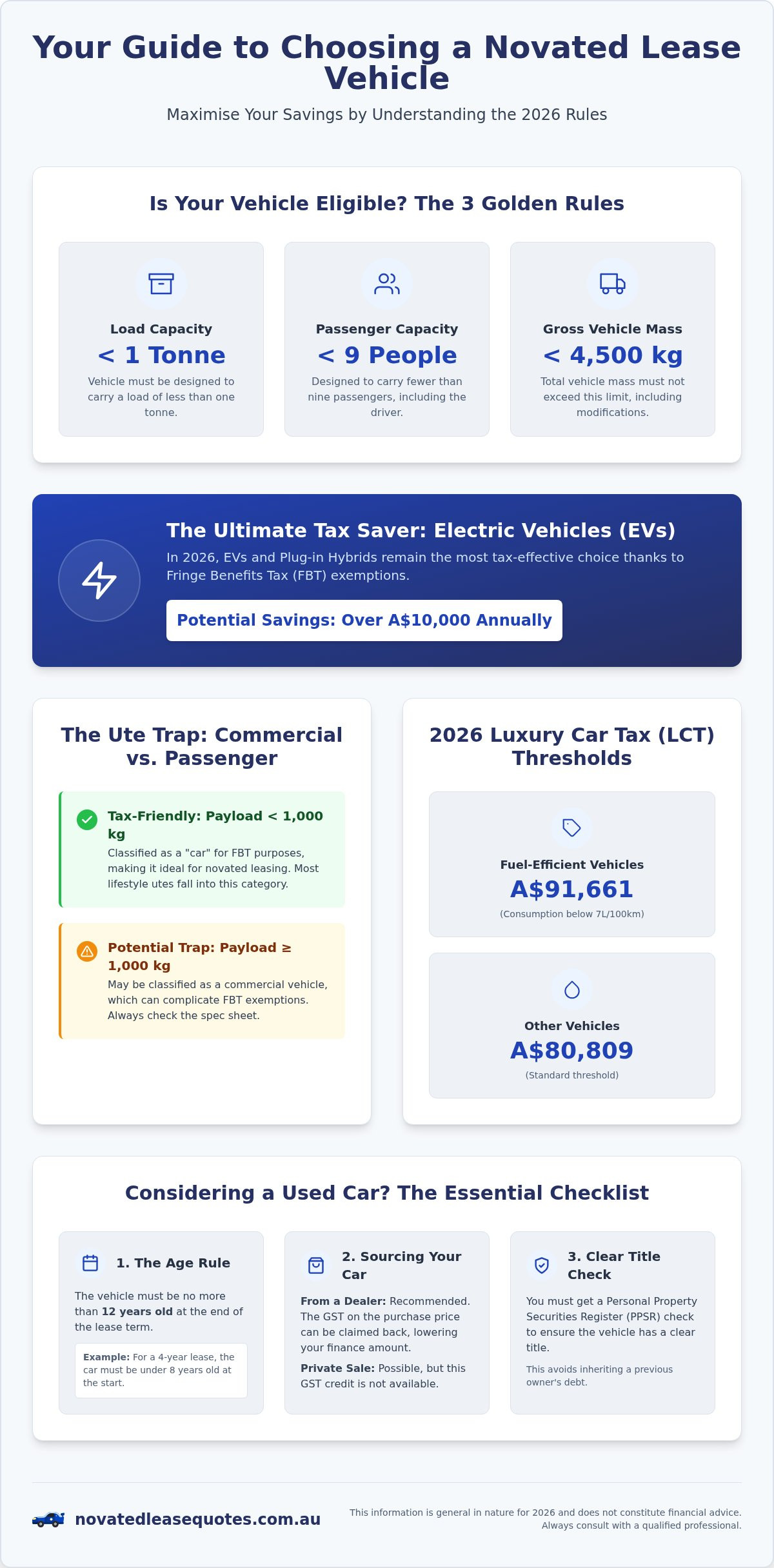
Selecting a car for salary packaging isn’t as simple as picking your favourite colour. The Australian Taxation Office (ATO) has a very specific definition of what constitutes a “car” for FBT purposes. To qualify as one of the many eligible novated lease vehicles, the model must be designed to carry a load of less than one tonne and fewer than nine passengers. You should understand What is a novated lease? before committing, as this three-way agreement relies on the vehicle meeting these strict classifications. Most passenger cars, SUVs, and standard 4×4 utes fit comfortably within these bounds, but heavy commercial vans and trucks are generally excluded.
Your intended use also plays a role in how you structure the deal. While the lease is designed for private use, the tax effectiveness remains high regardless of how many kilometres you drive for work. This makes the arrangement ideal for those who want a high-spec vehicle for personal lifestyle needs without the burden of using post-tax income for every running cost. It provides a structured way to drive a better car while optimising your take-home pay.
Passenger Vehicles vs Commercial Utes
Dual-cab utes are incredibly popular in Australia, but they carry a technical trap. The ATO’s 1,000kg payload rule is the deciding factor. If a ute’s payload, which is the Gross Vehicle Mass minus the kerb weight, is exactly one tonne or more, it’s often categorised as a commercial vehicle rather than a car. This change in status can complicate the FBT exemptions you might be expecting. Most manufacturers design their lifestyle utes to stay just under this limit, ensuring they remain “cars” for tax purposes. When choosing between a family SUV and a lifestyle ute, check the spec sheet for the payload capacity to avoid any surprises during the approval process.
Seating Capacity and Gross Vehicle Mass (GVM)
Capacity limits extend to the number of people you can transport. If a vehicle is designed to carry nine or more passengers, it’s no longer a “car” under the relevant tax legislation. This is a vital consideration for those with large families looking at specialised people movers. Additionally, the Gross Vehicle Mass (GVM) must not exceed 4,500kg. While standard novated lease vehicles rarely approach this weight, it’s a factor for those planning significant off-road modifications. Adding heavy steel trays, canopies, or GVM upgrade kits can shift the vehicle’s classification. Always ensure your modifications are ADR-compliant and don’t push the vehicle into a heavy vehicle category, as this will likely disqualify it from a standard novated lease.
New, Used, or Your Own: Exploring Vehicle Sourcing Options
While most people associate salary packaging with a shiny new model, the range of novated lease vehicles actually includes used cars and even the one currently sitting in your driveway. New cars remain popular because they come with full manufacturer warranties and the latest safety tech. They also simplify the finance process, as providers often have established relationships with major dealerships. However, if you’re looking to avoid the steep depreciation typical of the first few years of ownership, a well-maintained used car can be a smarter financial move for your budget.
The choice between new and used often comes down to your personal priorities for reliability versus upfront cost. New vehicles offer the peace of mind that comes with capped-price servicing and the latest fuel-efficiency standards. Conversely, used vehicles allow you to access higher-spec models that might otherwise sit outside your price range if bought brand-new. Both options allow you to bundle all running costs into a single, predictable monthly payment.
The Used Car Checklist
Sourcing a used vehicle requires a bit more due diligence to meet financier requirements. Most providers mandate that the car is no more than 12 years old at the end of the lease term. For example, if you’re planning a four-year lease, the vehicle cannot be older than eight years at the start. Buying from a licensed dealer is generally preferred because the GST on the purchase price can be claimed back by the leasing company, effectively lowering your total finance amount. Private sales are possible, but they don’t include this GST credit. You must also ensure the vehicle has a clear title via a PPSR check to avoid inheriting a previous owner’s debt.
What is a Leaseback Arrangement?
A leaseback allows you to unlock the equity in a car you already own. The leasing company “purchases” the vehicle from you at its current market value and then leases it back to you under a standard novated agreement. This process immediately shifts your fuel, insurance, and maintenance costs from post-tax to pre-tax income. It is a highly efficient way to manage Fringe Benefits Tax (FBT) rules while keeping your current car. If you have an existing car loan, the leaseback can often pay it out, consolidating your automotive expenses into one tax-effective payment. To see how much equity you could unlock, it is worth using a comparison service to evaluate different provider terms.
The age of the vehicle directly impacts your residual value, or “balloon” payment. This is the fixed amount you pay at the end of the lease to take full ownership. Older cars typically have lower residual percentages set by the ATO, meaning your monthly repayments might be slightly higher to cover the faster depreciation. Balancing the age of the car with the length of the lease is key to finding the most tax-effective outcome for your specific salary bracket.
The EV Revolution: Why Electric Vehicles Dominate 2026 Salary Packaging
Electric cars have transitioned from a niche preference to the primary choice for tax-conscious employees in 2026. This shift is driven by the Federal Government’s Electric Car Discount, which has made battery electric vehicles the most cost-effective novated lease vehicles on the market. By utilising the Electric Vehicle FBT exemption, you can often save over A$10,000 annually compared to a traditional petrol or diesel equivalent. These savings stem from the removal of Fringe Benefits Tax, which otherwise applies to internal combustion engine cars regardless of how they are financed.
It is vital to distinguish between different “green” technologies. Since April 1, 2025, Plug-in Hybrid Electric Vehicles (PHEVs) have been excluded from the full FBT exemption unless a binding agreement was already in place. For those starting a new lease in 2026, the focus should remain on pure Battery Electric Vehicles (BEVs) to secure the highest possible return on investment. This policy landscape means that even a more expensive EV can result in lower monthly out-of-pocket costs than a cheaper petrol car.
The FBT-Free Threshold
To qualify for the full tax shield, the vehicle’s retail price must sit below the Luxury Car Tax (LCT) limit. Staying under this ceiling is the difference between a standard lease and a highly optimised salary package. For the 2026-2027 financial year, the Luxury Car Tax threshold for fuel-efficient vehicles is A$91,661. If your chosen model exceeds this value, even by a small margin, you lose the full FBT exemption, which significantly increases your monthly repayments. Manufacturers have responded by pricing many premium EV models just under this limit to ensure they remain attractive for salary packaging.
Packaging Running Costs for EVs
The benefits of an electric lease extend far beyond the initial purchase price. You can package the entire charging ecosystem, including the installation of a high-speed wallbox at your home and heavy-duty charging cables for travel. Home electricity costs used for charging can also be estimated and included in your pre-tax budget, further reducing your taxable income. Many drivers also include public charging network subscriptions and RFID tags in their lease to ensure seamless, cashless charging across Australia. Because EVs have significantly fewer moving parts than petrol engines, your maintenance budget is typically much lower, leaving more room in your salary for other essentials. This streamlined approach to running costs makes electric novated lease vehicles the benchmark for financial efficiency in 2026.
Selecting Your Vehicle Based on Lifestyle and Tax Savings
Your annual salary is the most significant factor in determining the “effective” price of your car. Because a novated lease reduces your taxable income, those in higher tax brackets often see the most substantial savings. For a professional earning over A$190,000, the tax shield provided by novated lease vehicles can effectively reduce the purchase cost by thousands compared to using post-tax savings. It is no longer a requirement to drive high annual kilometres to see a benefit. The shift in Australian tax policy means the primary lever for ROI is now the vehicle’s classification and its ability to reduce your PAYG tax obligations.
When evaluating different models, it is essential to look at the long-term financial outcome. A novated lease vs car loan comparison reveals that while a standard loan might offer a lower interest rate, it lacks the GST savings on the purchase price and the ability to pay for fuel and servicing with pre-tax dollars. This makes the lease a superior tool for financial optimisation across almost every car segment.
Small Cars vs Large SUVs
The vehicle segment you choose dictates your residual value, which is the “balloon” payment required at the end of the lease. Mid-sized SUVs currently represent the “sweet spot” in the Australian market. They tend to hold their value better than small hatchbacks or oversized luxury wagons, which can lead to a better result if you choose to sell the car when the lease concludes. You should also consider how novated lease running costs scale with vehicle size. Larger SUVs incur higher insurance premiums and tyre replacement costs, all of which are bundled into your pre-tax repayments, so choose a size that fits both your driveway and your budget.
Impact of the Luxury Car Tax
Premium European vehicles often fall into the “Luxury Car Tax” trap. For the 2026-2027 financial year, the LCT threshold for non-fuel-efficient vehicles is A$80,809. If you select a petrol-powered sedan that costs A$85,000, you will pay a 33% tax on the amount above that threshold. This “near-luxury” price point can make some cars surprisingly expensive on a monthly basis. A smart strategy is to keep the base vehicle price below the threshold and package accessories, such as window tinting or tow bars, separately if they are fitted after delivery. This helps you avoid inflating the LCT-applicable value while still getting the features you need. To find the most tax-effective model for your specific salary, you can request a tailored comparison quote from our specialists.
Securing Competitive Quotes for Your Chosen Vehicle
Many Australian employees mistakenly believe they are locked into using the default leasing provider suggested by their employer. This assumption can be a costly mistake. Default providers often lack the incentive to offer the most competitive interest rates or management fees because they have a captured audience. To ensure you are getting the best deal on novated lease vehicles, you must take control of the procurement process. Start by using a novated lease calculator to establish a baseline for your expected savings. This tool allows you to model different scenarios based on your salary and the specific car you want, providing a clear figure to compare against any formal offer.
Transparency is your greatest asset during the negotiation phase. In 2026, typical interest rates for novated leases fluctuate between 7.00% and 10.3% p.a., so any quote significantly higher than this range deserves scrutiny. Look beyond the monthly repayment figure and ask for a breakdown of the financier’s margin and any ongoing administration fees. A slightly lower monthly payment might hide a higher interest rate if the residual value has been artificially inflated. Understanding these mechanics ensures you aren’t just saving tax, but also minimising the total cost of ownership.
Comparing Apples with Apples
Hidden fees can quickly erode the tax benefits of your salary packaging arrangement. When reviewing novated lease quotes, verify exactly what is included in the running costs budget. Does the insurance offer “new for old” replacement? Is premium roadside assistance included, or is it a basic tier? Some providers bundle high-margin add-ons like tyre and rim insurance or paint protection that you might not actually need. By stripping back the quote to the essentials, you can negotiate a leaner, more effective deal that prioritises your take-home pay over provider profits.
Ready to Package Your Next Car?
Transitioning from research to signing is a straightforward process when you have your documentation organised. First, obtain a firm price for your chosen car from a dealer or use a specialist to source the best fleet pricing. Second, gather your two most recent payslips and a copy of your driver’s licence to begin the credit approval. Finally, review the lease term carefully. While a five-year term offers the lowest monthly repayments, a three-year term might better suit your lifestyle if you prefer to upgrade novated lease vehicles more frequently. Once you have compared multiple independent quotes and verified the total cost of the lease, you can proceed with the confidence that your new car is working as hard for your finances as it does for your commute.
Maximise Your 2026 Salary Packaging Potential
Navigating the technicalities of ATO classifications and luxury tax thresholds is the first step toward a more efficient financial future. By aligning your vehicle choice with your salary bracket and lifestyle needs, you turn a standard commute into a powerful tax saving tool. You now understand that while electric cars offer the most significant savings in 2026, a carefully selected used vehicle or a strategic leaseback arrangement can also provide substantial benefits. The landscape for novated lease vehicles is highly competitive, meaning you have the leverage to secure a deal that prioritises your take-home pay.
To ensure you are getting the most value, it’s essential to look beyond your employer’s default provider. Our platform provides an independent and objective comparison service with access to multiple Australian providers. You can also use our free 2026 savings calculator to model your potential return on investment with precision. Compare Novated Lease Quotes for Your Dream Car Now and take the final step toward driving your ideal car with absolute confidence. It is time to put your salary to work and start enjoying the benefits of a smarter automotive choice today.
Frequently Asked Questions
What are the most popular novated lease vehicles in Australia for 2026?
Electric vehicles like the Tesla Model Y and the BYD Atto 1 are currently the most popular novated lease vehicles due to the significant FBT exemptions available. Mid-sized SUVs from Toyota and Kia also remain high on the list for their strong resale value and reliability. These models offer a balance of practical lifestyle features and tax efficiency that appeals to a broad range of Australian professionals looking to optimise their salary.
Can I get a used car on a novated lease if it is over 10 years old?
Yes, but the car must generally be no more than 12 years old at the end of the lease term. If you want a three-year lease, the car should be no older than nine years at the start. This ensures the vehicle maintains enough residual value to meet ATO requirements. It is a flexible way to package a reliable second-hand car without the high depreciation costs of a brand-new model.
Are dual-cab utes eligible for a novated lease?
Most dual-cab utes are eligible provided their payload capacity is less than 1,000kg. Popular models like the Ford Ranger and Toyota HiLux are designed to fit this “car” classification for tax purposes. If the payload exceeds one tonne, the vehicle may be classified as a commercial asset, which changes the FBT rules. You should always check the manufacturer’s Gross Vehicle Mass (GVM) before committing to a specific ute to ensure it qualifies.
Does the EV FBT exemption apply to all electric vehicles?
No, the exemption only applies to battery electric vehicles priced below the Luxury Car Tax threshold for fuel-efficient cars. For the 2026-2027 financial year, this limit is A$91,661. Any EV exceeding this retail price will incur Fringe Benefits Tax, which significantly reduces your potential savings. Additionally, plug-in hybrids are no longer eligible for the full exemption unless they were packaged under a binding agreement established before April 2025.
What happens to my leased vehicle if I change jobs?
Your novated lease is fully portable, meaning it can move with you to a new employer. If your new workplace offers salary packaging, they can simply take over the “novation” agreement. If they don’t, or if you take a break from work, you become responsible for the lease payments using your post-tax funds. This flexibility ensures you don’t lose the vehicle or the equity you’ve built during your employment transition.
Can I package a car that I already own through a leaseback?
You can package a car you already own through a process called a leaseback arrangement. The leasing company purchases the vehicle from you at its current market value and then leases it back to you as a standard novated lease vehicles arrangement. This is an efficient way to unlock equity in your car while shifting your running costs from post-tax to pre-tax income, immediately lowering your taxable salary and improving your cash flow.
Are there any vehicles that are specifically excluded from novated leasing?
Vehicles designed to carry more than one tonne or more than eight passengers are generally excluded from standard novated leasing. This includes heavy commercial trucks, large transit vans, and motorcycles. The ATO defines a “car” quite strictly for these agreements. If your vehicle doesn’t meet these criteria, you won’t be able to access the standard FBT concessions that make salary packaging so financially attractive for regular passenger cars.
Is there a limit on how much I can spend on a novated lease vehicle?
There is no legal limit on the purchase price, but the Luxury Car Tax (LCT) provides a practical ceiling for many drivers. For 2026-2027, the LCT threshold is A$80,809 for standard cars and A$91,661 for fuel-efficient models. Spending above these amounts triggers a 33% tax on the excess, which can make the lease less cost-effective. Your individual borrowing capacity and salary will ultimately dictate the most appropriate spending limit for your situation.