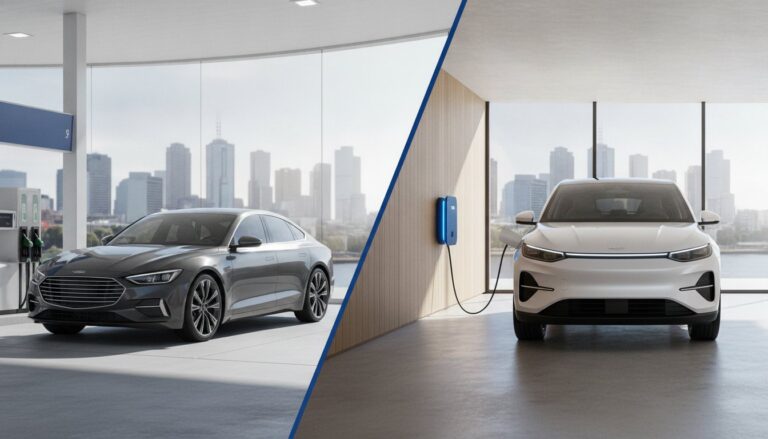
Could a $70,000 electric SUV actually leave more money in your bank account than a $45,000 petrol sedan? In the 2026 tax landscape, the traditional logic of chasing the lowest sticker price has been turned on its head. When you weigh up a novated lease petrol vs electric today, the decision isn’t just about the environment; it’s a calculated financial strategy to protect your salary from rising costs.
It’s frustrating to watch petrol prices sit stubbornly above 180 cents per litre while you try to figure out if the Fringe Benefits Tax (FBT) exemption still makes sense for your next car. We’re here to clear the confusion. You’ll discover exactly how the current tax savings, charging infrastructure, and the $91,661 Luxury Car Tax threshold compare so you can choose the most efficient salary package for your lifestyle. We’ll examine the hard data on running costs and the 2026-27 tax rules to ensure you aren’t leaving thousands of dollars on the table. Whether you’re a high-kilometre regional driver or a city commuter, this comparison provides the clarity you need to lower your total cost of ownership.
Key Takeaways
- Discover how the 2026 Fringe Benefits Tax (FBT) exemption for eligible electric vehicles can significantly reduce your monthly repayments compared to internal combustion alternatives.
- Evaluate the long-term financial impact of a novated lease petrol vs electric by comparing current fuel costs against home charging efficiency and the latest Luxury Car Tax thresholds.
- Learn how to package your daily running costs to ensure your budget remains predictable despite fluctuating prices at the bowser or changes in electricity tariffs.
- Assess your specific driving profile and infrastructure access to determine if an EV or a petrol vehicle is the most pragmatic choice for your regional or metropolitan lifestyle.
- Gain a clear, step-by-step framework to model different vehicle scenarios and find the exact salary package that maximises your take-home pay.
The Great Debate: Petrol vs Electric Novated Leases in 2026
The Australian automotive market has undergone a radical transformation over the last few years. By July 2026, battery electric vehicles (BEVs) have captured 23.4% of new car sales, reflecting a massive shift in how we choose our daily transport. However, deciding between a novated lease petrol vs electric isn’t just about following a trend. It’s about understanding what is a novated lease and how the three-way agreement between you, your employer, and a finance company actually functions in the 2026 tax environment. The sticker price you see at a dealership is often a poor indicator of your actual monthly out-of-pocket costs because the tax treatment varies wildly between engine types.
In the current market, the Federal Government’s Electric Car Discount remains the most influential factor for salary packaging. While the upfront purchase price of an EV might be higher, the ability to pay for the car and its running costs entirely from your pre-tax salary can result in a higher take-home pay than if you chose a cheaper petrol car. This creates a scenario where the “cheaper” car on paper is actually the more expensive one to own. For the 2026-27 financial year, the Luxury Car Tax (LCT) threshold for fuel-efficient vehicles has been set at $91,661, providing a generous ceiling for those looking to maximise their tax position through a novated lease.
The Traditional Petrol Lease: Familiarity and Flexibility
Internal combustion engine (ICE) vehicles remain a pragmatic choice for many Australians, particularly those in regional areas or high-kilometre drivers who require the convenience of rapid refuelling. For these cars, the Australian Taxation Office (ATO) typically applies a flat 20% statutory formula to calculate Fringe Benefits Tax (FBT). While this is a proven model, it’s sensitive to external factors that are difficult to control. With national unleaded prices averaging between 180.2 and 182.3 cents per litre in mid-2026, the volatility of the bowser can make budgeting for running costs a moving target. Petrol leases offer the widest range of vehicle styles and the flexibility of a mature refuelling network, but they don’t benefit from the aggressive tax breaks currently favouring electric alternatives.
The Electric Revolution: Tax Efficiency and Innovation
The 2026 landscape for electric vehicles is defined by significant tax efficiency. Eligible BEVs are currently exempt from FBT, a benefit scheduled to remain in its full form until March 31, 2027. This exemption is a financial game-changer; it effectively removes the largest tax burden associated with salary packaging a vehicle. With more than 103,000 EVs sold in the first half of 2026 alone, the market is no longer just for early adopters. The influx of affordable models, particularly from Chinese manufacturers who now hold 58% of the local EV market, means that financial optimisation and environmental goals are finally aligning for the average Australian worker. Choosing an EV in 2026 allows you to bypass fuel price hikes entirely while leveraging a tax landscape designed to reward the switch to cleaner technology.
The Financials: Comparing Tax Savings and Repayments
When you sit down to compare a novated lease petrol vs electric, the math often defies traditional logic. Usually, a more expensive asset means higher monthly outgoings. However, salary packaging flips this script. By using a combination of pre-tax and post-tax income, you can significantly reduce your taxable salary. Both vehicle types benefit from the GST savings on the purchase price. Because you aren’t paying the 10% GST upfront, you’re effectively increasing your buying power from day one. For an EV, this saving is often more pronounced because it applies to a higher purchase price, staying under the 2026-27 Luxury Car Tax (LCT) threshold for fuel-efficient vehicles of $91,661.
This higher threshold is a deliberate part of Australia’s New Vehicle Efficiency Standard, which aims to make cleaner cars more accessible. While standard petrol cars face an LCT threshold of $80,809, the extra breathing room for EVs allows you to opt for premium models without triggering additional tax penalties. To see how these numbers apply to your specific salary, you can request a comparison of competitive quotes from our panel of specialists.
The FBT Exemption: The EV Super-Weapon
The most significant financial lever in 2026 is the Fringe Benefits Tax (FBT) exemption. For a petrol vehicle, you’d typically need to use the “Employee Contribution Method” to offset FBT, which involves using a portion of your post-tax income. For an eligible electric vehicle, this requirement disappears. Your entire lease payment and all running costs come out of your salary before you’re taxed. It’s important to recognise that as of April 1, 2025, Plug-in Hybrids (PHEVs) are no longer eligible for this exemption unless you have a pre-existing lease. If you’re starting a new lease in 2026, the pure electric path is the only way to access these specific FBT-free benefits.
Repayment Realities: Petrol Sedan vs. Electric SUV
Consider the “effective cost” of your lease. A $45,000 petrol sedan might appear cheaper on a dealership window than a $65,000 electric SUV. But once the FBT exemption and pre-tax deductions are applied, the monthly impact on your take-home pay for the SUV can actually be lower. This happens because the tax you *don’t* pay on the EV lease payments often exceeds the difference in the vehicle’s price. You can model these scenarios yourself using our novated lease calculator to see the exact impact on your fortnightly pay. The results frequently surprise drivers who assume EVs are out of their budget.
Running Costs: Fuel and Maintenance in a Salary Package
One of the primary advantages of salary packaging is how it simplifies your monthly budget. Whether you choose a novated lease petrol vs electric, your provider bundles all anticipated expenses into a single, predictable payment. These novated lease running costs are paid using your pre-tax salary, which effectively gives you a discount on every litre of fuel or kilowatt-hour of power you consume. In 2026, managing these costs through a lease is a vital buffer against the rising cost of living.
For petrol and diesel drivers, the bowser remains a source of frustration. With national unleaded prices averaging between 180.2 and 182.3 cents per litre in July 2026, the cost of a full tank can swing wildly from week to week. Packaging these costs allows you to use a fuel card, ensuring you never have to dip into your take-home pay at the service station. Conversely, EV drivers benefit from significantly lower “fuel” costs, especially when charging at home. With residential electricity rates ranging from 26.5c to 43.9c per kWh, the cost per kilometre is a fraction of a petrol equivalent. While public fast-charging sites have surpassed 1,300 locations across Australia, home charging remains the most cost-effective way to power your lease.
Maintenance and Tyres: The Hidden Differences
The maintenance profile of an electric vehicle is fundamentally different from a petrol car. EVs have fewer moving parts; there are no oil changes, spark plugs, or timing belts to replace. This usually results in lower mechanical servicing bills over a typical five-year lease. However, EVs are significantly heavier due to their battery packs. This extra weight, combined with the instant torque of electric motors, means that EV tyres often wear out faster than those on a petrol sedan. When we calculate a novated lease petrol vs electric, we ensure your budget accounts for these higher-specification tyres to avoid any out-of-pocket surprises. We also monitor battery health data to ensure your vehicle remains a high-performing asset throughout the lease term.
Insurance and Registration in 2026
Insurance premiums for electric vehicles in 2026 continue to track slightly higher than petrol models, largely due to the specialised labour and parts required for repairs. However, many Australian states still offer registration incentives or discounts for zero-emission vehicles to offset these costs. By packaging your insurance and registration into your novated lease, you level the playing field. The tax savings generated by paying these premiums from your pre-tax income often more than compensate for the higher base price of EV insurance. This holistic approach to budgeting ensures that the total cost of car ownership remains optimised, regardless of the engine type you choose.
Lifestyle and Infrastructure: Is Your Home Ready for an EV?
Choosing between a novated lease petrol vs electric is as much about your driveway as it is about your tax bracket. For metropolitan commuters, the convenience of charging at home while you sleep is a significant lifestyle upgrade. It effectively removes the weekly detour to a service station and the frustration of fluctuating fuel prices. However, for those with specific heavy-duty requirements, petrol still holds a pragmatic advantage. If your lifestyle involves towing a three-tonne caravan or frequent long-distance regional travel where charging remains sparse, the energy density of liquid fuel provides a level of flexibility that electric alternatives haven’t quite matched yet.
Australia’s infrastructure has made massive strides to support the transition. As of mid-2026, the fast-charging network has grown to over 1,300 locations. This expansion has significantly reduced range anxiety on major interstate routes, making long-distance EV travel more viable than ever before. Despite this progress, the decision still requires a realistic assessment of your regional driving profile. If you’re often off the beaten track in remote areas, the ubiquity of petrol stations is a comfort that shouldn’t be overlooked in your planning.
Home Charging Installation and the Lease
You can generally include the supply and installation of a home wallbox charger within your novated lease package. This allows you to pay for the equipment and electrical labour with pre-tax income, maximising your initial tax benefit. For those with rooftop solar, the financial case for an EV becomes even more compelling, as you can charge your vehicle using excess generation. Apartment residents should be proactive and engage with their strata committee early to verify if charging infrastructure can be supported in their specific parking bay before signing a lease.
Resale Value and the Residual Payment
Every novated lease concludes with a residual payment, a fixed amount set by the ATO based on the lease term. In the 2026 market, used EV values have stabilised as buyer confidence in battery longevity has increased. However, the rapid pace of EV innovation means that resale values can be more volatile than their petrol counterparts, which follow a more traditional trajectory. Managing this transition requires a clear strategy for the end of your term. To ensure you choose a vehicle with a manageable end-of-lease outcome, request a tailored quote comparison to see how different models are projected to hold their value over time.
Making the Choice: How to Decide Which Engine Suits Your Package
Deciding on a novated lease petrol vs electric requires a structured approach to your personal finances and driving habits. It isn’t just about the vehicle itself; it’s about how that car fits into your tax return and your daily routine. To find the most efficient path forward, follow this five-step framework designed for the 2026 Australian market.
- Step 1: Calculate your annual kilometres and driving profile. Metropolitan commuters doing 10,000 to 20,000 kilometres annually typically see the fastest return on an EV. Conversely, if your work involves constant long-distance regional travel, petrol remains a pragmatic fallback.
- Step 2: Assess your home and workplace charging capabilities. The financial “sweet spot” for EVs relies on cheap residential electricity. If you can’t charge at home or work, your running costs will be higher due to reliance on public fast-charging networks.
- Step 3: Compare total cost of ownership (TCO). Don’t look at the monthly payment in isolation. Use a dedicated EV novated lease australia guide to understand how the FBT-free status impacts your take-home pay over a three-to-five-year term.
- Step 4: Factor in your marginal tax rate. The FBT exemption is most powerful for those in higher tax brackets. If you’re earning over $120,000, the tax you avoid by packaging an EV is significantly higher than for someone in a lower bracket.
- Step 5: Get multiple quotes. Financier offers and residual value assumptions vary between providers. Comparing real-world offers is the only way to see the true “effective cost” of each vehicle type.
When Petrol is the Smarter Move
While the tax incentives for EVs are compelling, a novated lease petrol vs electric comparison still favours internal combustion for specific profiles. Regional sales representatives who cover vast distances daily often find the refuelling speed of petrol essential for productivity. Similarly, if you frequently tow heavy loads like horse floats or large boats, the range depletion in current electric SUVs can be a significant hurdle. Finally, if you’re in the lowest tax bracket, the FBT savings are minimised, which may make a cheaper, entry-level petrol car the more conservative financial choice.
The Verdict: Why 2026 is the Year of the EV Lease
For the average Australian urban commuter, 2026 represents a unique window of opportunity. The combination of the FBT exemption, the $91,661 Luxury Car Tax threshold for fuel-efficient vehicles, and a mature range of affordable models makes the electric choice mathematically superior for most. However, the market is complex and rules are subject to change. Performing a thorough novated lease comparison is essential before you sign any agreement. Ready to see the numbers for yourself? Get your personalised petrol vs electric quote today and discover exactly how much you could be saving on your next car.
Optimise Your Salary for the 2026 Tax Year
The 2026 automotive landscape offers a rare chance to significantly boost your take-home pay through smart vehicle selection. While the Fringe Benefits Tax exemption makes electric vehicles a dominant choice for urban commuters, the flexibility of petrol remains a valid path for those with specific regional requirements. Successfully navigating a novated lease petrol vs electric decision comes down to comparing the total cost of ownership rather than just the showroom price. By leveraging the current tax thresholds and GST savings, you can drive a more premium vehicle while actually reducing your monthly out-of-pocket expenses.
It’s essential to model these scenarios against your specific salary and driving habits to ensure you aren’t leaving money on the table. Take the guesswork out of your next car purchase by using our expert resources. You can Get a Comparative Novated Lease Quote for Petrol and Electric Today to compare multiple 2026-ready quotes. Our specialised calculator and independent comparison service provide the clarity you need to maximise your financial position. You’re now equipped to choose a vehicle that works as hard for your budget as it does for your lifestyle.
Frequently Asked Questions
Is an EV novated lease always cheaper than a petrol car?
An electric vehicle is often cheaper on a monthly basis, but it depends on your specific driving profile. While the FBT exemption can make a more expensive EV have lower repayments than a mid-range petrol car, high-kilometre regional drivers may still find petrol more pragmatic due to refuelling speed. The best way to be certain is to model both scenarios against your exact salary.
What happens to the FBT exemption if I go over the Luxury Car Tax threshold?
If the value of your electric vehicle exceeds the 2026-27 Luxury Car Tax threshold of $91,661 for fuel-efficient vehicles, it loses its eligibility for the full FBT exemption. To maximise your savings, you should select a model that sits below this cap. Exceeding this limit triggers standard FBT rules, which significantly increases the effective cost of the lease.
Can I package a used electric vehicle on a novated lease?
Yes, you can package a used EV provided it meets specific ATO criteria. The vehicle must have been first held and used on or after 1 July 2022 and must remain under the Luxury Car Tax threshold for fuel-efficient vehicles. This allows you to access the same FBT-free benefits as a new car while benefiting from a lower initial purchase price.
How much can I save on petrol costs by switching to an EV lease?
Switching can save you thousands of dollars, especially with unleaded petrol prices averaging between 180.2 and 182.3 cents per litre in July 2026. By charging at home with residential rates as low as 26.5c per kWh, your cost per kilometre drops dramatically. Packaging these electricity costs into your lease allows you to pay for them with pre-tax income for even greater efficiency.
Does the FBT exemption for EVs apply to high-income earners?
High-income earners actually receive the greatest benefit from the FBT exemption. Because lease payments are deducted from your pre-tax salary, those in the 45% marginal tax bracket see a much larger reduction in their taxable income. This makes a novated lease petrol vs electric comparison particularly favourable for professionals looking to optimise their take-home pay while driving a premium vehicle.
What is the best way to compare petrol and electric novated lease quotes?
The most accurate method is to request a side-by-side comparison from an independent specialist. A comprehensive novated lease petrol vs electric quote should include the total cost of ownership, accounting for insurance, registration, and anticipated energy or fuel consumption. This ensures you are making a decision based on your actual out-of-pocket impact rather than just the vehicle’s sticker price.
Are PHEVs still FBT-exempt in 2026?
No, Plug-in Hybrid Electric Vehicles (PHEVs) are no longer eligible for the FBT exemption for new leases started in 2026. This incentive ended on 1 April 2025, meaning only battery electric and hydrogen fuel cell vehicles currently qualify for the Electric Car Discount. If you are looking for maximum tax efficiency today, a pure electric vehicle is the only remaining FBT-free option.
How do insurance costs differ between petrol and electric cars in a lease?
Insurance premiums for electric vehicles tend to be slightly higher than petrol models due to specialised parts and repair requirements. However, because you can package these premiums into your novated lease, you pay for them using your pre-tax salary. This tax saving often negates the higher base cost, making the insurance component of an EV lease very competitive with a traditional petrol vehicle.