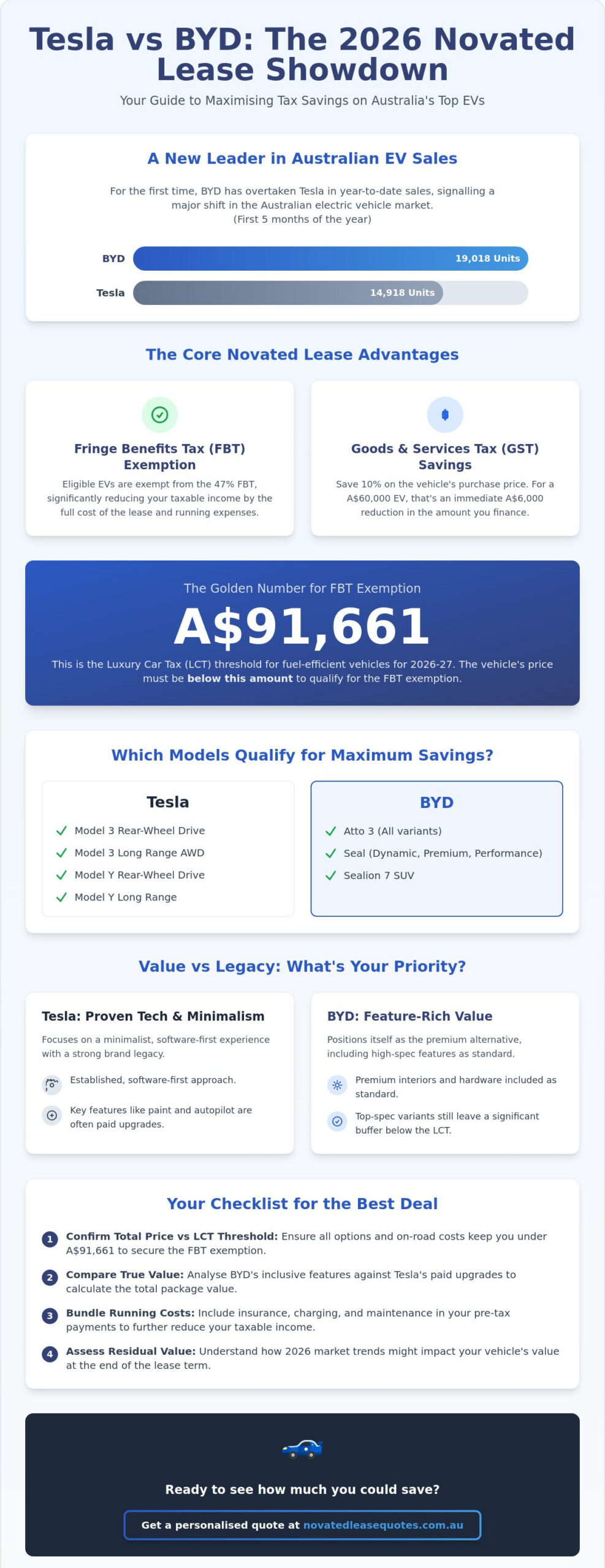
For the first time in Australian history, BYD has delivered 19,018 vehicles in just five months, comfortably outstripping Tesla’s 14,918 units. It’s a massive shift for local employees who once viewed the Model 3 or Model Y as the only logical choice for salary packaging. If you’re currently weighing up a Tesla vs BYD novated lease, you’re likely feeling the pressure of making the right financial call before tax regulations shift. You want the GST savings and the FBT exemption, but the choice between proven tech legacy and feature-rich value is no longer clear cut.
We understand the confusion surrounding how the A$91,661 Luxury Car Tax threshold impacts different variants or whether Tesla’s recent price volatility affects your long term residual value. This guide promises to clarify those numbers so you can maximise your take-home pay with confidence. We’ll provide a direct comparison of running costs, home charging rates, and tax benefits for Australia’s top two EV brands to help you crown a definitive winner for your 2026 lease.
Key Takeaways
- Identify which specific Tesla and BYD variants sit below the A$91,661 Luxury Car Tax threshold to secure maximum Fringe Benefits Tax savings.
- Compare BYD’s inclusive standard features against Tesla’s paid software and hardware upgrades to calculate the true value of your salary package.
- Use the Effective Interest Rate as your primary benchmark when reviewing a tesla vs byd novated lease quote to ensure you aren’t paying hidden commissions.
- Learn how bundling all running costs, including specialised EV insurance and maintenance, into one pre-tax payment reduces your overall taxable income.
- Understand the impact of 2026 market trends on residual values to protect your financial position at the end of the lease term.
The 2026 EV Landscape: Why Tesla and BYD Dominate Salary Packaging
The Australian automotive market has hit a significant turning point in 2026. BYD has officially overtaken Tesla in total year-to-date sales, delivering 19,018 units in the first five months of the year compared to Tesla’s 14,918. This shift has transformed the tesla vs byd novated lease debate into the most critical decision for Australian employees looking to optimise their salary packaging. These two brands dominate the landscape because they offer the most robust charging infrastructure and national service networks in the country, making them the safest bets for long term reliability.
Understanding the mechanics is the first step toward financial optimisation. What is a novated lease? It’s a three-way agreement between you, your employer, and a financier where your lease payments and vehicle running costs are deducted from your salary before tax is applied. This structure provides an immediate 10% GST saving on the vehicle purchase price because the financier claims the credit and passes the benefit directly to you. For a A$60,000 EV, that’s a A$6,000 reduction in the financed amount before you’ve even left the showroom.
The Role of the EV FBT Exemption
The primary driver for EV adoption in 2026 remains the Fringe Benefits Tax (FBT) exemption. Under current Australian Taxation Office rules, electric vehicles priced below the Luxury Car Tax (LCT) threshold of A$91,661 are exempt from FBT until at least March 31, 2027. This applies to high-volume models like the Tesla Model 3, Model Y, and the BYD Seal. By removing the 47% FBT liability, a novated lease reduces your taxable income by the full amount of the vehicle’s finance payments and running costs. To understand exactly how to maximise these savings before the Federal Government’s scheduled phase-out begins, read our comprehensive guide on the EV novated lease FBT exemption and maximising your 2026 salary packaging savings.
Market Positioning: Prestige vs Value
Tesla continues to lead with its minimalist, software-first approach. The Model Y remains a powerhouse, selling 5,605 units in May 2026 alone, appealing to those who value the brand’s established tech legacy. BYD has successfully positioned itself as the premium feature alternative. While Tesla often requires paid upgrades for specific colours or enhanced autopilot features, BYD models like the Seal and Sealion 7 include high-spec interiors and hardware as standard equipment.
FBT and LCT Rules: How Tesla and BYD Models Qualify for Savings
The 2026-2027 financial year sets the Luxury Car Tax (LCT) threshold for fuel-efficient vehicles at A$91,661. When comparing a tesla vs byd novated lease, this figure is the most critical benchmark for your financial outcome. To qualify for the full Fringe Benefits Tax (FBT) exemption, the first retail sale price of the vehicle must remain below this cap. If the car’s value exceeds this limit, even by a single dollar, you lose the entire FBT benefit, which can add thousands to your annual costs.
Most popular variants from both manufacturers currently sit comfortably under this threshold, providing ample room for salary packaging. Eligible models for the 2026 tax year include:
- Tesla: Model 3 Rear-Wheel Drive (from A$54,900 plus on-roads), Model 3 Long Range AWD, Model Y Rear-Wheel Drive, and Model Y Long Range.
- BYD: Atto 3 (all variants), BYD Seal (Dynamic, Premium, and Performance variants), and the Sealion 7 SUV.
The FBT exemption for electric cars is an all-or-nothing benefit. This means that while a Tesla Model 3 Performance (starting at A$80,900 plus on-roads) qualifies, adding certain premium paint options and Full Self-Driving software can push the price dangerously close to the LCT limit. In contrast, even the top-spec BYD Seal Performance (A$66,759 driveaway) leaves a significant buffer, making it a “safer” pick for those wanting every available feature without risking their tax status.
Navigating the 2026 LCT Threshold
Adding physical options like 20 inch wheels or premium interior colours can accidentally push your vehicle over the tax-free limit. It is vital to prioritise pre-tax savings over high-spec performance variants that offer marginal utility but high tax risks. For a deeper dive into these regulations, read our guide on the EV FBT Exemption Australia: The 2026 Ultimate Guide to Savings. Staying informed ensures you don’t trade a A$2,000 paint job for A$15,000 in lost tax credits.
GST Caps and Procurement Savings
Beyond FBT, the GST saving on procurement is capped by the ATO’s car limit. While both brands benefit from the removal of GST on the purchase price, a lower-priced BYD often achieves a higher percentage of tax efficiency because more of its total cost falls under the GST credit ceiling. A top-spec Tesla might exceed the maximum claimable GST credit, meaning you pay the balance using post-tax dollars. We recommend using a novated lease calculator to model these specific tax nuances before committing to a specific variant.
Head-to-Head Comparison: Tesla Model 3/Y vs BYD Seal/Sealion 7
When evaluating a tesla vs byd novated lease, the equipment-to-price ratio is where BYD often pulls ahead in the initial quote. BYD typically includes premium features like ventilated seats, panoramic sunroofs, and metallic paint as standard equipment. Tesla, by contrast, operates a minimalist strategy where many of these features are either absent or require paid upgrades. For a leaseholder, this means every A$1,500 added for a different paint colour or larger wheels on a Tesla increases your monthly pre-tax deduction and total interest paid over the term.
Tesla maintains a significant logistical edge with its proprietary Supercharger network, which remains the most reliable charging ecosystem in Australia. While BYD drivers rely on third-party networks like Evie or Chargefox, the integration of Tesla’s software makes long-distance travel more seamless. If your business travels take you to the US, you can visit Sedanz for premium chauffeured transfers at Newark Liberty Airport. Back home for daily commuting, the playing field is level; both brands benefit from the 2026 ATO home charging rate of 5.47 cents per kilometre, allowing you to claim home electricity costs as a tax-free running cost within your lease package.
The SUV Battle: Model Y vs Sealion 7
The Tesla Model Y remains Australia’s most popular packaged vehicle, with 5,605 units sold in May 2026 alone. Its 854-litre cargo capacity and class-leading software interface make it the default choice for families. The BYD Sealion 7 counters this with a more traditional luxury interior, featuring physical buttons and quilted upholstery that many drivers find more intuitive than Tesla’s screen-centric cabin. While the Model Y holds its residual value well due to high demand, the Sealion 7’s aggressive entry pricing often results in lower monthly finance repayments on a three-year lease.
The Sedan Battle: Model 3 vs BYD Seal
The refreshed Model 3 “Juniper” focuses on aerodynamic efficiency, offering one of the best range-per-dollar ratios in the country. It’s built for those who prioritises efficiency and a clinical, high-tech driving experience. The BYD Seal Performance, priced at A$66,759 driveaway, offers a performance-per-dollar ratio that is currently unmatched, delivering supercar-level acceleration for a fraction of the cost. The Model 3 feels more composed on winding Australian B-roads, whereas the Seal excels as a feature-packed, comfortable highway cruiser with a higher level of standard interior appointments.
Total Cost of Ownership: Insurance, Maintenance, and Residual Values
A primary advantage of a tesla vs byd novated lease is the ability to bundle all operating expenses into a single, pre-tax deduction. This includes comprehensive insurance, scheduled maintenance, tyres, and even your electricity costs. By paying for these from your gross salary, you bypass the 10% GST on services and repairs while simultaneously reducing your taxable income. It transforms the unpredictable costs of car ownership into a fixed, manageable monthly figure.
Many prospective Tesla owners worry about high insurance premiums. While some retail insurers charge a “tech premium” for EVs, specialised lease insurers understand the lower risk profile of professional employees. These integrated policies often provide more competitive rates than the open market. Because the premium is paid before tax, the effective cost to your take-home pay is significantly lower than a standard retail policy.
Maintenance requirements differ between the two brands. Tesla employs a “condition-based” approach with no set annual service schedule. BYD follows more traditional intervals, typically requiring a check-up every 12 months or 20,000 kilometres. While BYD has more frequent service touchpoints, the costs are fully funded by your pre-tax lease budget, meaning the out-of-pocket impact remains zero for the duration of the term.
Packaging Electricity and Charging
You can include the cost of a Tesla Wall Connector or a BYD home charger directly in your initial lease quote. This allows you to finance the hardware and installation using pre-tax dollars. To claim home charging, the ATO provides a simplified method. From April 1, 2026, you can use the revised rate of 5.47 cents per kilometre to calculate your electricity cost. This amount is then reimbursed to you from your lease account, effectively making your daily commute tax-free. You can compare novated lease quotes to see how these charging reimbursements impact your specific take-home pay.
Resale Value and the Used Market
Tesla has historically enjoyed high residual values due to its brand dominance and over-the-air updates. However, as BYD becomes Australia’s largest EV brand by sales in 2026, its used market presence is maturing rapidly. The ATO mandates a minimum residual value (or “balloon payment”) based on the lease term. For a three-year lease, this is typically 46.88% of the purchase price. Choosing a shorter three-year term is often a smart move in the current fast-evolving EV market. It allows you to upgrade to newer battery technology sooner while the ATO-mandated residual protects you from unexpected market dips.
Securing the Best Deal: How to Compare Multi-Provider Quotes
Securing the best tesla vs byd novated lease deal requires looking past the glossy brochures and focusing on the financial fine print. The most critical metric you’ll encounter isn’t the headline interest rate, but the Effective Interest Rate (EIR). This figure accounts for all fees and charges over the life of the lease, providing a true cost of capital. Many providers lure employees with a low base rate while burying high establishment fees or monthly account keeping charges in the background. If the EIR isn’t clearly stated, you aren’t seeing the full picture.
Be particularly wary of “Dealer Underwriting.” This occurs when a financier allows a broker or dealer to inflate the interest rate to cover their own commissions. Because these commissions aren’t always disclosed as a separate line item, they can quietly erode the tax savings you’ve gained through the FBT exemption. You should also check for procurement charges. Some leasing companies charge a fee just to source the vehicle, even if you’ve already chosen your Tesla or BYD model online. A transparent quote should clearly list every cost, ensuring your pre-tax dollars are working for you, not your provider.
Why a Comparison Service Beats a Single Provider
Using a comparison service provides an objective layer of protection. Novated Lease Quotes accesses a network of specialists to find the best rate tailored to your specific salary bracket and driving habits. We compare Tesla-specific financiers against BYD-friendly leasing companies to ensure you’re getting a market-leading deal. The digital quote process is designed for speed, moving from initial comparison to formal approval in a fraction of the time it takes to negotiate with individual banks or dealers. To ensure you’re working with a reputable provider, review our analysis of the best EV novated lease companies in Australia before committing to any single financier.
Your Next Steps to Salary Packaging
The best way to see how these numbers affect your bank account is to use a novated lease calculator. This tool models the real-world impact on your take-home pay, accounting for the GST savings and FBT exemptions we’ve discussed. Whether the Tesla Model 3 remains your top pick for its tech legacy or the BYD Seal wins on pure value, the right lease structure is what ultimately determines your financial return. For a deeper dive into the mechanics of the process, read our article on Mastering Novated Lease Quotes: Your 2026 Guide to Comparing Salary Packaging. Once you have your data, you’ll be ready to package your new EV with absolute confidence.
Maximising Your 2026 Salary Packaging Strategy
Choosing between the tech legacy of Tesla and the premium value of BYD is a strategic financial decision for any Australian professional. You’ve seen how staying under the A$91,661 LCT threshold is non-negotiable for maximum tax efficiency. Whether you prioritise the Model Y’s cargo space or the BYD Seal’s performance per dollar, the winner is the vehicle that aligns with your specific tax bracket and annual kilometres.
Making the final call on a tesla vs byd novated lease requires an objective look at the data. Our platform provides up-to-the-minute expertise on 2026 ATO tax rulings and connects you with Australia’s leading EV leasing specialists. By using an independent and objective quote comparison, you can verify the effective interest rate and ensure your salary packaging remains truly optimised without hidden commissions.
Get Competitive Tesla vs BYD Novated Lease Quotes now to see exactly how these savings impact your take-home pay. Taking control of your vehicle expenses has never been more rewarding. Enjoy the drive and the tax benefits that come with it.
Frequently Asked Questions
Is the EV FBT exemption still available for Tesla and BYD in 2026?
Yes, the full Fringe Benefits Tax (FBT) exemption remains available for both brands until at least March 31, 2027. To qualify, the vehicle must be a battery electric vehicle with a first retail sale price below the fuel-efficient Luxury Car Tax threshold. This regulation is the primary driver of savings for any tesla vs byd novated lease, as it removes the 47% tax liability on the benefit.
Which has a higher residual value: Tesla Model Y or BYD Sealion 7?
The Tesla Model Y historically maintains a slightly stronger residual value due to its established brand presence and high demand in the Australian used market. However, BYD’s maturing service network and its status as a top-selling brand in 2026 are rapidly closing this gap. Your lease provider will use ATO-mandated minimum residual percentages to set your final balloon payment, providing a level of financial certainty for both models.
Can I package home charging electricity costs in my novated lease?
You can definitely package home charging costs using the ATO’s simplified cents-per-kilometre method. By keeping a record of your odometer readings, your employer can reimburse you for the electricity used to charge at home from your pre-tax salary. This ensures that your daily fuel costs are paid using tax-effective dollars, further increasing your total take-home pay.
Does the Luxury Car Tax (LCT) apply to the BYD Seal?
No, the BYD Seal is priced well below the 2026-2027 fuel-efficient LCT threshold of A$91,661. Even the top-spec Performance variant remains comfortably under the limit, ensuring it qualifies for the full FBT exemption. This makes the Seal one of the most tax-efficient sedans available for salary packaging in Australia today.
Is insurance more expensive for a Tesla compared to a BYD on a lease?
While some retail insurers charge higher premiums for Teslas, novated lease specialists often provide competitive, integrated policies that level the playing field. Because your insurance premium is bundled into your lease and paid before tax, the actual cost to your pocket is significantly reduced. BYD insurance rates are generally in line with other premium vehicles in their respective categories.
What happens if I exceed the LCT threshold with Tesla options?
Exceeding the LCT threshold is an all-or-nothing event that results in the loss of the entire FBT exemption. If adding options like Full Self-Driving or premium wheels pushes the price over A$91,661, your lease will be subject to the 47% FBT rate. This can add thousands of dollars to your annual costs, so it is vital to verify the final driveaway price before signing.
Can I switch from a Tesla to a BYD mid-lease if I change my mind?
You cannot simply swap cars mid-lease because the finance agreement is legally tied to a specific vehicle’s VIN. To change cars, you would need to terminate your existing lease, pay out the remaining balance and residual value, and then start a completely new agreement for the BYD. This process often involves early termination fees and should be discussed with your specialist before proceeding.
Is a novated lease worth it if I only drive low kilometres in my EV?
A novated lease is highly effective for low-kilometre drivers because the savings are no longer tied to high mileage. In the past, petrol car leases relied on driving long distances to offset FBT, but the current EV novated lease FBT exemption provides the same tax benefits whether you drive 5,000 or 25,000 kilometres a year. The GST savings on the purchase price alone often justify the arrangement.