
2026 is officially the “Golden Year” for the ev fbt exemption, representing your final opportunity to lock in maximum tax benefits before the legislative landscape shifts permanently in 2027. You probably recognise that electric vehicles offer significant financial advantages, but the complexity of Luxury Car Tax thresholds and the looming phase-out of full exemptions can make the decision feel rushed. It’s frustrating trying to calculate your actual take-home pay when the rules feel like a moving target.
This guide provides the clarity you need to save thousands of dollars on your next vehicle purchase. We’ll break down the 2026 eligibility criteria, compare tax-effective leasing against standard finance, and show you how to navigate the upcoming 2027 changes with total confidence. You’ll gain a professional framework to evaluate your options and the data required to request a novated lease quote that maximises your financial position.
Key Takeaways
- Understand how the ev fbt exemption effectively removes the 20% statutory tax, allowing you to fund your vehicle and running costs entirely from your pre-tax salary.
- Identify which Battery Electric Vehicles qualify under the current A$91,387 Luxury Car Tax threshold and why 2026 is the final year to maximise benefits on higher-value models.
- Discover the “double dip” financial advantage of a novated lease, which combines significant GST savings with a substantial reduction in your reportable taxable income.
- Learn how to future-proof your investment by locking in a lease before the March 2027 legislative shift and the introduction of the new A$75,000 price cap.
- Gain a step-by-step framework for comparing lease quotes and verifying employer eligibility to ensure you secure the most competitive rate available in the market.
What is the EV FBT Exemption? A 2026 Overview
Fringe Benefits Tax (FBT) in Australia is a tax paid by employers on certain benefits provided to their employees in place of salary or wages. For decades, providing a company car or a novated lease meant the employer had to pay a tax usually calculated at 20% of the vehicle’s value. The ev fbt exemption completely removes this tax for eligible electric vehicles, creating a unique financial window for Australian workers. It’s a significant shift in policy designed to make sustainable transport more affordable.
The primary goal of this legislation is to achieve price parity between Electric Vehicles (EVs) and Internal Combustion Engine (ICE) vehicles. While EVs often have a higher upfront purchase price, removing the FBT liability levels the playing field. 2026 is a critical year for action. With the full exemption scheduled to transition to a tiered discount system from April 2027, 2026 represents the final opportunity to lock in a lease under the most generous current rules. Acting now ensures you maximise your savings before the new A$75,000 price cap for full exemptions takes effect.
The Mechanics of Salary Packaging an EV
Salary packaging allows you to pay for your vehicle and its running costs using your pre-tax income. Normally, employees use the “Employee Contribution Method” to reduce FBT by paying a portion from their post-tax salary. Because of the ev fbt exemption, this complex step is now unnecessary. You pay for the entire lease from your gross salary, which reduces your taxable income significantly. You must keep in mind that while you pay no tax on the benefit, the value is still recorded as a Reportable Fringe Benefits Amount (RFBA) on your payment summary. This amount can influence your HECS/HELP repayments or Medicare Levy Surcharge calculations.
Why the Federal Government Introduced the Concession
The Australian Government introduced this concession to accelerate national fleet decarbonisation. By reducing the Total Cost of Ownership (TCO) for households, they aim to meet emissions targets faster. This incentive is strictly linked to the Luxury Car Tax (LCT) threshold. For the 2026/27 financial year, the LCT threshold for fuel-efficient vehicles is A$91,387. As long as the vehicle’s value at the first retail sale is below this threshold, you can access the full tax benefit. It is a pragmatic tool that empowers consumers to choose modern technology without the “green premium” usually associated with new energy vehicles.
This focus on modern technology and environmental impact isn’t limited to cars; for example, you can explore Sea-Speed V 10 X Ultra to see how advanced marine coatings are improving vessel performance and protection.
Eligibility Criteria: Which Vehicles Qualify in 2026?
To access the ev fbt exemption in 2026, your vehicle must meet strict definitions. It needs to be a zero or low emissions vehicle, which currently includes Battery Electric Vehicles (BEVs) and Hydrogen Fuel Cell Electric Vehicles. A critical change for 2026 is the exclusion of Plug-in Hybrid Electric Vehicles (PHEVs). Since 1 April 2025, PHEVs have been removed from the exemption list for new agreements. Unless you have a pre-existing lease that has remained unchanged since that date, a PHEV will no longer provide these tax savings.
The “First Held and Used” rule is a vital consideration for those looking at the used market. A second-hand EV can still qualify for the exemption provided it was first held and used on or after 1 July 2022. This means you aren’t restricted to brand-new models. However, the vehicle’s value must always have stayed below the fuel-efficient Luxury Car Tax (LCT) threshold at the point of its first retail sale. Detailed guidance on these requirements can be found in the Official ATO EV FBT Exemption Rules. If you’re unsure if a specific model qualifies, using a novated lease quote comparison service can help verify eligibility before you commit.
The 2026 Luxury Car Tax (LCT) Threshold
For the 2026/27 financial year, the LCT threshold for fuel-efficient vehicles is set at A$91,387. If the car’s value exceeds this amount at the time of purchase, the entire vehicle becomes ineligible for the FBT exemption. This value includes the GST-inclusive price plus any optional extras, accessories, or dealer delivery charges added at the time of purchase. It’s essential to monitor your “drive-away” price closely. Even a premium paint choice or wheel upgrade could push an eligible model over the limit and negate your tax benefits.
Associated Running Expenses Included in the Exemption
One of the most overlooked aspects of the ev fbt exemption is that it covers more than just the lease payments. You can also package associated running costs without incurring FBT. This includes registration, insurance, tyres, and general repairs. For 2026, the ATO has clarified rules around home charging. While you can package the cost of a home charging station, you can also claim electricity costs. For the 2026-27 FBT year, the ATO has set a home charging rate of 5.47 cents per kilometre, providing a simplified way to calculate and claim your charging expenses through your pre-tax salary.
Calculating the Savings: Novated Lease vs. Car Loan
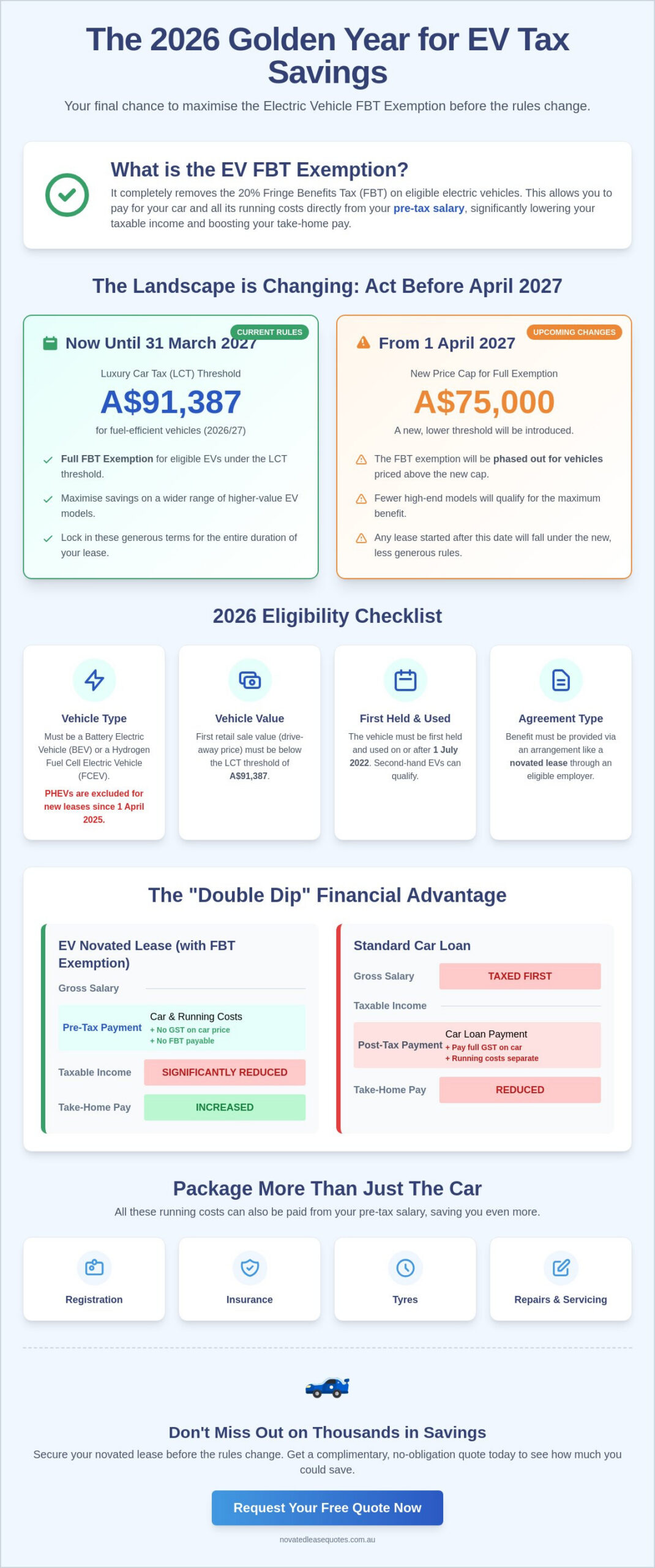
Choosing between a standard car loan and a novated lease involves more than just comparing interest rates. For a A$70,000 electric vehicle, the financial outcome changes dramatically when you apply the ev fbt exemption. Under a traditional car loan, you pay for the vehicle using your take-home pay after the government has already taken its share of income tax. You also pay the full GST on the purchase price and all subsequent running costs. In contrast, a novated lease allows you to pay for these expenses using your gross salary, effectively lowering the cost of the car by your marginal tax rate.
The government’s Electric Car Discount policy was specifically designed to make this comparison lean heavily in favour of electric models. By eliminating the FBT, the “luxury car” penalty that usually applies to high-value leases is removed. Over a typical three-year term, the Total Cost of Ownership (TCO) for a A$70,000 EV on a lease can be thousands of dollars less than an identical vehicle financed through a bank. This is because every dollar spent on the lease is a dollar that isn’t subject to income tax. If you’re weighing up specific models, our detailed Tesla vs BYD novated lease comparison for Australian employees breaks down the real numbers across running costs, residual values, and take-home pay impact.
GST Savings on Purchase and Running Costs
A novated lease provides an immediate 10% discount on the vehicle’s purchase price because your employer can claim the GST back as an Input Tax Credit. This saving isn’t just limited to the initial buy. It extends to every running cost packaged into the lease, including tyres, servicing, and even your home charging electricity. When you pay for these items through your lease provider, you’re effectively paying the GST-exclusive price. This “double dip” of GST and income tax savings is exclusive to the salary packaging model and cannot be replicated with a standard car loan.
Income Tax Brackets and Your Savings Potential
Your individual income tax bracket determines the scale of your savings. Higher income earners, particularly those in the 37% or 45% tax brackets, see the most significant impact because they’re avoiding a higher rate of tax on every dollar spent. By making payments from your pre-tax salary, you reduce your total taxable income, which can sometimes keep you in a lower tax bracket and prevent “bracket creep.” Pre-tax payments reduce your taxable income by the total amount of the lease and running costs, ensuring you only pay tax on what remains of your salary.
The 2027 Phased Changes: Navigating the Transition
The 31 March 2027 deadline marks a significant turning point for Australian tax incentives. Currently, the ev fbt exemption provides a full tax waiver for all eligible vehicles below the Luxury Car Tax threshold. This changes on 1 April 2027. From this date, the Australian Government will introduce a tiered system that narrows the scope of the full exemption. Understanding these phases is vital for anyone planning a vehicle upgrade in the next 18 months. Acting in 2026 allows you to bypass these complications and lock in the most aggressive savings available.
The new legislation introduces a A$75,000 cap for the full exemption. Vehicles valued between A$75,001 and the LCT threshold, which is currently A$91,387, will see their benefit reduced to a 25% FBT discount rather than a total waiver. This reduction continues until 31 March 2029, after which the government plans to move all eligible electric vehicles to the 25% discount model. This phased approach is designed to encourage the uptake of more affordable electric models as the market matures. It makes 2026 a strategic “sweet spot” for high-value EV purchases.
Grandfathering Clauses for 2026 Leases
Legislation typically includes protections for existing contracts. If you sign a novated lease and take delivery of your vehicle before 1 April 2027, your full exemption is “grandfathered.” This means you continue to pay zero FBT for the entire life of that lease, even as the rules change for new applicants. However, if you extend your lease or enter a new agreement after the deadline, you will be subject to the new tiered rates. Waiting until 2027 to decide introduces unnecessary financial risk and could cost you thousands in lost tax offsets.
Future-Proofing Your Vehicle Choice
Selecting a Battery Electric Vehicle (BEV) remains the safest long-term strategy. While Plug-in Hybrids (PHEVs) have already lost their eligibility for new agreements, BEVs continue to be the primary focus of government support. If you are considering a vehicle that sits close to the A$75,000 mark, it is wise to use our Novated Lease Calculator to model how different purchase prices impact your 2027 scenarios. This data ensures you choose a car that maximises your take-home pay both now and after the transition. You can request a tailored quote today to see exactly how these upcoming changes will affect your specific salary and vehicle choice.
How to Secure the Exemption via a Novated Lease
Securing the ev fbt exemption requires a structured approach to ensure you meet all Australian Taxation Office requirements while maximising your financial return. The process is straightforward but relies on the correct administrative setup between you, your employer, and the leasing company. Following a logical sequence of steps ensures you don’t miss out on the thousands of dollars in potential annual savings available through salary packaging.
- Step 1: Verify Employer Eligibility. Confirm that your employer offers salary packaging for motor vehicles. Most Australian organisations, from government departments to large private firms, provide this as a standard benefit to attract and retain staff.
- Step 2: Compare Multiple Quotes. Interest rates and procurement fees differ between providers. Comparing quotes allows you to identify the most competitive finance package and avoid overpaying on management costs.
- Step 3: Select an Eligible EV. Choose a Battery Electric Vehicle with a retail value below the A$91,387 Luxury Car Tax threshold for the 2026/27 financial year. Ensure any accessories or dealer delivery charges don’t push the total price over this limit.
- Step 4: Execute the Tripartite Agreement. Finalise the contract that links you, your employer, and the lessor. This document authorises your payroll department to deduct lease payments from your pre-tax salary.
Evaluating Novated Lease Quotes
When you receive a quote, look beyond the monthly payment figure. Transparency in fees and the disclosed interest rate is paramount. Some providers might include “bundled” running expenses that appear convenient but contain hidden margins on insurance or maintenance. It’s essential to scrutinise the breakdown of GST savings and ensure the ev fbt exemption is applied correctly to both the finance and the operating costs. Getting multiple quotes is the only way to ensure you’re receiving a market-leading rate on your EV financing. To help you evaluate your options, our guide to the best EV novated lease companies in Australia provides a detailed comparison of providers based on transparency, total cost, and long-term flexibility.
Next Steps: Getting Started
Your first move should be to model your potential savings based on your specific salary and vehicle preference. You can use our Novated Lease Calculator to estimate your 2026 take-home pay and see the immediate impact of the tax waiver. Once you have a clear idea of your budget, prepare your recent pay slips and the details of your chosen EV for your payroll department. To ensure you’re getting the best possible deal in the current market, get your competitive novated lease quotes today and secure your 2026 tax advantages before the legislative landscape changes.
Lock in Your Tax Savings Today
The 2026 financial year offers a unique window to maximise the ev fbt exemption before the legislative landscape shifts. By acting now, you can secure a full tax waiver on vehicles up to the LCT threshold and ensure your benefits are grandfathered against the upcoming 2027 changes. A novated lease remains the most efficient path to EV ownership, allowing you to fund both the car and its running costs entirely from your pre-tax salary.
Don’t leave your financial optimisation to chance. We provide access to Australia’s leading leasing specialists and expert guidance on the latest tax regulations to help you make an informed choice. Our platform offers a free, no-obligation quote comparison that simplifies the process of finding the right provider for your specific needs.
Compare Novated Lease Quotes and Save on Your New EV
Take the first step toward a smarter, more cost-effective way to drive. With the right support, you can transition to an electric vehicle with total confidence in your long-term savings.
Frequently Asked Questions
Is the EV FBT exemption ending in 2027?
The full exemption does not end entirely in 2027, but the rules transition to a more targeted tiered system. From 1 April 2027, only eligible electric vehicles valued at A$75,000 or less will retain the full tax waiver. Vehicles priced between A$75,001 and the Luxury Car Tax threshold will move to a 25% FBT discount. If you start your lease before this deadline, your current benefits are grandfathered for the remainder of the contract term.
Can I get the FBT exemption on a used electric car?
You can access the ev fbt exemption on second-hand vehicles provided they were first held and used on or after 1 July 2022. The vehicle must also have been valued below the fuel-efficient Luxury Car Tax threshold at the time of its original retail sale. This allows you to source high-quality used models while still enjoying the same significant salary packaging benefits as a buyer of a brand-new vehicle.
Does the FBT exemption apply to Tesla Model 3 and Model Y?
Yes, most variants of the Tesla Model 3 and Model Y qualify for the exemption. Eligibility depends on the total drive-away price staying below the fuel-efficient Luxury Car Tax threshold, which is A$91,387 for the 2026/27 financial year. You should be cautious with high-performance trims or extensive options, such as premium wheels or Full Self-Driving software, as these additions might push the purchase price over the eligibility limit. If you’re also considering BYD models as an alternative, our Tesla vs BYD novated lease guide provides a detailed side-by-side analysis to help you choose the right vehicle for salary packaging.
What happens to my FBT exemption if I change jobs?
Your exemption remains valid, but the novated lease agreement must be transferred to your new employer. Most Australian organisations offer salary packaging, and the transition is usually a simple administrative process. If your new workplace doesn’t support leasing, you’ll have to make payments from your post-tax income, which removes the tax benefit. It’s best to confirm the salary packaging policy of a prospective employer before finalising your career move.
Are charging stations at home covered by the FBT exemption?
Home charging stations can be included as an associated running expense under the ev fbt exemption guidelines. You can package both the hardware cost and the professional installation into your lease agreement to pay for them with pre-tax dollars. Additionally, for the 2026-27 FBT year, the ATO allows you to claim electricity costs at a set rate of 5.47 cents per kilometre, providing a simplified way to fund your daily charging.
Is there a limit on how many kilometres I must drive to get the exemption?
There is no minimum or maximum kilometre requirement to qualify for this tax benefit. Unlike older FBT rules that relied on distance travelled, current regulations apply regardless of whether you drive 5,000 or 50,000 kilometres per year. This flexibility makes electric vehicle leasing highly attractive for both short-distance city commuters and high-mileage regional drivers. You simply need to ensure the vehicle meets the basic eligibility and value criteria.
Do I still need to keep a logbook for an exempt EV?
You are not required to maintain a formal logbook to claim the FBT exemption. Because the benefit is exempt from tax regardless of the split between business and private use, the administrative burden is significantly lower than traditional car leasing. However, you should still keep records of your odometer readings. Your leasing provider requires this data to manage your running cost budgets and ensure your fuel or charging allowances remain accurate.
How does the FBT exemption affect my HECS/HELP debt?
The value of the exempt car benefit is recorded as a Reportable Fringe Benefit Amount (RFBA) on your annual payment summary. While you don’t pay FBT on the vehicle, this reported value is used by the ATO to calculate your adjusted taxable income. This can result in higher HECS/HELP repayment obligations or impact your eligibility for certain government offsets. It’s a vital factor to consider when calculating the total net impact on your take-home pay.


