
Did you know that choosing an eligible electric vehicle under the current luxury car tax threshold of $91,661 can effectively eliminate your Fringe Benefits Tax liability? For many professionals, salary packaging a car is the most powerful tool available to lower taxable income and offset the rising costs of vehicle ownership. However, the shift in 2026 regulations, including the removal of exemptions for most plug-in hybrids, means the strategy you used a few years ago might no longer be the most efficient path forward.
It’s natural to feel hesitant when faced with complex pre-tax calculations or concerns about how a lease affects your mortgage borrowing capacity. You want the tax savings without the stress of a surprise balloon payment at the end of your term. This guide simplifies the entire process, showing you how to maximise the 2026 EV incentives and use precise modelling to see the real impact on your take-home pay. We’ll walk through the latest ATO thresholds and explain how to compare multiple quotes to ensure you secure the most competitive deal available.
Key Takeaways
- Understand the mechanics of salary packaging a car to pay for your vehicle and all running costs using pre-tax dollars, effectively lowering your taxable income.
- Learn how to unlock an immediate discount by saving on the GST of your car’s purchase price and ongoing maintenance expenses.
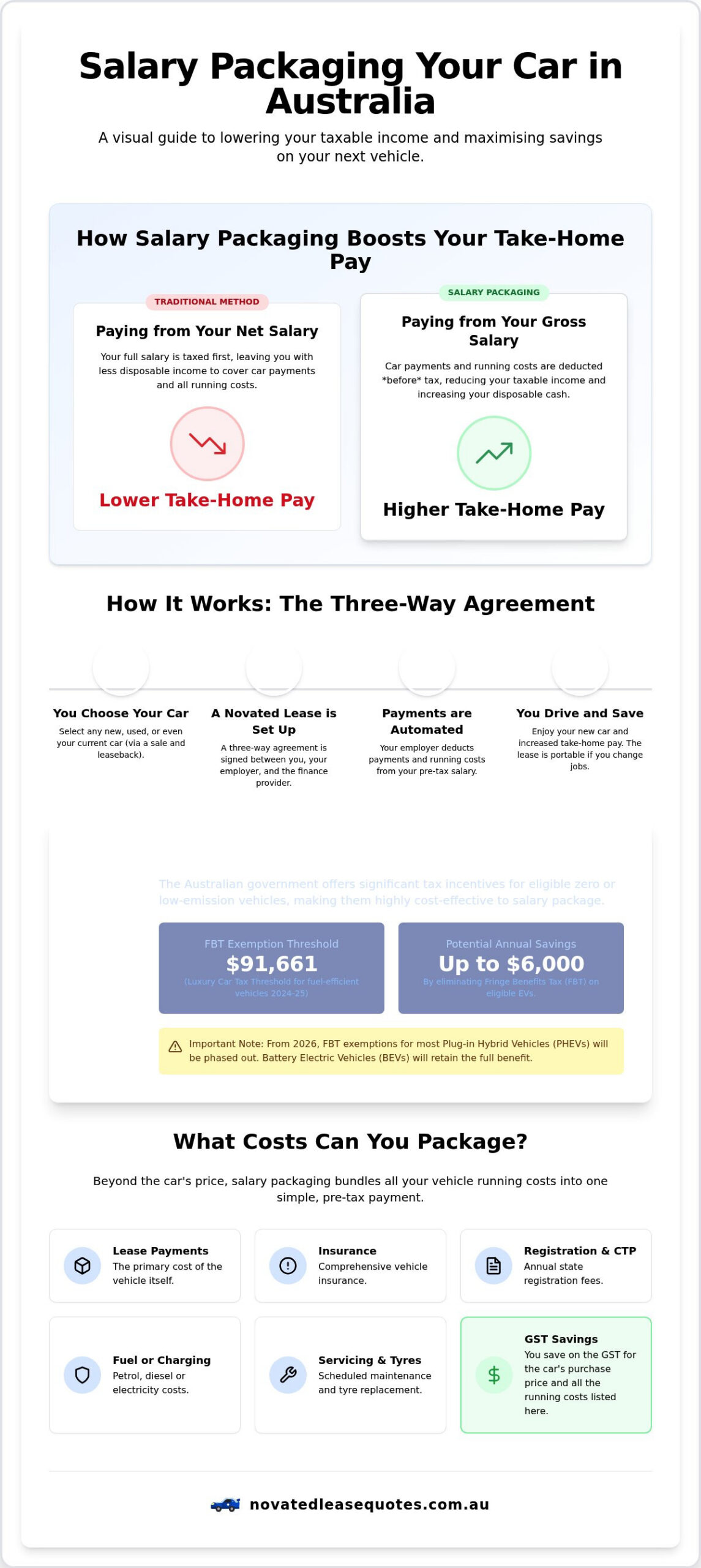
- Maximise the 2026 EV tax incentives to secure FBT-free motoring, which can provide annual savings of up to $6,000 on eligible zero-emission models.
- Identify the common pitfalls of sticking with “default” leasing providers and how to compare independent quotes to find the most transparent interest rates and management fees.
Unlocking the Benefits of Salary Packaging a Car in 2026
Salary packaging a car is a strategic financial arrangement where you pay for a vehicle and its running costs using a combination of pre-tax and post-tax salary. It is a proven way to reduce taxable income by paying for car costs before your income tax is calculated. By redirecting a portion of your gross salary toward vehicle expenses, you effectively lower the amount of income the Australian Taxation Office (ATO) can tax you on. This isn’t just about the purchase price; it covers fuel, insurance, registration, and servicing too.
The ATO recognises this through a structured three-way agreement. Your employer pays the lease and running costs on your behalf, and in return, you sacrifice a portion of your salary. This structure benefits everyone involved. Your employer provides a valuable perk without increasing their overheads, and you get a car for a significantly lower net cost than if you paid for it from your bank account after tax. It is an efficient way to manage a major life expense while simultaneously optimising your tax position.
What Exactly is Salary Packaging?
At its core, salary packaging is a form of salary sacrifice. Unlike a standard car loan where you make repayments from your take-home pay, a Novated Lease Agreement allows these payments to happen at the source. This legal framework in Australian employment law means the responsibility for the lease is novated, or transferred, to your employer for the duration of your employment. If you change jobs, the lease can often move with you to your next employer.
Most full-time and part-time employees in Australia are eligible, provided their employer offers salary packaging as a benefit. It’s a versatile option that isn’t restricted to high-income earners or specific industries. You can choose a new car, a used vehicle, or even package a car you already own through a sale and leaseback arrangement. This flexibility makes it an accessible tool for thousands of Australian workers looking to modernise their transport while saving money.
Why It Feels Like a Pay Rise
The most immediate impact of salary packaging a car is the boost to your disposable income. When you lower your gross income, you might even drop into a lower tax bracket. For the 2026-27 financial year, the tax brackets are quite specific. If your salary is just above a threshold, packaging a vehicle could reduce your taxable income enough to keep you in a lower bracket, saving you thousands in tax that would otherwise go straight to the government.
This is the central point of the novated lease vs car loan debate. While a car loan is a simple debt, salary packaging is a tax-optimisation strategy. You aren’t just buying a car; you’re reorganising your finances to keep more of what you earn. The result is more money in your pocket every fortnight, despite having a brand-new vehicle in the driveway. By paying for petrol, tyres, and servicing with dollars that haven’t been taxed, your money simply goes further.
How Salary Packaging a Car Works: The Three-Way Agreement
Understanding the mechanics of salary packaging a car is simpler than many online forums suggest. It’s essentially a three-way agreement between you, your employer, and the finance provider. This structure ensures that while you remain the primary driver and owner of the vehicle’s benefits, the financial obligations are integrated directly into your employment contract. It’s a transparent process that replaces a standard car loan with a more tax-efficient alternative.
- Step 1: Select your vehicle. You aren’t limited to a specific fleet. You can package a brand-new car, a quality used vehicle, or even your existing car via a sale-and-leaseback arrangement.
- Step 2: The Novated Deed. Your employer signs a document that transfers the lease payment obligation to them for as long as you are employed there.
- Step 3: Automated Payroll. Your employer pays the leasing company directly from your salary before your income tax is calculated.
- Step 4: Portability. If you move to a new company, the lease is portable. You simply take the contract to your new employer to continue the arrangement without needing to refinance.
Your Employer’s Role in the Process
Most Australian organisations, from small private firms to large public sector departments, support these arrangements because they’re cost-neutral. The leasing provider manages the heavy lifting, including the administrative burden of tracking fuel expenses and servicing. Employers often benefit from reduced payroll tax, as your gross salary is technically lower after the sacrifice. It’s a pragmatic solution that helps businesses attract and retain talent without increasing their internal workload or complicating their accounting systems.
Managing Your Pre-Tax and Post-Tax Deductions
For vehicles that aren’t exempt from Fringe Benefits Tax (FBT), such as standard petrol or diesel models, the Employee Contribution Method (ECM) is the industry standard. This involves making a portion of your payments from your post-tax salary. By doing this, you reduce the taxable value of the benefit to zero, meaning your employer doesn’t have to pay the 47% FBT rate. This balance between pre-tax savings and post-tax contributions is what makes the strategy so effective for everyday Australian workers.
Visualising this split is easiest when using a novated lease calculator. It allows you to see exactly how much of your pay is diverted and what your final take-home salary looks like. If you’re ready to see how these numbers apply to your specific income, you can request a tailored comparison to find the most efficient deduction structure for your budget.
Calculating the Real Savings: Tax, GST, and Running Costs
The true value of salary packaging a car lies in the structural discounts it applies to every stage of vehicle ownership. While a standard car loan requires you to pay for everything using your remaining income after the government takes its cut, a novated lease intervenes before that tax is even calculated. This creates a compounding savings effect that covers the purchase price, the interest, and the daily expenses of keeping the car on the road. It is a pragmatic shift from simply spending money to strategically allocating it.
Instant GST Savings on the Purchase Price
One of the most significant upfront benefits is the immediate removal of GST from the vehicle’s purchase price. When you buy a car privately, you pay the full retail price including 10% GST. However, in a salary packaging arrangement, the leasing company is often able to claim this GST back as an input tax credit, passing that saving directly to you. For the 2026-27 financial year, the maximum GST credit you can claim for a vehicle is $6,353. This effectively reduces the amount you need to finance from day one.
This saving is restricted by the Luxury Car Tax (LCT) thresholds. For 2026-27, the threshold for fuel-efficient vehicles is $91,661, while other vehicles sit at $80,809. By staying under these limits, you ensure you aren’t hit with additional taxes that could erode your savings. Because this 10% discount is applied to the base price, it frequently outweighs the best discounts a private buyer could negotiate at a dealership.
Packaging Your Fuel, Insurance, and Maintenance
The savings continue long after you drive out of the showroom. By bundling your novated lease running costs into your monthly payment, you pay for petrol, electricity, tyres, and servicing using pre-tax dollars. This means if you are in the 30% or 37% tax bracket, every litre of fuel or set of tyres effectively costs you 30% to 37% less than it would at the retail counter. You also save the GST on these ongoing expenses, providing an additional 1/11th discount on almost every car-related bill.
This “set and forget” approach to budgeting eliminates the shock of registration renewals or major service invoices. Your leasing provider estimates these costs and spreads them evenly across your pay cycles. Beyond the tax advantages, fleet providers often have access to bulk-buying power for insurance and maintenance. This results in lower premiums and discounted labour rates that aren’t available to the general public. When you compare the effective interest rate of a novated lease against traditional finance, the tax savings on these running costs often make the lease the far more economical choice.
The 2026 EV Advantage: FBT-Free Salary Packaging
The Australian Government’s Electric Vehicle Discount has fundamentally changed the financial logic of salary packaging a car. By removing the 47% Fringe Benefits Tax (FBT) on eligible zero-emission vehicles, the government has made it significantly cheaper to lease an electric car than to buy one privately or even package a traditional petrol model. For most employees, this exemption translates to an annual saving between $4,000 and $6,000. It is the most aggressive tax incentive available to Australian motorists in decades, and it’s designed to make high-tech transport accessible to the average worker.
Why Electric Vehicles Are the Smartest Packaging Choice
When you choose a Battery Electric Vehicle (BEV) or a hydrogen fuel cell car, the administrative and financial burden of the Employee Contribution Method (ECM) disappears. Because the vehicle is FBT-exempt, you can pay for 100% of the lease and running costs from your pre-tax salary. This effectively slashes the net cost of the lease by nearly 40% compared to a standard finance arrangement. This is why many professionals are finding that a premium EV actually costs less per fortnight than a mid-range petrol SUV. To see how these savings apply to specific makes and models, you should check out our EV novated lease Australia 2026 guide.
Eligible Vehicles and Luxury Car Tax Limits
Navigating the eligibility criteria is vital to securing these savings. For the 2026-27 financial year, the vehicle must be a zero or low-emissions car with a retail value below the fuel-efficient Luxury Car Tax (LCT) threshold of $91,661. It is important to remember that as of April 1, 2025, Plug-in Hybrids (PHEVs) no longer qualify for the FBT exemption for new lease agreements. The car must be below the LCT threshold to qualify for the FBT exemption. If you are considering a high-performance EV, ensure the total price, including options and dealer delivery, doesn’t tip you over this limit, as exceeding it by even a dollar will trigger the full FBT liability.
The combination of zero FBT and pre-tax running costs makes the electric transition a purely financial decision for many professionals. If you want to see exactly how much you could save on your next vehicle, get a competitive novated lease quote comparison today to compare the latest BEV models against your current vehicle costs.
How to Secure the Best Salary Packaging Quotes for Your Situation
Securing the most efficient deal for salary packaging a car requires looking beyond the glossy brochures of a single provider. Many Australian employees mistakenly believe they must use their employer’s default leasing company. While these providers offer convenience, they often lack the competitive pressure needed to deliver the lowest interest rates or the most transparent fee structures. By exploring the broader market, you can often find significant variations in how different companies package the same vehicle.
Transparency is the most important factor when evaluating a quote. You should specifically request a breakdown of the interest rate, the monthly management fees, and any margins added to the insurance premiums. A lower monthly payment doesn’t always mean a better deal; it could simply mean the provider has set a higher residual value, also known as a balloon payment. The ATO sets strict minimum residual values based on the lease term, such as 46.88% for a three-year lease or 28.13% for a five-year term. Ensure your quote aligns with these regulations so you aren’t left with an unmanageable bill at the end of your contract.
Why You Should Never Settle for One Provider
Management fees vary significantly between Australian providers, and these costs can quietly erode your tax savings over several years. Some providers also include hidden margins in fleet insurance or fuel cards that aren’t immediately obvious. These small additions might seem negligible on a monthly basis, but they add up to thousands of dollars over the life of a lease. To understand how to spot these discrepancies, refer to our novated lease comparison guide, which details how to evaluate competing offers side-by-side.
Using a Novated Lease Calculator to Compare Offers
Before committing to a contract, it is vital to establish a baseline for your potential savings. By inputting your gross salary and the vehicle’s purchase price into a tool, you can see how different lease terms and annual kilometre estimates affect your take-home pay. This allows you to adjust parameters to find a balance that suits your lifestyle and budget. Using data-driven modelling ensures you aren’t guessing about your financial future. If you’re ready to see the real-world impact on your bank account, you can get a competitive novated lease quote today and start the process of optimising your next vehicle purchase.
Maximise Your 2026 Vehicle Savings
Salary packaging a car remains one of the most effective ways for Australian professionals to reduce their tax bill while driving a modern vehicle. By leveraging pre-tax income for both the purchase and running costs, you ensure that every dollar you earn works harder for you. The 2026 landscape is particularly favourable for those transitioning to electric vehicles, as the zero-FBT incentives offer a level of financial efficiency that traditional petrol models simply cannot match.
The real secret to a successful lease is transparency and choice. You don’t have to settle for your employer’s default provider. Benchmarking interest rates and management fees across multiple specialists is the only way to ensure you aren’t paying more than necessary. It’s about making a pragmatic, data-driven choice that aligns with your long-term financial goals and protects your take-home pay.
Compare Novated Lease Quotes and Save Thousands today. Our independent comparison service and free-to-use 2026 savings calculator provide the objective resources you need to secure a better deal. It’s time to take control of your vehicle expenses and keep more of your hard-earned salary.
Frequently Asked Questions
Is salary packaging a car worth it for low-income earners?
Yes, but the benefits are typically more modest than for those in higher tax brackets. While you still save the 10% GST on the purchase price and running costs, the income tax savings are lower if you are in the 15% bracket compared to the 30% or 37% brackets. For many, salary packaging a car is still a viable way to manage a budget through automated deductions, but the net financial gain is tied directly to your marginal tax rate.
What happens to my salary packaged car if I lose my job?
If you leave your current employer, the lease becomes “un-novated,” meaning the obligation to make payments shifts from your employer back to you. You will need to pay the monthly lease costs and running expenses from your post-tax bank account until you find a new job. Because the lease is portable, your new employer can usually sign a new novated deed to resume the tax-effective payroll deductions immediately.
Can I salary package a used car or a car I already own?
You can package a used vehicle or even a car currently sitting in your driveway. For a car you already own, a “sale and leaseback” arrangement allows the leasing company to purchase the vehicle from you at its current market value and lease it back to you. This process frees up cash for other uses while allowing you to pay for your ongoing fuel, rego, and insurance using pre-tax salary.
How does salary packaging a car affect my mortgage application?
Lenders treat the monthly lease payment as a fixed financial liability, which can reduce your total borrowing capacity. However, because salary packaging a car also reduces your reportable taxable income, it can change how certain banks calculate your serviceability. It is vital to provide your mortgage broker with a full breakdown of your packaging arrangement during the application process to ensure they understand your actual take-home pay.
What is a balloon payment and why do I have to pay it?
A balloon payment, or residual value, is a final lump sum required by the ATO to ensure the contract is a genuine lease rather than a purchase. The ATO sets minimum percentages based on the lease term, such as 28.13% for a five-year lease or 46.88% for a three-year term. When the lease ends, you can pay the balloon amount to own the car, sell the vehicle to cover the payment, or refinance the amount into a new lease.
Are there any downsides or risks to salary packaging a car?
The primary risk is the potential for the car’s market value to drop below the required balloon payment at the end of the term. You are also entering a fixed-term financial contract, which can be difficult to exit early without incurring break fees. Additionally, if you drive significantly fewer kilometres than you initially estimated, you may end up with a surplus of funds in your account that is taxed as normal income when returned to you.
Does a novated lease include insurance and registration?
A comprehensive novated lease bundles almost every vehicle-related expense into a single monthly payment. This includes your comprehensive insurance, annual registration, CTP, fuel or electricity costs, tyres, and scheduled servicing. By paying for these through your lease, you save the 10% GST on these costs and pay for them using a portion of your salary that hasn’t been hit by income tax.
How much can I save on an electric car with the FBT exemption?
You can save between $4,000 and $6,000 per year on an eligible electric vehicle compared to a traditional petrol car. This is because eligible zero-emission vehicles are exempt from the 47% Fringe Benefits Tax, provided the car’s retail price is below the 2026-27 fuel-efficient Luxury Car Tax threshold of $91,661. This exemption allows you to pay for the entire lease and all running costs from your gross salary, maximising your take-home pay.


