
That “low-cost” management fee on your quote might actually be the most expensive mistake you make this year. It’s frustrating to look at three different quotes and see three completely different interest rate formats and fee structures. You likely want the tax benefits of salary packaging without the nagging feeling that a provider is padding their margins with hidden costs or uncompetitive procurement fees. We understand that the lack of transparency in the industry makes it difficult to feel confident in your decision, especially when you feel locked into an employer-exclusive arrangement.
This 2026 guide provides a comprehensive novated lease provider fees comparison to help you master the complexities of salary packaging. You’ll learn how to identify the most cost-effective provider for your next vehicle, whether you’re chasing the FBT exemption on a new EV or looking to maximise savings on a traditional petrol model. We will break down every fee type, from establishment costs to the “effective interest rate,” and provide a clear framework to compare multiple quotes side-by-side. Our goal is to ensure you secure maximum tax savings without overpaying on administration or falling for clever marketing jargon.
Key Takeaways
- Identify the difference between disclosed administration charges and hidden finance margins to ensure your “low-cost” quote isn’t hiding profit elsewhere.
- Categorise every cost into upfront, ongoing, and backend buckets to understand exactly how your pre-tax salary is being utilised.
- Master a professional novated lease provider fees comparison framework that prioritises the effective interest rate over misleading headline figures.
- Learn how to request a full breakdown of the amount financed to verify the actual vehicle price against the manufacturer’s suggested retail price.
- Discover why independent comparison platforms often deliver superior financial outcomes compared to being locked into a single employer-exclusive provider.
The Hidden Cost of Convenience: Why a Novated Lease Provider Fees Comparison is Vital in 2026
Convenience has a price tag. In the world of salary packaging, that price is often obscured by layers of financial jargon and bundled services. While the core concept of What is a Novated Lease? remains straightforward, the way providers extract profit has become increasingly sophisticated. A novated lease provider fees comparison is now the only way to distinguish a genuine tax-saving vehicle from a high-margin financial product. True provider fees are a combination of the administration charges you see and the finance margins you don’t.
Focusing solely on a low monthly repayment is a common trap. A lower figure on your pay slip doesn’t always equate to a cheaper lease over the full term. Providers can manipulate these numbers by extending the lease duration or adjusting the residual value to the ATO minimums. This reduces the immediate impact on your take-home pay but increases the total amount of interest paid over time. In 2026, the only metric that truly matters is the Total Cost of Ownership (TCO). This figure represents every dollar that leaves your pocket, from the first establishment fee to the final disposal charge.
The “Zero Interest” Trap and Hidden Margins
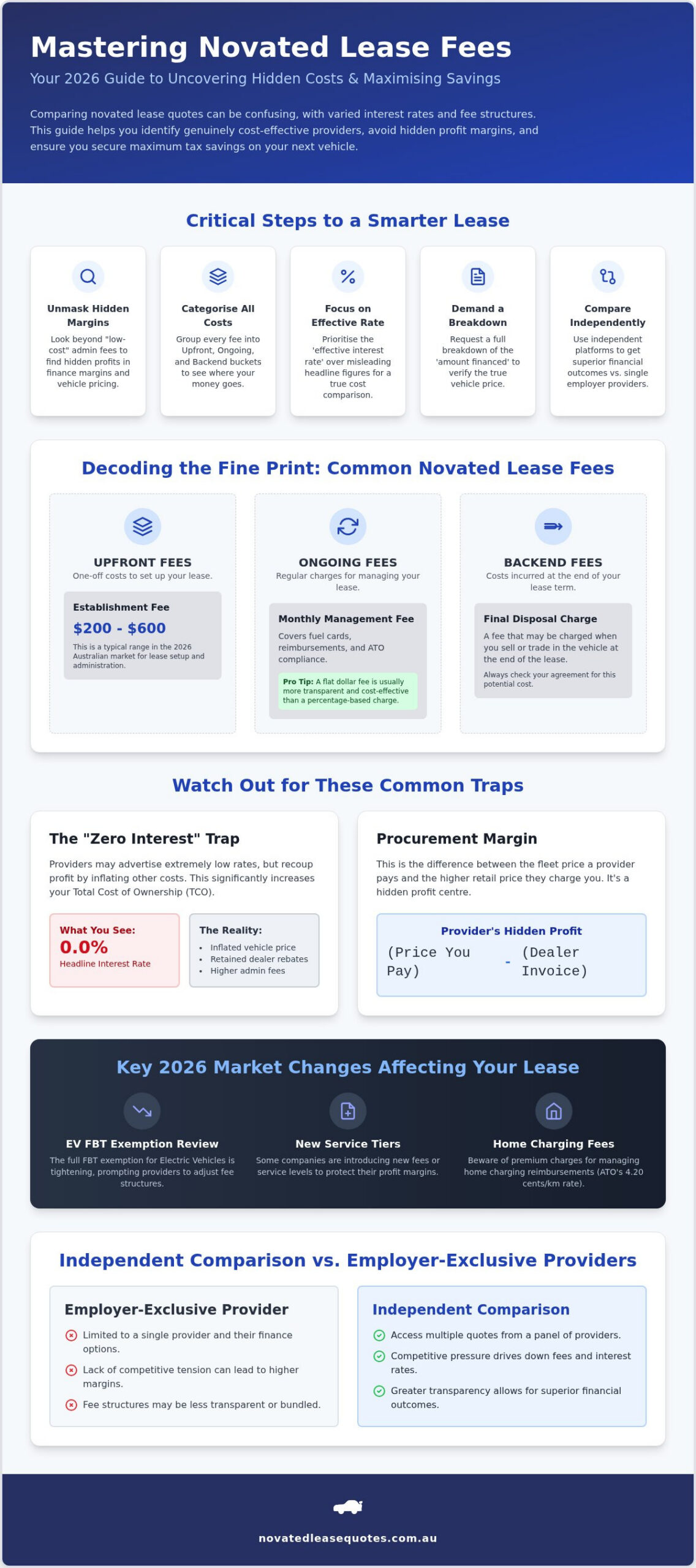
Some providers offer headline interest rates that appear incredibly competitive, sometimes even approaching zero. They often recoup this lost revenue by inflating vehicle procurement fees or retaining dealer rebates. You might think you’re getting a bargain, but if the provider pays a fleet price and charges you the full retail price, you’re losing thousands in upfront savings. Procurement Margin is the difference between the dealer invoice and the price charged to the lessee. Identifying these gaps requires looking beyond the interest rate and scrutinising the total amount financed.
Impact of the 2026 EV FBT Review on Fee Structures
The 2026 financial year marks a significant shift in the Australian market. With the luxury car tax (LCT) threshold for fuel-efficient vehicles at $91,661 and the phased wind-back of EV incentives, many providers are diversifying their fee structures. As the full FBT exemption for EVs starts to tighten, some companies have introduced new service tiers or increased management fees to protect their bottom line. It’s also vital to check for hidden charges related to the ATO’s 4.20 cents per kilometre home charging rate. If a provider charges a premium to manage these reimbursements, it can quickly erode the savings gained from the FBT exemption. This makes a novated lease provider fees comparison essential for anyone entering or renewing a lease this year.
Decoding the Fine Print: Common Fees and Charges in Australian Novated Leases
A meaningful novated lease provider fees comparison requires looking beyond the monthly deduction. To truly understand what you’re paying, it’s helpful to categorise costs into three distinct buckets: upfront, ongoing, and backend. Most of these fees are paid from your pre-tax salary, which provides a tax benefit, but that doesn’t mean they should be ignored. The way these fees are structured can significantly impact your total savings.
Tax treatment is a critical part of the equation. According to Australian Taxation Office guidelines, your employer is generally entitled to claim Input Tax Credits (ITCs) for the GST included in the lease payments and running costs. A transparent provider will ensure these ITCs are passed back to you, effectively reducing your costs by 10 per cent. If a quote doesn’t clearly show these credits being applied to your benefit, you’re likely overpaying. You should also be wary of “bundled” insurance products. These often carry high commissions for the provider and might be more expensive than sourcing your own comprehensive cover separately.
Establishment and Monthly Management Fees
Establishment fees are the one-off costs for setting up your lease. In the 2026 Australian market, these generally range from $200 to $600. Once the lease is active, you’ll pay a monthly management fee. This covers the provider’s work in managing your fuel cards, processing reimbursements, and ensuring ATO compliance. It’s best to look for a provider that charges a flat dollar fee. Some providers charge a percentage of the vehicle’s value, which can become prohibitively expensive if you’re leasing a high-end EV near the luxury car tax threshold.
Vehicle Procurement and Disposal Fees
Procurement fees, often called brokerage fees, are charged for sourcing the vehicle through the provider’s dealer network. These are frequently buried within the “Amount Financed” section of your quote, making them hard to spot without a professional novated lease provider fees comparison. Similarly, disposal or “de-novating” fees apply at the end of the term or if you leave your employer. These backend costs can catch you by surprise if you haven’t scrutinised the fine print. Using a novated lease quote comparison service can help you identify these hidden charges before you sign the contract.
Always ask for a line-by-line breakdown of the amount being financed. If a provider is hesitant to disclose the exact brokerage fee or the disposal costs, it’s usually a sign that those margins are higher than the industry average. Transparency is the hallmark of a competitive provider.
Exclusive vs. Independent Providers: Comparing the Real Financial Outcomes
Many Australian employees assume they must use the specific leasing company listed in their workplace benefits portal. This is the “Exclusive Provider” model. While it feels convenient, it often creates a captive market where the provider doesn’t have to compete on price. In contrast, an independent approach allows you to get multiple novated lease quotes from across the market. This competition is the most effective tool you have to drive down costs and ensure you aren’t paying a “convenience tax” on your new vehicle.
A rigorous novated lease provider fees comparison often reveals that exclusive panels carry higher margins. This happens because the provider may be paying commercial rebates back to the employer to maintain their “preferred” status. These rebates aren’t free; they’re funded by the higher interest rates and management fees you pay every fortnight. It’s worth checking your HR policy for a “Choice of Provider” or “BYO Provider” clause. Many organisations allow you to nominate your own specialist, even if they don’t actively publicise the option to the wider workforce.
The Cost of Employer Exclusivity
Exclusive arrangements often lack the transparency found in an open market. When a provider is the only game in town, their incentive to offer the sharpest vehicle procurement price or the lowest management fee diminishes. You aren’t just paying for the car; you’re often subsidising the administrative ease of the employer. If your current quote feels uncompetitive, ask your payroll department if they can facilitate a deed with an external specialist. Most modern payroll systems can handle multiple providers with ease, meaning the “exclusivity” is often more about tradition than technical necessity.
Effective Interest Rates vs. Headline Rates
Don’t be fooled by a shiny headline rate. A provider might advertise 7 per cent while another offers 8 per cent, yet the 8 per cent option could actually be cheaper. This occurs when the lower rate quote includes high “undisclosed” margins or upfront brokerage fees that are capitalised into the loan. You should focus on the effective interest rate, which accounts for the total interest paid over the term relative to the actual amount financed. You can use a novated lease calculator to model these different scenarios accurately. By comparing the total cost of ownership rather than just the percentage, you ensure your novated lease provider fees comparison is based on real-world outcomes rather than marketing promises.
Your Step-by-Step Fee Comparison Framework for 2026
Executing a precise novated lease provider fees comparison requires a structured approach. You can’t rely on a single-page summary to reveal the true cost of a vehicle. To ensure you aren’t overpaying, follow this five-step framework to audit every quote you receive.
- Step 1: Request a “Full Breakdown of the Amount Financed.” This document is the only way to see exactly what is being borrowed. It should list the vehicle price, any accessories, and every setup fee separately.
- Step 2: Identify the “Net Achieved Price” vs MSRP. Compare the price the provider is charging you against the Manufacturer Suggested Retail Price (MSRP). If the provider is using their fleet buying power, that discount should be reflected in a lower amount financed, not absorbed as a provider margin.
- Step 3: Compare the “Management Fee” over the entire lease term. A $50 monthly fee might look small, but over a 60-month lease, that’s $3,000 of your pre-tax salary. Always calculate the total cost over 36, 48, or 60 months to see the real impact.
- Step 4: Scrutinise running cost budgets for “padding.” Providers often inflate budgets for tyres, servicing, and fuel to make the estimated tax savings look more impressive. While this money stays in your account, it can lead to unnecessary pre-tax deductions that could be better utilised elsewhere.
- Step 5: Verify the finance component. Use an independent tool or calculator to ensure the interest rate and finance charges align with current 2026 market benchmarks for your credit profile.
Calculating the Total Cost of Ownership (TCO)
Total Cost of Ownership is the sum of all lease payments, plus the residual value, minus tax savings. This is the only figure that allows for an objective novated lease provider fees comparison across different companies. To standardise your quotes and ensure you’re comparing “apples with apples,” you can use this novated lease comparison guide. Make sure every quote uses the same car model, lease term, and annual kilometres, or the TCO calculation will be fundamentally flawed.
Questions to Ask Your Leasing Consultant
When you speak with a provider, you need to be direct. There are several specific questions to ask a novated lease provider to flush out hidden costs. Start by asking: “Is there a procurement commission built into the vehicle price?” This forces them to disclose any rebates they’re receiving from the dealer. You should also ask: “Can I choose my own comprehensive insurance provider without penalty?” Some providers mandate their own high-commission insurance products, which can add hundreds of dollars to your annual costs.
If you’re ready to see how different specialists stack up, you can get a competitive novated lease quote comparison to start your search with transparent data.
Streamlining Your Search with Novated Lease Quotes
Finding the right provider shouldn’t be a manual chore. Novated Lease Quotes serves as the essential starting point for any search for novated lease quotes online. Instead of spending hours contacting individual companies and repeating your details, our platform allows you to have multiple specialists compete for your business. This competition is what drives transparency and ensures your novated lease provider fees comparison results in a genuine financial benefit rather than a high-margin contract that erodes your take-home pay.
The 2026 tax environment is complex, particularly with the phased changes to EV incentives and the luxury car tax threshold for fuel-efficient vehicles set at $91,661. Accessing independent expertise is the most reliable way to ensure your lease remains cost-effective as these regulations evolve. Simply comparing two or more providers can often uncover thousands of dollars in potential savings that would otherwise be lost to undisclosed margins, inflated procurement fees, or uncompetitive finance rates that aren’t actively publicised by employer-exclusive panels.
How Our Comparison Service Works
Our process is designed for speed and clarity. You provide your vehicle preferences and basic employment details, and we connect you with specialists from our national network of leasing experts. These specialists understand the specific technical requirements for an EV novated lease Australia, including the ATO’s home charging rates and the impact of reportable fringe benefit amounts on government benefits. We facilitate the connection so you can focus on choosing the right car while we ensure the underlying finance structure is competitive and transparent.
Maximising Your 2026 Salary Packaging Savings
Don’t settle for the first quote provided by your HR department or an exclusive panel provider who may not have the incentive to offer their sharpest rates. In the current financial year, being an informed consumer is the best way to protect your take-home pay and maximise your tax savings. We encourage you to use our specialised calculator to see how different fee structures impact your total savings over the life of the lease. Taking a few minutes to compare options today ensures you optimise your salary packaging and enjoy the full benefits of your new vehicle without overpaying for administration or hidden brokerage fees.
Secure Your Financial Advantage in 2026
Mastering the intricacies of salary packaging requires a shift in focus from monthly deductions to the total cost of ownership. By scrutinising the effective interest rate and uncovering hidden procurement margins, you ensure that your tax savings aren’t being absorbed by provider profit. A thorough novated lease provider fees comparison is the most effective way to audit your current quotes and confirm you’re receiving the full benefit of fleet pricing and GST credits. It’s about looking past the headline rates to see the real impact on your take-home pay.
Don’t let the complexity of the 2026 FBT landscape or an employer-exclusive panel limit your savings potential. You have the power to demand transparency and choose a specialist that aligns with your financial goals. It’s possible to maximise your 2026 tax savings with independent and objective advice that puts your interests first. To get started, you can Get Multiple Competitive Novated Lease Quotes Now and compare options from top Australian providers in minutes. Taking control of your vehicle finance today ensures you drive away with a deal that’s as smart as it is cost-effective.
Frequently Asked Questions
What are the most common hidden fees in a novated lease?
Procurement margins and inflated insurance commissions are the most frequent hidden costs. While establishment fees are usually disclosed, the difference between a dealer’s fleet price and the price on your quote is often retained by the provider as profit. You should also check for “document fees” or “settlement fees” capitalised into the amount financed. These hidden layers can add thousands to the total cost without ever appearing as a line-item management charge.
Do novated lease providers charge a fee if I pay out the lease early?
Yes, most providers charge an early termination or payout fee if you settle the lease before the agreed term ends. These charges cover the administrative cost of calculating the payout figure and finalising the contract with the financier. You’ll likely also pay any remaining interest charges or a “break fee” specified in the credit provider’s terms. Always request an early exit schedule before signing to understand these potential backend costs.
Is the management fee tax-deductible or paid from pre-tax salary?
Management fees are typically paid from your pre-tax salary, which effectively makes them tax-deductible for most Australian employees. This reduces your taxable income, meaning the real cost to your take-home pay is lower than the headline dollar amount. However, you should still perform a novated lease provider fees comparison to ensure the pre-tax deduction isn’t unnecessarily high. Even with the tax benefit, a lower fee always results in more take-home pay at the end of each fortnight.
How can I tell if the interest rate on my quote is competitive?
A competitive interest rate in 2026 generally falls between 6 per cent and 9 per cent per annum, depending on the vehicle type and your credit profile. To verify if your quote is sharp, you must look at the “effective interest rate” rather than the base rate. If the total interest paid over the term seems disproportionately high compared to the amount borrowed, the provider may have built additional margins into the finance component. Comparing multiple quotes is the only way to establish a market benchmark.
Why do different providers give me different tax saving figures for the same car?
Discrepancies in tax savings usually occur because providers use different assumptions for your running costs or income tax brackets. One provider might “pad” the budget for fuel or tyres to make the tax-free portion of your salary look larger. Alternatively, they may not have updated their models for the July 2026 tax rate reductions. Always ensure you provide identical salary and kilometre data to every provider to get an accurate and honest comparison.
Can I negotiate the fees with a novated lease provider?
You can certainly negotiate fees, especially if you have a competing quote from another specialist. While some administration fees are fixed, procurement margins and interest rate spreads often have room for movement. Providers are often willing to “price beat” or match a competitor to secure your business. Bringing transparent data to the table is the best way to force a provider to sharpen their pencil and reduce their disclosed or undisclosed charges.
What happens to the fees if I change employers during the lease term?
If you change employers, the lease is usually “de-novated,” and you become responsible for the full monthly payments from your post-tax income. Most providers charge a de-novation or disposal fee to handle the administrative transition. You can often transfer the lease to your new employer if they agree to the arrangement, but this may involve a new set of establishment fees. It’s essential to notify your provider immediately to avoid payment defaults during the job transition.
Are EV novated leases subject to higher management fees because of the FBT exemption?
EV novated leases are generally not subject to higher management fees, though some providers charge extra for managing home charging reimbursements. Because EVs under the $91,661 luxury car tax threshold are FBT-exempt in 2026, the administrative reporting is often simpler than for petrol vehicles. You should perform a novated lease provider fees comparison specifically for electric models to ensure you aren’t paying a premium for specialist EV management that should be a standard service.