
By May 2026, battery electric vehicles reached a record 20% market share in Australia, and more than half of those sales were facilitated through the Electric Car Discount in novated leases. As an employer, you’re likely aware that offering salary packaging is a powerful tool for talent retention, yet the perceived complexity often holds businesses back. You might worry about the administrative burden on your payroll team or the potential liability if a staff member leaves. It’s a common concern that the novated lease employer requirements australia demands are too heavy for a lean operation to manage.
We understand that you need clarity and efficiency, not more paperwork. This guide provides the exact roadmap you need to implement a tax-effective policy that remains cost-neutral for your company. You will discover the specific administrative, financial, and legal steps required to support your team’s vehicle choices while protecting your bottom line. We will cover everything from handling FBT and GST reporting to the seamless process of “de-novating” a lease when an employee moves on.
Key Takeaways
- Understand the tripartite structure of a novated lease and how the agreement effectively transfers vehicle costs from the employee to the business temporarily.
- Learn how to manage novated lease employer requirements australia through seamless payroll integration of pre-tax and post-tax salary packaging deductions.
- Master the use of the Employee Contribution Method (ECM) to offset Fringe Benefits Tax liabilities and ensure the arrangement remains cost-neutral for your organisation.
- Gain confidence in managing employee departures by understanding the de-novation process that transfers all financial responsibility back to the driver if they leave.
- Discover how to partner with specialist providers to automate administrative tasks and provide your staff with access to competitive quote comparisons and calculators.
Understanding the Employer’s Role in a Novated Lease Agreement
The role of an employer in a novated lease is often misunderstood as a complex financial burden. In reality, your business acts as a facilitator rather than a financier. By understanding the novated lease employer requirements australia mandates, you can provide a high-value benefit that remains entirely off your balance sheet. The arrangement is designed to be cost-neutral. This means the business doesn’t pay for the car; it simply redirects a portion of the employee’s existing salary to the leasing provider. Because the car is not a company-owned asset, you avoid the risks of depreciation and the administrative weight of managing a traditional fleet.
The Tripartite Relationship Explained
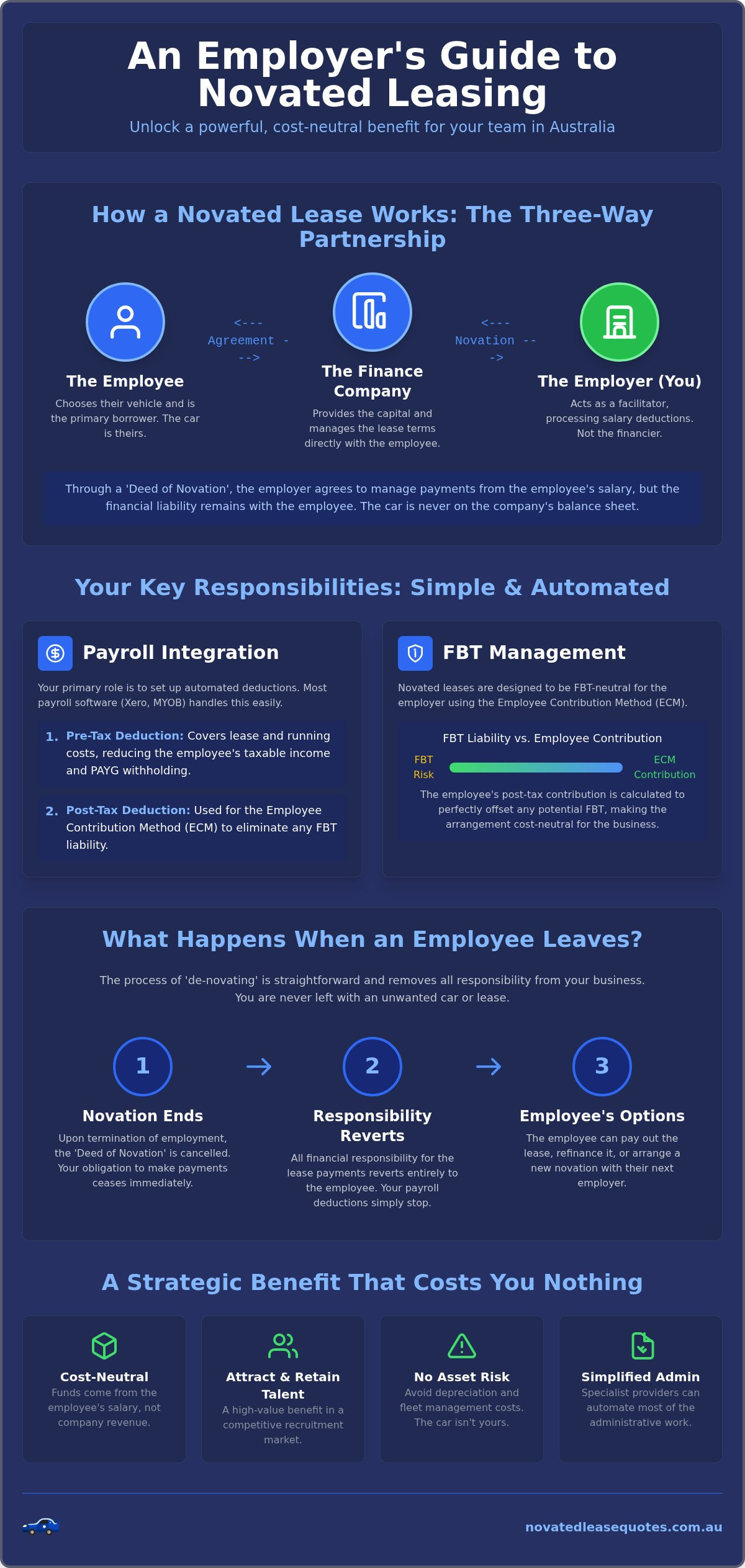
A novated lease is built on a three-way contract known as a tripartite agreement. To understand What is a Novated Lease?, you must look at how the legal obligations shift between the three parties. Initially, the employee enters into a finance agreement with a lender. Through a “Deed of Novation”, the employer agrees to take over the payment obligations for as long as that person remains on the payroll.
Responsibilities are clearly split to protect all parties:
- The Employee: Chooses the vehicle, manages daily maintenance, and remains the primary borrower.
- The Finance Company: Provides the capital and manages the lease terms.
- The Employer: Deducts funds from the employee’s salary and remits them to the provider.
Since the employee is the one who ultimately owns the vehicle, the asset never appears on the company’s books. This keeps your debt-to-equity ratios clean while still providing a professional benefit. If the employee leaves, the “novation” ends, and the payment responsibility reverts to the individual.
Why Australian Businesses Offer Salary Packaging
Implementing a salary packaging policy is a strategic move for any Australian firm. It helps you meet novated lease employer requirements australia while offering a “pay rise” that doesn’t cost the business a cent. Modern recruitment in Australia is highly competitive, and offering these tax-effective benefits helps you stand out without inflating your gross wage expenses.
Many businesses use this as a smarter alternative to a traditional company fleet. You avoid the risks associated with vehicle depreciation, insurance management, and fuel cards. You aren’t left with an idle car in the car park or a lease you can’t cancel if a staff member moves on. It’s a flexible solution that aligns with the needs of a mobile, modern workforce. By facilitating the lease, you empower your staff to choose the car they actually want, while you maintain a lean, efficient payroll operation.
Key Administrative and Financial Requirements for Employers
Managing the financial workflow is the core of novated lease employer requirements australia. Your primary responsibility is to act as the conduit between the employee’s salary and the leasing provider. While the business doesn’t fund the lease, you must ensure that the payroll deductions are calculated accurately and remitted on time. This process requires a clear understanding of how pre-tax and post-tax contributions interact within your existing payroll system to maintain ATO compliance.
Payroll Integration and PAYG Adjustments
Most modern Australian payroll platforms, such as Xero, MYOB, or Employment Hero, are designed to handle salary packaging with minimal manual effort. You will need to set up two distinct recurring deduction lines for each participating employee. The first is a pre-tax deduction, which covers the lease finance and most running costs. This reduces the employee’s gross taxable income, meaning you must adjust their PAYG withholding downwards. The second is often a post-tax deduction, used for the Employee Contribution Method (ECM) to offset Fringe Benefits Tax.
Getting this split right is essential. If the PAYG is not adjusted correctly, the employee won’t receive the immediate “pay rise” effect that makes novated leasing so attractive. It’s a rhythmic process: once the initial setup is complete, the deductions occur automatically each pay cycle, requiring only a periodic review to ensure the amounts align with the leasing company’s latest statements.
Managing GST and Input Tax Credits (ITCs)
One of the most significant financial advantages of a novated lease involves the treatment of GST. When the leasing company invoices your business for the monthly lease payment and budgeted running costs, those invoices include GST. As a GST-registered employer, you can claim these amounts back as Input Tax Credits (ITCs) on your quarterly Business Activity Statement (BAS).
The crucial step is to pass these GST savings back to the employee. Because the business is being reimbursed for the GST by the ATO, you shouldn’t “charge” the employee the GST-inclusive price. Instead, you deduct the GST-exclusive amount from their salary packaging account. This effectively gives the employee a 10% discount on their car’s running costs, including fuel, tyres, and servicing. If you want to see how these credits impact an employee’s take-home pay, you can use a novated lease calculator to model the exact savings for different vehicle types.
Accurate record-keeping is the final pillar of compliance. You must maintain clear logs of all remitted payments and GST claims to satisfy ATO audit requirements. Additionally, if the taxable value of the fringe benefit exceeds A$2,000 in an FBT year, you’re required to record the Reportable Fringe Benefit Amount (RFBA) on the employee’s annual payment summary. While this doesn’t result in extra tax for the business, it’s a mandatory reporting obligation that requires diligent payroll management.
Navigating Fringe Benefits Tax (FBT) and Reporting Obligations
While the employer is legally responsible for paying Fringe Benefits Tax (FBT) to the ATO, the actual financial impact on your business is typically zero. Under the novated lease employer requirements australia framework, most agreements use the Employee Contribution Method (ECM) to offset this liability. This involves the employee paying a specific portion of their vehicle’s running costs from their post-tax salary. By doing so, they reduce the taxable value of the fringe benefit to A$0, which effectively eliminates the FBT expense for the company. It’s a pragmatic solution that allows you to offer the benefit without adding a tax line item to your corporate budget.
The 2026 EV FBT Exemption Landscape
The most significant change in Australian salary packaging recently is the surge in electric vehicle (EV) adoption. For the 2026-2027 FBT year, battery electric vehicles and hydrogen fuel cell cars remain exempt from FBT, provided their value is below the luxury car tax threshold of A$91,661. This exemption has transformed the market, making EVs the most cost-effective choice for staff. It’s important to remember that plug-in hybrid vehicles (PHEVs) are no longer eligible for this exemption as of 1 April 2025, unless a binding commitment was already in place before that date.
Even though an EV might be FBT-exempt, you still have reporting duties. You must calculate the taxable value of the benefit as if FBT were payable. This value is used to determine the employee’s reportable fringe benefits amount, which we will cover in the next section. For most employers, this means your payroll team needs to track the vehicle’s base value and the date it was first held to ensure the exemption is applied correctly in your annual FBT return.
Annual Reporting and Payment Summaries
Every year, if the total value of fringe benefits provided to an employee exceeds A$2,000, you must record a Reportable Fringe Benefits Amount (RFBA) on their payment summary. This isn’t a direct tax on the employee, but it is used by the ATO to assess their eligibility for certain government benefits and obligations. The Statutory Formula Method calculates the taxable value of a car fringe benefit as a flat 20% of the vehicle’s base value, regardless of the distance travelled. This figure is then “grossed up” using the relevant ATO rate (currently 1.8868 for Type 2 benefits) to arrive at the final RFBA.
Accurate reporting is vital because the RFBA can influence an employee’s Medicare Levy Surcharge or their HECS/HELP repayment levels. Clear communication from HR is essential here. Employees should be encouraged to seek independent financial advice so they understand how their salary packaging choice might affect their broader financial position. By maintaining precise records throughout the year, your end-of-financial-year reporting becomes a straightforward administrative task rather than a last-minute scramble for data.
A Step-by-Step Checklist for Implementing Novated Leasing
Setting up a salary packaging program doesn’t have to disrupt your operations. By following a structured roadmap, you can satisfy novated lease employer requirements australia standards while minimising the impact on your HR and finance teams. The goal is to create a repeatable process that allows you to scale the benefit as more staff members opt in. It’s a simple transition when handled methodically. You’ll find that once the initial framework is in place, the ongoing management becomes a standard part of your monthly payroll cycle.
Establishing an Internal Salary Packaging Policy
A robust policy is the foundation of a successful program. You should clearly define eligibility; for instance, many Australian firms limit leasing to full-time or permanent part-time staff to ensure consistent salary deductions. You also need to decide if you’ll restrict vehicle choices, such as focusing on FBT-exempt EVs, or allow a broader range of passenger vehicles. Finally, your policy must address edge cases like unpaid leave or maternity leave, where salary deductions may temporarily cease. Having these rules in writing prevents confusion and ensures equitable treatment across the workforce. It protects the business and provides clarity for your staff.
Selecting a Specialist Leasing Provider
Partnering with the right provider is the most effective way to reduce administrative overhead. Look for specialists who offer sophisticated digital reporting tools that integrate with your payroll software. It’s often beneficial to encourage staff to perform a novated lease comparison to ensure they are securing the most competitive finance and management rates available in the 2026 market. A provider that offers comprehensive support for both the payroll department and the individual driver will handle the bulk of the technical paperwork on your behalf. This ensures the novated lease employer requirements australia are met without straining your internal resources.
To get started, follow this five-step implementation checklist:
- Step 1: Finalise your internal salary packaging policy and eligibility criteria to set clear boundaries.
- Step 2: Appoint a specialist provider to manage the quotes and daily administration for your staff.
- Step 3: Review and sign the Master Leasing Agreement or individual Deeds of Novation to formalise the tripartite arrangement.
- Step 4: Configure your payroll software with the specific pre-tax and post-tax deduction codes provided by the lessor to ensure PAYG is calculated correctly.
- Step 5: Establish a monthly reconciliation process to check payroll deductions against the lessor’s statements and account for variances in running costs.
If you’re ready to see how this fits into your current business structure, you can request a novated lease quote comparison to evaluate the best options for your team and ensure they receive the maximum tax benefits available.
Minimising Business Risk and Administrative Overhead
Many Australian business owners hesitate to offer salary packaging because they fear being “stuck” with a vehicle if an employee resigns. This is a common misconception. Under the novated lease employer requirements australia framework, the business holds no equity in the vehicle and carries no long-term financial liability. If the employment contract ends, the lease obligation ends with it. Your risk is strictly limited to the duration of the staff member’s tenure. The vehicle is not a company asset, and the debt is not a company liability.
Handling Employee Departures and Terminations
When a driver leaves your organisation, the process is known as “de-novation”. Your payroll team simply ceases the deductions on the final pay cycle. At this point, the Deed of Novation is cancelled. The financial responsibility for the lease and all ongoing running costs reverts entirely to the individual. They can choose to continue payments personally or “re-novate” the agreement with their new employer. This portability is a key feature of the Australian market. It ensures that a resignation or termination doesn’t leave your finance team with an administrative headache or an unwanted asset in the car park.
The employer also holds zero liability for vehicle damage, insurance claims, or excess wear and tear. These are private matters between the driver, the insurer, and the leasing company. Your role remains purely transactional. Because the lease is an agreement between the employee and the financier that you simply facilitate, the business is protected from the typical risks associated with company-owned fleets.
Leveraging Technology to Reduce Admin
Modern salary packaging doesn’t require manual spreadsheets or complex data entry. Specialist providers now offer “ready-to-upload” payroll files that sync directly with your accounting software. This automation ensures that novated lease employer requirements australia for accurate reporting are met with minimal human intervention. To further reduce the burden on HR, you should encourage staff to use a novated lease calculator. This tool allows them to model their own savings and running costs, which significantly cuts down on internal enquiries about take-home pay impact.
Choosing the right partner is essential for a low-touch experience. Using a novated lease quote comparison service helps you identify providers that offer the most intuitive employer-facing portals. These platforms provide real-time visibility into all active leases, making the monthly reconciliation process fast and transparent. By leveraging these digital tools, you can offer a premium benefit that enhances your employee value proposition without adding unnecessary complexity to your daily business operations.
Optimising Your Business for 2026 Salary Packaging
Implementing a novated lease program is a strategic advantage that doesn’t have to complicate your daily operations. By mastering the novated lease employer requirements australia landscape, you can offer a high-value benefit that remains cost-neutral and carries minimal financial risk. The tripartite structure ensures that the lease is portable; if a staff member moves on, the obligation departs with them, shielding your company from long-term liabilities or idle assets. With the current FBT exemptions for electric vehicles, there has never been a more tax-effective time to modernise your employee benefits package.
Modern digital portals and automated payroll reporting now handle the heavy lifting, allowing your finance team to maintain compliance with precision and speed. If you’re ready to enhance your employee value proposition and attract top-tier talent, get a competitive novated lease quote comparison for your team today. Our national service provides expert guidance on FBT and salary packaging compliance while allowing you to compare multiple Australian providers in one convenient place. Taking the first step toward a smarter payroll strategy is a pragmatic move for any forward-thinking organisation.
Frequently Asked Questions
Does an employer have to pay for the car if the employee is fired?
No, the employer is not responsible for the car if an employee is terminated or resigns. The deed of novation is cancelled immediately, and the lease reverts to a direct agreement between the individual and the finance provider. This portability is a core feature of the arrangement. The employee must then choose to pay the lease from their own pocket or re-novate it with a new employer if they find a new role.
Is there any direct cost to the business for offering a novated lease?
There is no direct cost to your business when offering a novated lease. All lease payments, fuel, and maintenance costs are funded by the employee through a combination of pre-tax and post-tax salary deductions. The only “cost” is the minor administrative time taken to process these deductions through payroll. Because the business claims GST credits back from the ATO, the entire process remains cash-flow neutral for the organisation.
How much extra work is required for our payroll department?
Your payroll department will typically spend about 15 minutes per employee for the initial setup. Once the two deduction lines for novated lease employer requirements australia are established in your software, the process is automated. You simply remit the total monthly amount to the leasing provider. Most modern providers also supply automated reconciliation files that sync directly with your accounting platform, further reducing the manual workload for your finance team.
Are small businesses in Australia eligible to offer novated leasing?
Yes, small businesses in Australia are fully eligible to offer novated leasing to their staff. Any organisation with a valid Australian Business Number (ABN) that is registered for GST can facilitate these agreements. It’s an excellent way for smaller firms to compete with larger corporations for talent by offering tax-effective salary packaging without needing a massive HR department or a dedicated fleet manager to oversee the vehicles.
What are the FBT implications for an employer in 2026?
In 2026, the primary FBT implication is the requirement to report the benefit on the employee’s payment summary. While the employer is technically liable for the tax, this is usually reduced to zero through the Employee Contribution Method or by choosing FBT-exempt electric vehicles. For eligible EVs under the A$91,661 luxury car tax threshold, the FBT is entirely eliminated; however, you must still calculate and report the Reportable Fringe Benefit Amount (RFBA).
Can an employer refuse a novated lease request from a staff member?
Yes, an employer can legally refuse a request for a novated lease. Offering salary packaging is a voluntary benefit rather than a mandatory requirement under Australian employment law. However, most businesses find that refusing such requests can hurt staff morale and retention. It’s often better to establish a clear internal policy that outlines who is eligible, which helps manage expectations while still providing the benefit to permanent staff members.
What happens if the employee goes on unpaid leave?
If an employee goes on unpaid leave, the salary deductions will naturally stop. In this scenario, the novation agreement is typically suspended. The employee becomes responsible for making the lease payments directly to the finance company using their own funds until they return to work and salary deductions can resume. It’s vital to outline these specific terms in your company’s internal salary packaging policy to ensure both parties understand their obligations during leave.
Do we need to include the vehicle on our company balance sheet?
No, you don’t need to include the vehicle on your company balance sheet. One of the main novated lease employer requirements australia advantages is that the car remains the property of the finance company or the employee. Since the business is not the owner or the primary borrower, the vehicle is considered an off-balance-sheet item. This keeps your business’s debt-to-equity ratios healthy and ensures you aren’t exposed to vehicle depreciation risks.


