
Buying outright isn’t automatically cheaper. In a novated lease vs buying a car comparison, the better option depends on tax treatment, running costs and whether you want to own the vehicle at the end. A novated lease packages eligible vehicle costs through salary deductions, while paying cash or taking out a car loan offers a different route to ownership.
It’s sensible to focus on the total cost, not just the advertised vehicle price or monthly payment. A lease can include expenses such as fuel, servicing, registration and insurance, but it may also have mileage limits, charges and a residual value to manage at the end.
This guide compares a novated lease with paying cash or borrowing, explains the tax and GST considerations, and shows which costs to include in your calculations. You’ll also see how lease terms, the residual and your employment arrangements affect the decision, so you can weigh the options against your budget and plans for your next car.
Key Takeaways
- Compare the total cost of each option, including running expenses and any residual, rather than judging by the monthly payment alone.
- Identify how salary packaging, GST treatment and your personal circumstances can affect the potential tax benefits.
- Plan for the end of the lease by understanding the residual and the choices available for the car.
- Use a quote comparison and calculator to assess how lease costs and inclusions fit your budget and driving needs.
How does novated leasing compare to traditional car financing or buying outright?
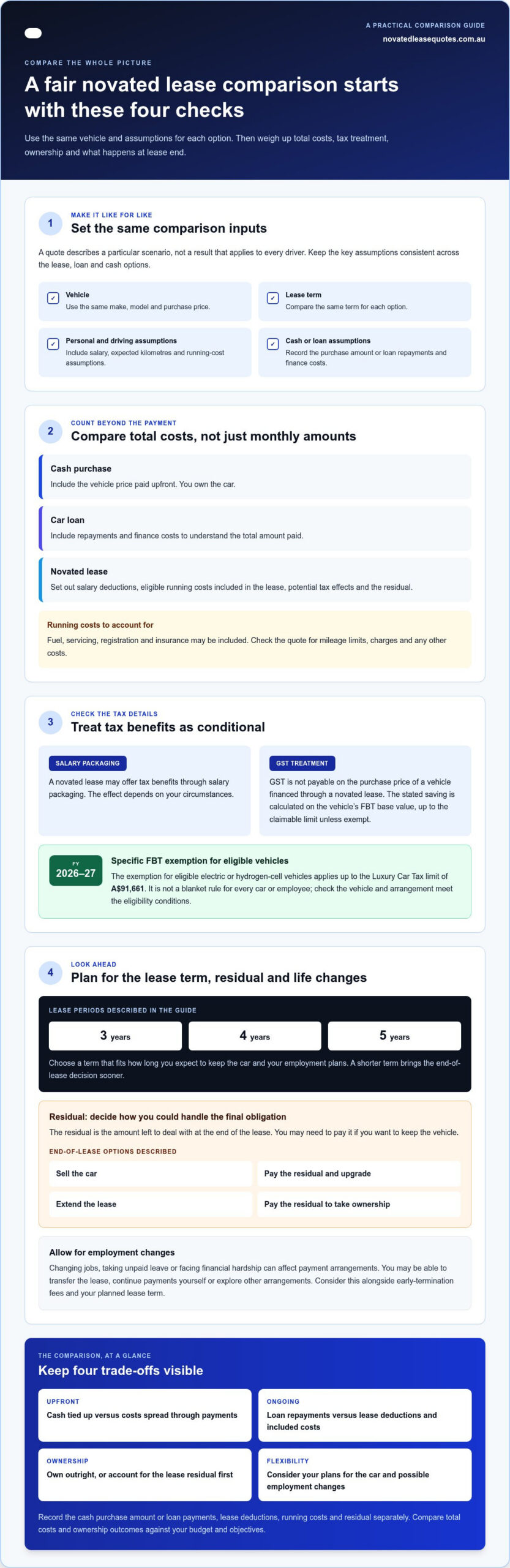
A novated lease combines vehicle finance with salary packaging. A car loan or cash purchase follows a different path to ownership. To compare a novated lease quote with buying, use the same vehicle, lease term, salary, expected kilometres and running-cost assumptions. Include the residual, too, along with your cash or loan assumptions, so the comparison is like for like.
Comparing Leasing and Outright Purchase
With a cash purchase, you pay the vehicle price upfront and own the car. With a loan, repayments and finance costs determine the total you pay. A novated lease instead packages eligible vehicle costs through salary deductions.
Figures from a quote illustrate a particular scenario, not a result that applies to every driver. Compare the same vehicle, term and expected use, then account for running costs and the residual. Consider your priorities as well: ownership, predictable budgeting and the flexibility to change cars.
Residual Values and End-of-Lease Options
A residual is the amount left to deal with at the end of a lease. It can require a payment if you want to keep the vehicle. Before signing, consider whether that future obligation fits your budget and plans. At the end, options can include selling the car, paying the residual and upgrading, extending the lease, or paying the residual to take ownership.
Novated lease periods can be three, four or five years. Choose a term that fits how long you expect to keep the car and your employment plans. A shorter term brings the end-of-lease decision sooner; a longer one changes the payment period and when you reassess the vehicle. Compare each term against the same car and driving assumptions.
Your vehicle choice affects the quote and the comparison. Start with the make, model and purchase price, then set the intended term and expected kilometres. Check that the vehicle suits your needs and meets novated lease eligibility requirements.
Employment changes can affect how payments are managed. If you change jobs, take unpaid leave or face financial hardship, you may be able to transfer the lease, continue payments yourself or explore other arrangements. Consider these possibilities alongside the planned term, rather than treating the quoted payment as the only decision factor.
For a practical comparison, set out the vehicle and term first, then add salary and running-cost assumptions. Record the loan payments or cash purchase amount, lease deductions and residual separately. This makes the trade-offs clear: upfront cash, ongoing payments, ownership timing and the final lease obligation. Choose the option that best fits your budget and objectives.
Novated leasing compared with a car loan or paying cash
Compare the total cost and ownership outcome, not just the payment amount. Tax treatment, running costs and your financial situation can all affect which option suits your objectives.
Tax and GST Benefits
A novated lease may offer tax benefits through salary packaging. GST is not payable on the purchase price of a vehicle financed through a novated lease. The stated GST saving is calculated on the vehicle’s FBT base value, up to the claimable limit unless exempt. The effect depends on your circumstances, so compare the estimated tax treatment with the payments and other costs.
For FY 2026-27, the FBT exemption for eligible electric or hydrogen-cell vehicles applies up to the Luxury Car Tax limit of A$91,661. This is a specific exemption, not a blanket rule for every car or employee. Check whether the particular vehicle and arrangement meet the eligibility conditions before including an exemption in your comparison.
Risks of Leasing Instead of Buying
A novated lease has a residual to pay at the end if you want to own the vehicle, and early termination may incur fees. A cash purchase means you own the car without a lease residual; a loan has its own repayment obligations. Compare the full terms and costs, and consider whether your driving pattern or employment might change during the lease.
If you change jobs, take unpaid leave or face financial hardship, you may be able to transfer the lease, continue payments yourself or explore other arrangements. Those options can affect your budget and require decisions at a difficult time. Include this risk in your comparison, rather than considering only the expected tax benefit.
Leasing as a Way to Get a Car
A novated lease lets an eligible employee finance a vehicle through salary packaging, rather than paying the full purchase price upfront or arranging a conventional car loan. The employer makes salary deductions, and the lease can bundle eligible vehicle expenses. Check that the proposed vehicle, payment structure and lease term suit your objectives.
To compare fairly, use the same vehicle and term for each option. Set out the cash purchase amount or loan repayments, then compare them with lease deductions, included running costs, potential tax effects and the residual. This step-by-step view makes the trade-offs clearer: upfront spending, ongoing budget impact and the payment required to own the car at lease end.
Consider whether you value owning the car outright, spreading payments, or packaging costs through salary. A cash purchase ties up money upfront; a loan spreads payments but adds finance costs; leasing changes the payment and end-of-term structure. A novated lease quote comparison can help you assess the lease side against your own figures.
Ultimately, the better choice depends on your financial situation and how you plan to use the car. Compare total costs, tax treatment and end-of-term obligations before deciding. For an eligible electric or hydrogen-cell vehicle in FY 2026-27, the FBT exemption limit is A$91,661, while other vehicles follow different tax treatment. Check the applicable eligibility and the quote assumptions before relying on a projected saving.
Indicative vehicle costs and their assumptions
Indicative figures are useful only when their assumptions are clear. In Australia, compare the same vehicle, payment budget and term for a loan and a novated lease. Account for the purchase price, running costs and residual separately. A headline saving may reflect one particular set of inputs, not a result that applies to every driver or car.
These figures compare different vehicle prices against one budget, so they aren’t a direct comparison of the total cost of the same car.
The distinction matters when you assess a purchase. A loan involves repayments, while a lease calculation also needs to include the residual and account for how running costs are treated. Paying cash uses money upfront, so include the purchase amount and the costs of keeping the vehicle. Compare each option over the same three-year period and using the same driving assumptions.
That figure depends on the vehicle, finance and lease assumptions used in the comparison. To understand its relevance, identify which costs are included, how the payment is calculated and what you must pay at the end. A saving figure without those details doesn’t show the full cost of a particular vehicle.
The Hyundai Tucson example shows why residual assumptions matter. It uses a residual rate of 46% over a three-year lease period and projects that the vehicle will retain 64% of its value over that period. On that projected value, the comparison estimates customers could receive 18% of the initial cost back. This outcome relies on the projected resale value and the example’s residual figure.
Build your own comparison by recording the vehicle’s purchase price, payment structure and lease term first. Add the running costs included in each option, then list the residual separately as an end-of-term payment.
Use consistent assumptions for each quote. If a lease bundles fuel, servicing, registration or insurance, include those items when comparing it with a loan or cash purchase. Keep any projected resale value separate from a guaranteed amount, and assess the figures against your vehicle choice and circumstances.
Potential income tax and GST savings
A novated lease can affect vehicle costs through salary packaging and GST treatment. Assess these separately: income tax effects relate to your salary packaging arrangement, while GST treatment applies to the vehicle purchase. Neither figure alone shows the full cost. Compare both with the payment obligations, bundled expenses and residual in the lease terms.
For income tax, a novated lease packages vehicle costs through salary deductions. Tax savings depend on your individual circumstances. Your salary, the arrangement’s structure and the vehicle costs being packaged all affect the comparison. Treat a projected saving as one part of your assessment, not as the vehicle’s total cost or a guaranteed outcome.
GST treatment is another part of the calculation. GST is not payable on the purchase price of a vehicle financed through a novated lease. The stated GST savings are calculated on the vehicle’s FBT base value, up to the claimable limit unless exempt. This saving relates to that base value and limit; it does not automatically equal a discount on every vehicle’s advertised price.
Compare a novated lease with an outright purchase using the same vehicle and costs for each option. For the lease, separate salary deductions, packaged running expenses and the residual. For a cash purchase, record the upfront vehicle payment and expenses you would pay separately. Then account for the lease’s income tax and GST treatment, rather than subtracting a projected tax benefit from the car’s sticker price alone.
A clear assessment follows a practical sequence:
- Identify the vehicle and purchase price used in the lease calculation when researching smartleasing vs buying a car.
- Separate the FBT base value from the purchase price when considering GST.
- List the packaged costs and the salary deductions attached to the arrangement.
- Compare the resulting lease costs with the cash purchase and its separate expenses.
- Include the residual as a future obligation, not as a current tax saving.
These steps help avoid two common comparison errors: treating GST savings as a reduction equal to the vehicle’s full price, and overlooking the residual when weighing tax benefits. Use the same vehicle, costs and period in both calculations. That makes the assumptions clear and shows how tax treatment affects the particular arrangement.
Salary packaging has financial consequences beyond the vehicle calculation. Employees should obtain independent financial advice before entering into or changing the terms of a salary packaging arrangement. Include this step in your decision process, especially when comparing a novated lease with paying cash for a car, and visit Novated Lease Quotes to explore your options.
Salary deductions and bundled running costs
A novated lease can group vehicle expenses into an arrangement funded through salary deductions. This can make budgeting more convenient than managing separate bills for fuel, servicing, registration and insurance. The value of the package depends on which costs it includes and how closely its assumptions match your driving and vehicle needs.
Check the inclusions line by line. A full-service novated lease payment can include finance repayments, fuel or charging, servicing, maintenance, registration, CTP insurance, tyres, accident management and comprehensive insurance. Some items, including fuel, may be excluded under a non-maintained option. Also account for costs such as tolls, fines, parking and personal modifications when comparing the package with a car loan or cash purchase.
Use a practical cost checklist before deciding:
- Vehicle: identify the car and the costs connected with financing it.
- Fuel: consider how your regular trips affect fuel spending.
- Servicing: include scheduled maintenance in the comparison.
- Registration: account for this expense alongside other vehicle costs.
- Insurance: note whether it is packaged or arranged separately.
This checklist helps you compare the packaged payment with the expenses you would manage yourself. If your travel changes or you drive more or less than expected, fuel and servicing needs may differ from the estimates. Review each category rather than assuming that one bundled figure suits every driver.
Salary packaging also affects the vehicle’s impact on your take-home pay. Compare the salary deductions with your available budget, then set aside any expenses that remain outside the package. Tax savings depend on your individual circumstances, so consider a personal estimate alongside the actual inclusions, not as a substitute for them.
Build a like-for-like comparison by using the same vehicle and driving assumptions for the lease and purchase options. For a cash purchase, list fuel, servicing, registration and insurance as separate expenses. For a loan, add those same costs to the loan payments. Compare the complete totals and show any residual separately, so bundled running costs don’t hide the payment due at lease end.
According to the Queensland Government, independent financial advice is strongly recommended before entering into or changing the terms of a salary packaging arrangement. This is particularly relevant when a change in salary, vehicle use or packaged expenses could affect your budget. For a personalised comparison of packaged costs and deductions, compare novated lease quotes against your own vehicle expenses.
Novated Lease Quotes: Novated lease quotes
Novated Lease Quotes helps Australian employees compare novated lease quotes when weighing salary packaging against a loan or cash purchase. Its Novated Lease Calculator estimates potential tax savings and packaging costs, giving you a starting point to review vehicle payments, running costs and the residual. The Novated Lease Quote Comparison Service lets you compare quotes from multiple providers side by side, including their assumptions and inclusions. Use these tools once you’ve chosen a vehicle and considered your budget, expected driving and lease preferences. They can help you assess whether a novated lease suits your circumstances. Visit novatedleasequotes.com.au to use the calculator or request a quote comparison.
Make your next car decision with clarity
Next, decide what matters most to your day-to-day finances: owning the car outright, managing regular vehicle expenses or aligning payments with your salary. Use those priorities to judge whether a novated lease fits your plans, rather than choosing based on one appealing figure. A sound smartleasing vs buying a car decision should reflect the vehicle you want and how you expect to use it.
Novated Lease Quotes can help you move from general comparisons to your own figures with novated lease quotes, a Novated Lease Calculator and a Novated Lease Quote Comparison Service. Use these tools to explore options and compare the assumptions that affect your decision. This gives you a clearer basis for deciding what to do next, without treating a potential saving as the only measure of value.
Contact Novated Lease Quotes today to take the next step towards a car-financing choice that suits your priorities.
Frequently Asked Questions
What if your circumstances change?
If you change jobs, take unpaid leave or experience financial hardship, review how lease payments will continue and what arrangements apply. You may need to transfer the lease or make payments yourself. For example, if a new employer can’t process salary deductions straight away, you’ll need to address who is responsible for payment. Check the agreement’s provisions for changes and early termination, which may incur fees.
What is a residual, and why does it matter?
A residual is the amount remaining at the end of a novated lease, and it shapes your final decision about the car. To own the vehicle outright, you must pay the residual. You can also sell the car, pay the residual and upgrade, or refinance into a new lease. Before deciding, compare the residual with your budget and plans for the vehicle.