
Did you know that the average Australian full-time wage has now reached $106,950, effectively pushing many public servants into the Medicare Levy Surcharge bracket? If you feel like your salary isn’t stretching as far as it used to, you’re not alone. Most government workers recognise the value of their stable income but often feel frustrated by how much tax is deducted before they can even pay for their commute. It’s a common struggle to balance the need for a reliable vehicle with the desire to maximise your actual take-home pay.
This guide explains how a novated lease for government employees can turn those tax obligations into significant savings. You’ll discover how to bundle all your running costs into a single, tax-effective payment that reduces your taxable income and puts thousands back in your pocket. We will navigate the complexities of the 2026 FBT landscape, clarify the difference between sole provider and open panel arrangements, and provide a clear strategy for keeping your lease intact if you change departments. By the end of this article, you’ll have a pragmatic roadmap to securing a brand new car while optimising your financial position for the years ahead.
Key Takeaways
- Learn how a novated lease for government employees uses your pre-tax salary to cover vehicle costs, which reduces your taxable income and increases take-home pay.
- Confirm your eligibility across Federal, State, or Local government tiers to unlock the full range of salary packaging benefits available to you.
- Capitalise on the 2026 EV FBT Exemption to secure an eligible electric vehicle with zero Fringe Benefits Tax, provided it stays below the Luxury Car Tax threshold.
- Compare independent quotes against your department’s nominated provider to ensure you secure a more competitive deal.
- Understand the practical steps for managing your lease during a department change to prevent unexpected out-of-pocket costs.
What is a Novated Lease for Government Employees?
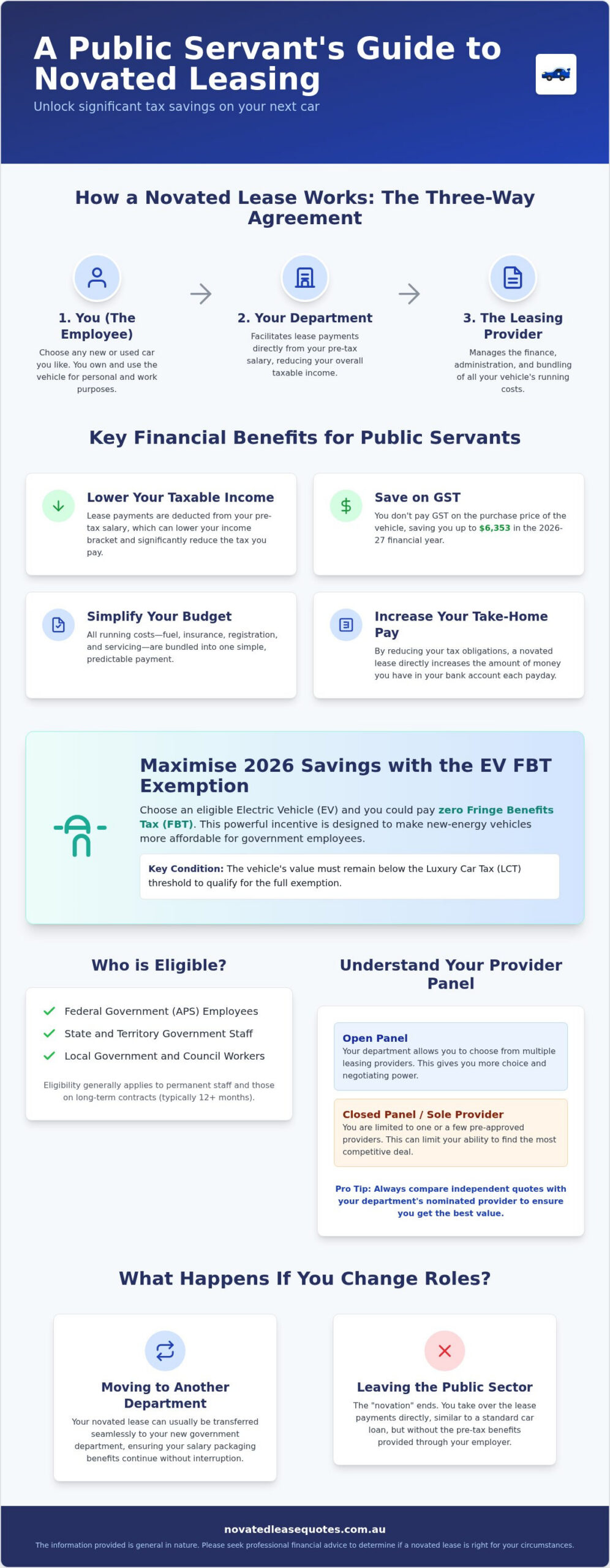
A novated lease is a strategic financial arrangement where an employee, their employer, and a leasing company enter into a three-way agreement. It’s a salary sacrifice arrangement that covers both the vehicle’s finance and all associated running costs. This method of vehicle procurement has become a standard benefit across the Australian Public Service (APS) and various state-level departments. To understand the legal framework, many professionals ask, What is a novated lease? at its core. It’s a mechanism that allows you to pay for your car using a portion of your pre-tax salary, which reduces your taxable income and increases your take-home pay.
How Salary Packaging Benefits Public Servants
For most government workers, the primary advantage lies in the reduction of taxable income. By deducting lease payments from your gross salary, you effectively lower the amount of income the Australian Taxation Office (ATO) can tax. In many instances, this reduction is enough to drop an employee into a lower tax bracket. This provides a dual benefit of lower tax rates and higher take-home pay. Additionally, you don’t pay GST on the purchase price of the vehicle. This can save you up to $6,353 in the 2026-2027 financial year. Bundling fuel, insurance, registration, and servicing into a single, predictable fortnightly payment simplifies your personal budgeting. It removes the stress of large, unexpected bills that often disrupt a public servant’s financial planning.
The Tripartite Agreement Explained
A novated lease for government employees relies on a clear division of roles. You, the driver, choose the car and use it as your own. Your Department, as the employer, facilitates the payments from your salary. The Leasing Provider manages the finance and administrative side of the vehicle’s running costs. A common concern involves what happens when you move between government agencies. Since the lease is “novated” to your employer, the agreement can usually be transferred to another department that supports salary packaging. Importantly, the vehicle remains your property. If you decide to leave the public sector entirely, the “novation” ends. You simply take over the payments directly, similar to a standard car loan, without the tax benefits attached to the employer’s contribution.
Public Sector Eligibility: Federal, State, and Local Government
Public sector roles are highly valued for their stability and structured benefits. This stability makes a novated lease for government employees an exceptionally accessible financial tool. Whether you work for a small local council or a massive federal department, chances are you’re eligible to salary package a vehicle. Generally, permanent staff and those on long-term contracts, typically 12 months or more, meet the criteria. The process is managed through your department’s payroll, adhering to strict guidelines set by the Australian Taxation Office (ATO). It’s a formal way to ensure your vehicle costs are handled before your income is taxed.
Federal Government (APS) Leasing Rules
Most agencies within the Australian Public Service (APS) include novated leasing as a standard feature in their Enterprise Agreements. Federal departments typically operate under two types of provider arrangements: “closed panels” and “open panels.” A closed panel limits you to a handful of pre-approved leasing companies, while an open panel offers more choice. One significant advantage for APS staff is the portability of the lease. If you transfer between federal departments, your lease agreement can usually follow you. This ensures your salary packaging remains uninterrupted as your career progresses, provided the new agency supports the same provider or allows for a transfer of the novation agreement.
State Government and Local Council Specifics
State governments often take a more centralised approach to vehicle procurement. For example, departments in NSW, VIC, or QLD frequently operate under strict sole-provider contracts. While this simplifies the administration for the department, it can sometimes limit your ability to shop around for the best interest rates or insurance products. In contrast, Local Government (Councils) tend to offer the most flexibility. Many councils allow employees to choose any reputable provider, which creates a competitive environment for your business. This flexibility is particularly useful when trying to maximise the GST savings on the vehicle’s purchase price, which is capped at $6,353 for the 2026-2027 financial year.
If you’re unsure how your specific department’s rules affect your potential savings, you can use a novated lease calculator to model different scenarios before committing to a specific provider. It’s the most efficient way to see how your take-home pay changes based on different car models and lease terms.
Regardless of your level of government, your first step should be to locate the “Salary Packaging Policy” document on your department’s intranet. This file outlines exactly which providers you can use and how the Fringe Benefits Tax (FBT) and GST credits are handled internally. Understanding these local rules is essential before you sign any tripartite agreement, as it ensures you don’t face unexpected administrative fees or compliance issues later on.
Maximising 2026 Savings with the EV FBT Exemption
The Electric Vehicle (EV) FBT Exemption stands as the single most powerful financial incentive for public sector staff in 2026. This policy allows eligible employees to package a zero-emission vehicle without the burden of the standard 47% Fringe Benefits Tax that usually applies to car fringe benefits. For a qualifying electric vehicle, 100% of the lease payment is sourced from your pre-tax salary without any FBT penalty, which is a significant departure from the standard statutory formula applied to petrol cars. This creates a scenario where the federal government effectively subsidises your daily commute through substantial tax relief.
Why EVs Suit the Public Sector Profile
Public servants are uniquely positioned to capitalise on this technology. The long-term stability of government employment provides the financial confidence required to finance EVs, which often have a higher upfront purchase price than their internal combustion counterparts. Many departments have also modernised their office infrastructure by installing workplace charging stations for staff. This shift aligns perfectly with broader government “Net Zero” targets, making a novated lease for government employees a choice that is both financially savvy and ethically sound. It allows you to support national sustainability goals while simultaneously reducing your personal cost of living.
Calculating EV vs Petrol Savings
The financial disparity between petrol and electric leasing is stark. A typical public servant can save between $2,000 and $5,000 per year by choosing an EV over a similarly priced petrol SUV. While a Tesla Model 3 or a BYD Atto 3 might have a higher sticker price, the actual “out-of-pocket” cost is often lower because 100% of the finance and running costs are paid with pre-tax dollars. For a deeper dive into these specific financial mechanics, you can consult our EV novated lease australia guide. It provides a granular look at how these tax savings manifest across different salary brackets.
To qualify for the full exemption in the 2026-2027 financial year, the vehicle must be priced below the fuel-efficient Luxury Car Tax (LCT) threshold of $91,661. It is vital to note that as of April 2025, Plug-in Hybrids (PHEVs) are no longer considered zero or low-emission vehicles for FBT purposes and are not eligible for the new EV exemption. This makes pure battery electric vehicles the primary vehicle for those seeking to maximise their take-home pay. By leveraging this exemption today, you secure these tax benefits for the entire life of your lease, regardless of future policy shifts.
How to Compare Government Novated Lease Quotes Effectively
Many public servants mistakenly believe that their department’s “preferred provider” automatically offers the most competitive terms. While these providers are vetted for administrative reliability, they don’t always provide the lowest interest rates or the most transparent fee structures. To ensure you’re getting the best deal on a novated lease for government employees, you must treat the initial quote as a baseline rather than a final offer. Creating competitive tension is the only way to verify that your tax savings aren’t being eroded by excessive financier margins.
Follow these four steps to audit your lease offer:
- Step 1: Obtain a formal quote from your department’s nominated provider. This provides a clear starting point for comparison.
- Step 2: Use an independent novated lease calculator to verify the tax mathematics. Ensure the GST credits and FBT calculations align with current 2026-2027 ATO thresholds.
- Step 3: Seek at least two external quotes. Focus on the “Effective Interest Rate” and the total cost of credit rather than just the monthly payment.
- Step 4: Determine if you’re forced to use the provider’s insurance. Sourcing your own comprehensive cover can often save you hundreds of dollars annually.
Identifying Hidden Costs in Public Sector Quotes
Leasing quotes can be complex, often masking secondary costs that inflate the total price. Look closely for “Procurement Fees” or “Dealer Origination Fees” added to the vehicle purchase price. These fees can sometimes exceed $1,000, effectively cancelling out a portion of your GST savings. You should also examine the “Residual Value” or balloon payment. While this must align with ATO guidelines, some providers might manipulate this figure to make monthly payments look more attractive. Finally, check for high monthly “Administration Fees.” A small difference in these fees can add up to thousands over a five-year term.
The Power of Independent Comparison
Even if your agency mandates that you use a specific provider for payroll deductions, you still have leverage. Presenting a more competitive external quote can often prompt a “preferred” provider to match the terms or lower their management fees. Novated Lease Quotes provides the market-wide transparency needed to make these comparisons effectively. By bridging the gap between department panels and the broader market, you gain a clearer understanding of what a “good” deal actually looks like. For more detailed strategies on evaluating different offers, read our novated lease comparison guide. It’s the most efficient way to ensure your salary packaging strategy delivers the maximum possible benefit to your bank account.
Ready to see how your current offer stacks up? You can request a competitive quote comparison today to uncover potential savings.
Common Pitfalls and How to Avoid Them
While the benefits of a novated lease for government employees are extensive, certain administrative and financial traps can diminish your total savings. One common issue is the “un-novating” process that occurs if you leave the public sector. If your employment ends, the three-way agreement collapses, and you become responsible for the full post-tax lease payments until you either pay out the vehicle or find a new employer to take over the novation. Another risk is over-budgeting for running costs like fuel or tyres. While it’s tempting to set a high buffer, having excess credit at the end of the term results in that money being returned to you as taxed income. This effectively negates the original tax benefit you worked to achieve. You should review your spending every six months and adjust your budgets to align with your actual kilometres travelled.
HECS, HELP, and Government Benefits
It’s vital to understand the Reportable Fringe Benefits Amount (RFBA). Even if you choose an EV with a $0 FBT liability, the “grossed-up” value of the benefit still appears on your payment summary. This figure is used to calculate your HECS/HELP repayments and Centrelink entitlements. With the 2026-2027 compulsory repayment threshold set at $69,528, a novated lease could increase your loan repayment percentage. If you have a significant HECS debt or complex family tax benefit requirements, you should run a specific calculation to see if the tax saving outweighs the increased loan repayments. Consulting a financial advisor is a smart move for anyone with complex family income requirements or multiple salary packaging items.
Changing Departments or Roles
Career mobility is a hallmark of the public sector. Moving from one State Government department to another is usually a straightforward “transfer of novation”, provided both agencies use the same provider panel. However, moving from a State role to a Federal agency often requires “re-novating” the lease. This involves terminating the old agreement and signing a new one with an APS-approved provider. To ensure a seamless transition, there are specific questions to ask a novated lease provider regarding their portability terms. Checking these details early prevents administrative delays and ensures your salary packaging remains a tool for wealth creation. You also need to consider “residual risk”. Choosing a car with poor resale value can lead to a gap between the balloon payment and the car’s actual worth. Selecting a vehicle with high demand in the secondary market is a pragmatic way to protect your financial position at the end of the term.
Maximise Your Public Sector Benefits Today
Optimising your salary packaging is one of the most effective ways to combat the rising cost of living in 2026. By leveraging the current FBT exemptions for electric vehicles and understanding the nuances of your department’s leasing panel, you can significantly increase your monthly take-home pay. It’s clear that a novated lease for government employees offers a powerful path to driving a brand new car while reducing your overall tax burden. However, the greatest savings are found by those who look beyond the first quote and verify every fee.
Don’t leave your hard-earned money on the table by accepting a standard offer without verification. You can get a competitive novated lease quote tailored for your government department today through our independent comparison service. We provide objective advice and specialist public sector knowledge to help you compare quotes from multiple Australian providers. It’s a simple, transparent process designed to give you the confidence that you’ve secured the most efficient deal possible. Take control of your vehicle expenses and enjoy the financial freedom that comes with a smart, tailored leasing strategy.
Frequently Asked Questions
Do all government agencies offer novated leasing?
Most federal, state, and local government agencies offer salary packaging as a standard employment benefit. While availability is widespread across the Australian Public Service (APS) and major state departments, you should always check your specific Enterprise Agreement or department intranet. Some smaller agencies might have specific provider panels you’re required to use for payroll deductions, but the core benefit remains available to the vast majority of permanent staff.
Is a novated lease worth it if I am on a lower government salary grade?
A novated lease can provide significant value even for those in lower income brackets. While the income tax savings are higher for top-tier earners, every employee benefits from the GST savings on the car’s purchase price and ongoing running costs. This effectively gives you a 10% discount on fuel, servicing, and tyres that you wouldn’t get if paying with post-tax income. It’s a pragmatic way to manage a tight budget with a single, predictable payment.
Can I lease a used car as a government employee?
You can certainly lease a used vehicle, provided it meets the age and condition requirements set by the leasing company. Most providers require the car to be no older than 10 to 12 years at the end of the lease term. This is an excellent way for public servants to reduce their finance costs while still enjoying the tax benefits of salary packaging. It allows you to access a higher quality vehicle than you might otherwise afford through a standard car loan.
How does the EV FBT exemption work for public servants in 2026?
For a novated lease for government employees involving an eligible electric vehicle, the FBT exemption allows you to pay 100% of the lease costs from your pre-tax salary. To qualify in the 2026-2027 year, the car must be a zero-emission vehicle priced below the $91,661 luxury car tax threshold. It’s important to remember that plug-in hybrids no longer qualify for this specific exemption, making pure battery electric vehicles the most tax-efficient choice for public sector staff.
What happens to my novated lease if my government contract ends?
If your contract ends, the lease remains your responsibility but the “novation” or employer contribution stops. The agreement reverts to a standard personal lease, meaning payments are made from your bank account using post-tax funds. You can usually re-novate the lease if you secure a new role with another government department or a private employer that offers salary packaging. This flexibility ensures you don’t lose the vehicle just because you change roles.
Does a novated lease affect my HECS-HELP debt repayments?
A novated lease can increase your HECS-HELP repayments because the value of the benefit is reported on your payment summary. The ATO uses this “Reportable Fringe Benefits Amount” to determine your repayment income. Since the 2026-2027 compulsory repayment threshold is $69,528, it’s vital to calculate whether your tax savings outweigh any increase in your annual debt repayments. Many staff find the overall tax benefit still leaves them ahead financially.
Can I choose my own car dealer or do I have to use the leasing company’s network?
You generally have the freedom to choose any dealer, but using a leasing company’s procurement network often secures “fleet pricing” discounts. These discounts can be significantly lower than the best price a private buyer could negotiate. If you’ve already found a specific vehicle at a local dealership, most providers will simply coordinate the purchase with that dealer on your behalf. This ensures you get the car you want while still accessing professional procurement rates.
Are the running costs like fuel and servicing really tax-free?
All budgeted running costs are paid using your pre-tax salary, which effectively makes them tax-free to the extent of your marginal tax rate. This includes fuel, electricity for charging, servicing, registration, and even replacement tyres. Because these expenses are deducted before tax is calculated, you’re paying for your daily driving with “gross” dollars rather than “net” dollars. This is often where a novated lease for government employees provides the most consistent day-to-day financial relief.