
The cheapest way to buy your next vehicle in 2026 might actually be the option with the higher interest rate. While that sounds counterintuitive, the real question remains: is a novated lease worth it once you look past the headline figures and into your actual take-home pay? You’ve likely heard conflicting advice; some colleagues swear by the tax savings while others worry about hidden costs or how the debt affects a home loan application. It’s a valid concern, especially when complex ATO rules make it difficult to see the bottom line.
We believe financial decisions should be based on data, not guesswork. This guide provides a clear framework to help you decide if salary packaging is the right move for your specific tax bracket. We’ll weigh the 2026 GST credits and FBT exemptions against interest and fees to show you exactly how much you could save. From the impact of the new 15% tax rate to the significant incentives for electric vehicles, you’ll gain the confidence to compare quotes and optimise your wealth.
Key Takeaways
- Determine if is a novated lease worth it for your specific income level by calculating the net effect on your take-home pay after tax.
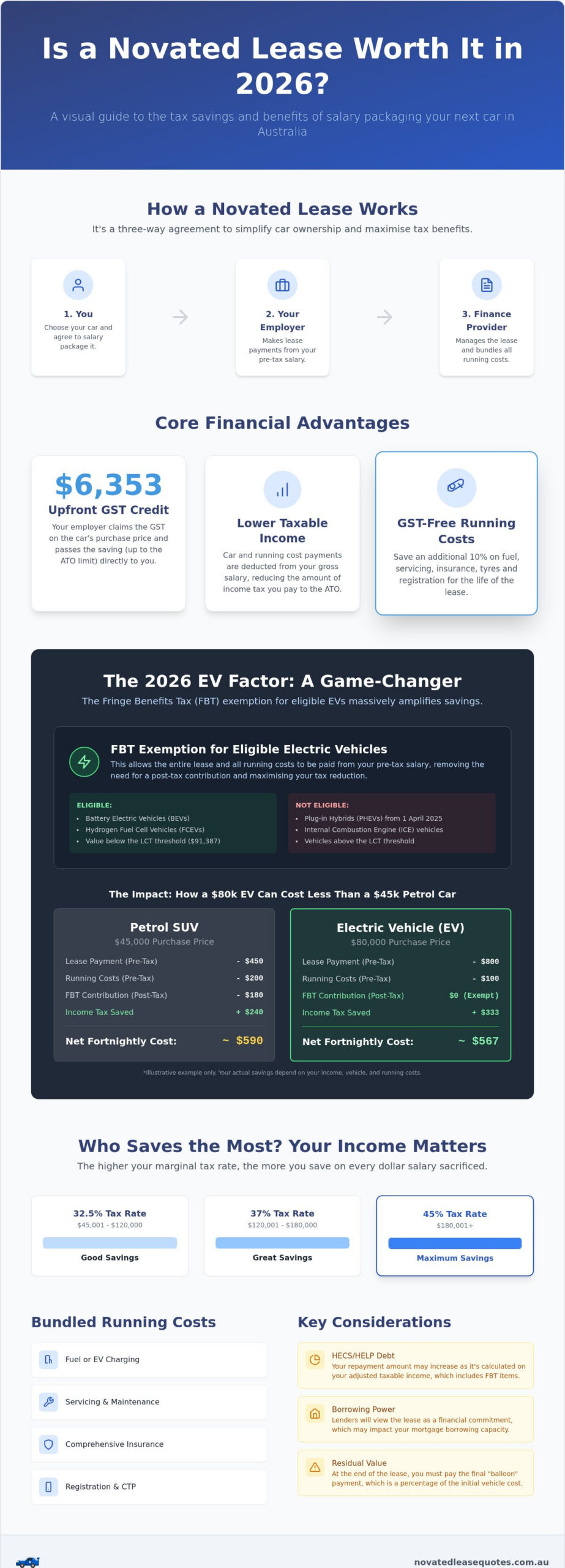
- Maximise your upfront savings by claiming up to $6,353 in GST credits on the vehicle purchase price and removing GST from all ongoing running costs.
- Leverage the FBT exemption for eligible electric vehicles under the $91,387 threshold to potentially save thousands annually compared to petrol or diesel models.
- Evaluate how salary packaging impacts your HECS/HELP debt and mortgage borrowing power to ensure your vehicle choice aligns with your long-term property goals.
- Use a specialised 2026 calculator to compare multiple quotes and uncover the most competitive interest rates currently available in the Australian market.
The Mechanics of Value: How a Novated Lease Actually Saves You Money
To answer the core question, is a novated lease worth it, you must first grasp the underlying mechanics of salary packaging. At its heart, the value of this arrangement stems from a unique legal structure. What is a novated lease? It is essentially a three-way agreement between you, your employer, and a finance provider. Your employer takes on the lease obligations and makes the payments on your behalf via a salary sacrifice arrangement. This structure shifts the vehicle from being a private, post-tax expense to a business-related pre-tax deduction.
One of the most immediate benefits is the GST saving. When you buy a car privately, you pay 10% GST upfront. In a novated lease, your employer claims the GST back as an Input Tax Credit and passes that saving directly to you. For the 2026-2027 financial year, this credit is capped at $6,353. This effectively reduces the purchase price of the vehicle before you’ve even made a single payment. This same logic applies to your running costs; you won’t pay GST on fuel, tyres, or servicing throughout the life of the lease.
For internal combustion engine (ICE) vehicles, the Employee Contribution Method (ECM) is used to manage Fringe Benefits Tax (FBT). By paying a portion of the running costs from your post-tax salary, you can often reduce the FBT liability to zero. This “invisible” discount means you’re paying for petrol, tyres, and comprehensive insurance using a mix of pre-tax and post-tax funds. It is a far more efficient method than using your bank account after the government has already taken its share of your income.
The Tax Bracket Threshold: Who Benefits Most?
The higher your income, the more effective this strategy becomes. If you’re in the 37% or 45% tax brackets, every dollar sacrificed from your pre-tax salary saves you a significant amount in income tax that would otherwise go to the ATO. For an employee on $90,000, the tax savings are respectable. However, for a professional on $180,000, the benefits are amplified because they are avoiding a 45% marginal tax rate on every dollar sacrificed. Taxable income reduction in the context of salary packaging is the strategic lowering of your gross earnings by the cost of your vehicle and its operations, which results in a smaller portion of your pay being subject to income tax.
GST Credits and Running Costs
The savings don’t stop at the showroom floor. Your employer also claims back the GST on all packagable running costs, which are then passed back to your lease budget. Deciding if is a novated lease worth it often comes down to these ongoing expenses. Packagable costs typically include:
- Fuel or charging costs
- Scheduled servicing and maintenance
- Registration and CTP
- Comprehensive insurance and roadside assistance
Because leasing companies manage thousands of vehicles, they often provide access to specialised “fleet pricing” for maintenance and tyres. This means you aren’t just saving on tax; you’re often paying less for the actual service than a retail customer would at the same service centre.
The 2026 EV Factor: Why Electric Vehicles Are the Ultimate Value Play
The landscape of salary packaging shifted dramatically with the introduction of the Fringe Benefits Tax (FBT) exemption for electric vehicles. This single policy change has redefined the math for thousands of Australians. When asking is a novated lease worth it in the current market, the answer often hinges on whether you’re willing to go electric. Eligible battery electric vehicles (BEVs) and hydrogen fuel cell vehicles remain exempt from FBT in 2026, provided their value stays below the luxury car tax threshold. This exemption effectively removes the need for the Employee Contribution Method, allowing you to pay for the entire lease and all running costs from your pre-tax salary.
It is vital to distinguish between different types of low-emission vehicles. The FBT exemption for Plug-in Hybrids (PHEVs) ended on 1 April 2025 for new arrangements. If you’re entering a lease now, a PHEV will be treated similarly to a petrol or diesel car for tax purposes. For those looking for the maximum “tax-free” benefit, a full BEV is the primary path to optimisation. The financial impact is significant; an $80,000 EV can often result in the same monthly out-of-pocket cost as a $45,000 petrol SUV because of the massive tax offset. You can calculate your potential EV savings to see this discrepancy in real-time.
The savings extend beyond the vehicle itself. According to ATO guidelines on GST, the tax benefits of a lease apply to the infrastructure and energy required to keep the car moving. In 2026, you can package the cost of a home charging station and even the electricity used for charging, provided you use a compliant method to track the energy consumption. This turns a major household utility expense into a pre-tax benefit.
The Luxury Car Tax (LCT) Limit in 2026
To qualify for the full FBT exemption, the vehicle’s value must remain below the LCT threshold for fuel-efficient vehicles. For the 2025-2026 financial year, this limit is $91,387. Staying under this “green” limit is critical. If the vehicle price exceeds this figure, even by a small amount, the entire FBT exemption is lost, which drastically changes the financial profile of the deal. You can find a detailed breakdown of eligible models in our EV Novated Lease Australia: The 2026 Guide.
Pros and Cons of EV Packaging
- Pro: Zero Fringe Benefits Tax, which can save an employee earning $100,000 between $5,000 and $8,000 per year.
- Pro: Drastic reduction in daily running costs; electricity is significantly cheaper than premium unleaded fuel.
- Con: Higher initial purchase price compared to entry-level petrol models, though the tax savings often bridge this gap.
- Con: Rapidly evolving battery technology may impact the long-term resale value of older models.
When you weigh these factors, is a novated lease worth it for an EV? For most high-income earners, the answer is a definitive yes. The combination of GST credits and the FBT exemption creates a level of subsidisation that is unavailable through any other finance method.
Comparing the Alternatives: Novated Lease vs Car Loan vs Cash
When weighing up your finance options, it is easy to get tunnel vision on the interest rate. A standard car loan for a prime borrower in 2026 might sit around 7.67%, while a novated lease quote could show 10% or higher. However, to determine if is a novated lease worth it, you must look at the effective cost rather than the nominal rate. The lease interest is often subsidised by the fact that you aren’t paying GST on the car’s purchase price and you’re making payments from your pre-tax salary, which is a benefit no bank loan can match.
The “Total Cost of Ownership” (TCO) approach is the only accurate way to compare these methods over a three or five-year term. A car loan requires you to pay for registration, insurance, and fuel using money that has already been taxed at your marginal rate. With a lease, these costs are bundled into one payment, largely funded by your gross income. This creates a structural advantage that typically outweighs a slightly higher interest rate, particularly for those in higher tax brackets who see the largest reduction in their taxable income.
Paying cash often seems like the safest bet, but it frequently falls into the “offset account trap.” If you have a mortgage, every dollar you take out of your offset account to buy a car is a dollar that is no longer reducing your home loan interest. In a high-interest-rate environment, the opportunity cost of using cash can be higher than the cost of a lease. You’re effectively trading a tax-deductible vehicle for more non-deductible home loan interest, which is rarely the most efficient use of capital.
The Real Interest Rate Debate
Leasing companies operate differently from banks and don’t always provide a simple comparison rate. This can make direct comparisons difficult for the average consumer. You should use a novated lease calculator to model the “break-even” point where the tax savings equal the interest costs. A higher interest rate on a lease is frequently subsidised by the significant income tax and GST savings that a standard loan simply cannot provide.
Lease vs Loan: A Side-by-Side Scenario
Consider a professional earning $120,000 per year looking at a $50,000 Mazda CX-5 over a four-year term. With a standard car loan, the monthly repayment comes entirely from their take-home pay. With a novated lease, the impact on their net pay is often hundreds of dollars lower each month because a large portion of the cost is funded by their pre-tax earnings. While a lease includes a mandatory residual payment at the end, the cumulative tax savings and GST credits usually leave the driver in a stronger cash position overall, even after the balloon payment is settled.
Beyond the Tax Savings: HECS, Borrowing Capacity, and Residual Risks
While the tax optimisation strategies discussed in previous sections are compelling, a holistic financial view is essential to determine if is a novated lease worth it for your specific circumstances. A lease does not exist in a vacuum; it interacts with your student loans, your ability to secure a mortgage, and your future career moves. Understanding these broader implications ensures that a “smart” tax move doesn’t create an unexpected bottleneck elsewhere in your financial life.
One of the most significant considerations for younger professionals is the impact on HECS/HELP repayments. When you salary package a vehicle, your taxable income decreases. However, the ATO requires your employer to report a Reportable Fringe Benefits Amount (RFBA) on your payment summary. Because HECS repayments are calculated based on your adjusted taxable income, which includes this grossed-up RFBA, your mandatory student loan repayments could actually increase. For some, this might lead to a faster loan payoff, but for others, it can create a noticeable squeeze on monthly cash flow.
Mortgage borrowing power is another area where transparency is vital. Banks generally view a novated lease as a fixed financial commitment, similar to a personal loan or credit card limit. When you apply for a home loan, the lender will factor the monthly lease payment into your debt-to-income ratio. While the lease reduces your take-home pay, it also replaces your need to fund a car, fuel, and insurance from your net income. Most lenders are familiar with these structures, but it is always wise to compare novated lease quotes before approaching a bank to ensure your total debt profile remains within their serviceability limits.
Understanding RFBA (Reportable Fringe Benefits Amount)
The RFBA mechanism is often where confusion arises. While your taxable income drops, providing the tax savings we’ve discussed, your “reportable” income rises. This grossed-up value is used to assess your eligibility for various government benefits and obligations. This includes the Medicare Levy Surcharge and Centrelink entitlements. If your RFBA pushes your combined income over certain thresholds, you might find yourself liable for the Medicare Levy Surcharge if you don’t have private hospital cover. Calculating the grossed-up value is a technical process, usually involving multiplying the fringe benefit value by a specific ATO rate (currently 1.8868 or 2.0802 depending on the type of benefit).
Managing the End of the Lease
Every novated lease concludes with a mandatory residual payment, also known as a balloon payment. This is a pre-determined amount set by ATO guidelines that you must settle to take full ownership of the vehicle. You generally have three paths at this stage:
- Option 1: Pay the residual using your savings and own the car outright.
- Option 2: Sell or trade in the car. If the market value is higher than the residual, you keep the tax-free profit and can use it as a deposit for a new lease.
- Option 3: Refinance the residual amount into a new lease term to keep the monthly payments low.
The risk here is that the car’s market value could be lower than the residual payment, though conservative ATO rates usually prevent this. Job mobility is also less of a hurdle than many fear; if you change employers in 2026, most leases are portable. You can simply “novate” the agreement to your new employer, provided they offer salary packaging. For a deeper look at how different providers handle these transitions, see our Novated Lease Comparison 2026.
Decision Time: Is a Novated Lease Right for Your Financial Situation?
After analysing the tax structures, electric vehicle incentives, and the opportunity costs of cash, you’ve reached the final hurdle. Determining is a novated lease worth it for your specific household requires a move from theoretical savings to a concrete decision. This isn’t just about the car you want to drive; it’s about whether the structural benefits of salary packaging align with your broader financial goals for 2026 and beyond. Just as property owners may explore Insurance Comparison and Lead Generation to protect their assets efficiently, car buyers must evaluate their finance options with similar precision. A lease is a powerful tool for optimisation, but like any financial product, its value depends entirely on how it’s utilised.
The most important step in this process is ensuring transparency. Many employees mistakenly believe they must use their company’s “preferred” leasing provider. In reality, you often have the right to seek independent novated lease quotes to ensure the interest rates and fees are competitive. This competition forces providers to strip away hidden costs and present a deal that actually puts more money back in your pocket.
The ‘Worth It’ Checklist
Before signing a lease agreement, run your numbers against this four-point framework to see if the math truly stacks up:
- Income Threshold: Do you earn over $45,001 per year? While the tax rate for the $18,201 to $45,000 bracket drops to 15% from July 1, 2026, the real benefits of salary packaging accelerate once you hit the 30% and 37% marginal brackets.
- Retention Period: Are you planning to keep the vehicle for at least three years? The upfront setup costs and procurement fees are usually amortised over the life of the lease. Short-term leases of 12 months often see these fees erode the tax savings.
- Vehicle Efficiency: Is the car an EV or a highly efficient model? With the FBT exemption for eligible electric vehicles under the $91,387 threshold, the “worth it” factor for EVs is currently at an all-time high.
- Usage: Do you have high running costs? If you drive long distances, the ability to pay for fuel or charging from your pre-tax salary significantly increases the value of the package.
How to Secure the Best Deal
To avoid the common traps, don’t focus solely on the monthly repayment figure. Providers can lower this number by increasing the residual payment or extending the term, which might cost you more in the long run. Instead, ask for the “Total Cost to Clear” the lease. This figure includes every monthly payment plus the final residual amount. It’s the only way to compare a lease directly against a bank loan or a cash purchase.
Watch out for red flags in your quote. Excessive “procurement fees” or “document fees” can often be negotiated or avoided by switching providers. Always insist on a full breakdown of the interest rate and the monthly administration fees. If a provider is hesitant to disclose these, it’s usually because they aren’t competitive. You can get a competitive novated lease quote comparison today to benchmark your current offer against the wider Australian market. If the tax savings outweigh the financing costs and the vehicle fits your lifestyle, a novated lease remains one of the most effective ways to reduce your taxable income while driving a better car.
Optimise Your 2026 Vehicle Strategy
The 2026 financial landscape offers unique opportunities for salary packaging, particularly with the ongoing FBT exemptions for electric vehicles and substantial GST credits. Deciding if is a novated lease worth it requires looking past the monthly repayment to the total impact on your take-home pay. While factors like HECS repayments and mortgage borrowing capacity are important variables, the structural tax advantages often provide a superior outcome compared to traditional car loans or using cash from an offset account.
Success lies in the details. Our independent comparison service provides expert 2026 market analysis to help you navigate complex ATO rules. With national Australian support, we ensure you find a deal tailored to your specific tax bracket and career trajectory. Don’t settle for the first quote you receive. Compare Novated Lease Quotes Now to uncover the most competitive rates and maximise your savings. Taking control of your vehicle finance today ensures a more efficient financial future and puts more money back in your pocket where it belongs.
Frequently Asked Questions
Is a novated lease worth it if I’m on a low income?
A novated lease is typically less effective for low-income earners. If you earn under $45,000, your marginal tax rate is reduced to 15% from July 2026, meaning the tax savings might not outweigh the administration fees. To determine if is a novated lease worth it at this level, you must compare the small tax offset against the higher interest rates and fees associated with the lease structure.
Can I get a novated lease for a used car in 2026?
Yes, you can package a used car in 2026. Most leasing companies allow used vehicles provided they aren’t older than 10 to 12 years at the end of the lease term. You still benefit from GST savings on running costs and the ability to pay for the car from your pre-tax salary. However, you won’t get the upfront GST credit on the purchase price if buying from a private seller.
What happens to my novated lease if I lose my job?
If you lose your job, the lease agreement remains with you but is “de-novated.” This means you become responsible for making the full lease payments from your post-tax bank account. Once you secure new employment, you can usually novate the lease to your new employer to resume the tax benefits. This is provided your new workplace has a salary packaging policy in place to facilitate the agreement.
Is an EV novated lease still worth it without the FBT exemption for PHEVs?
Full Battery Electric Vehicles (BEVs) remain highly beneficial because they still qualify for the FBT exemption. While Plug-in Hybrids (PHEVs) lost their exemption in April 2025, a BEV under the $91,387 threshold remains the most tax-efficient way to finance a car. Deciding if is a novated lease worth it for an EV involves weighing the zero FBT status against the higher purchase price and charging infrastructure costs.
Do I have to pay GST on the residual (balloon) payment at the end?
Yes, GST is payable on the residual payment. When you reach the end of your term and choose to purchase the vehicle from the finance company, the ATO requires GST to be added to that final balloon amount. You should factor this 10% cost into your end-of-lease strategy. It is a mandatory requirement that the leasing company cannot waive, regardless of the vehicle type or your tax bracket.
How does a novated lease affect my ability to get a home loan?
Lenders treat a novated lease as a financial commitment, which can reduce your maximum borrowing capacity. However, because the lease covers all running costs like fuel and insurance, your declared living expenses are often lower. Most Australian banks are sophisticated enough to understand this trade-off. It is wise to consult a mortgage broker before committing to a lease if you plan to apply for a home loan soon. If you are also managing rental investments, using PropAlly can help you track property cash flow and tax compliance, giving you a clearer picture of your total financial position before speaking with a lender.
Is insurance and petrol really included in the pre-tax payment?
Yes, all running costs are included in the pre-tax deductions. Your leasing provider sets a budget for comprehensive insurance, fuel or charging, registration, and servicing based on your estimated kilometres. These funds are deducted from your gross salary and held in a dedicated account. If you spend less than the allocated budget, the surplus is eventually returned to you as taxed income at the end of the lease.
Can I drive the car for 100% personal use and still get the tax benefits?
You can absolutely use the car for 100% personal use. Unlike a standard logbook-based car claim on your tax return, a novated lease does not require any business kilometres to qualify for tax savings. This makes it a popular choice for commuters and families who want to optimise their vehicle costs. You get the same tax advantages without needing to justify work-related travel to the ATO.